
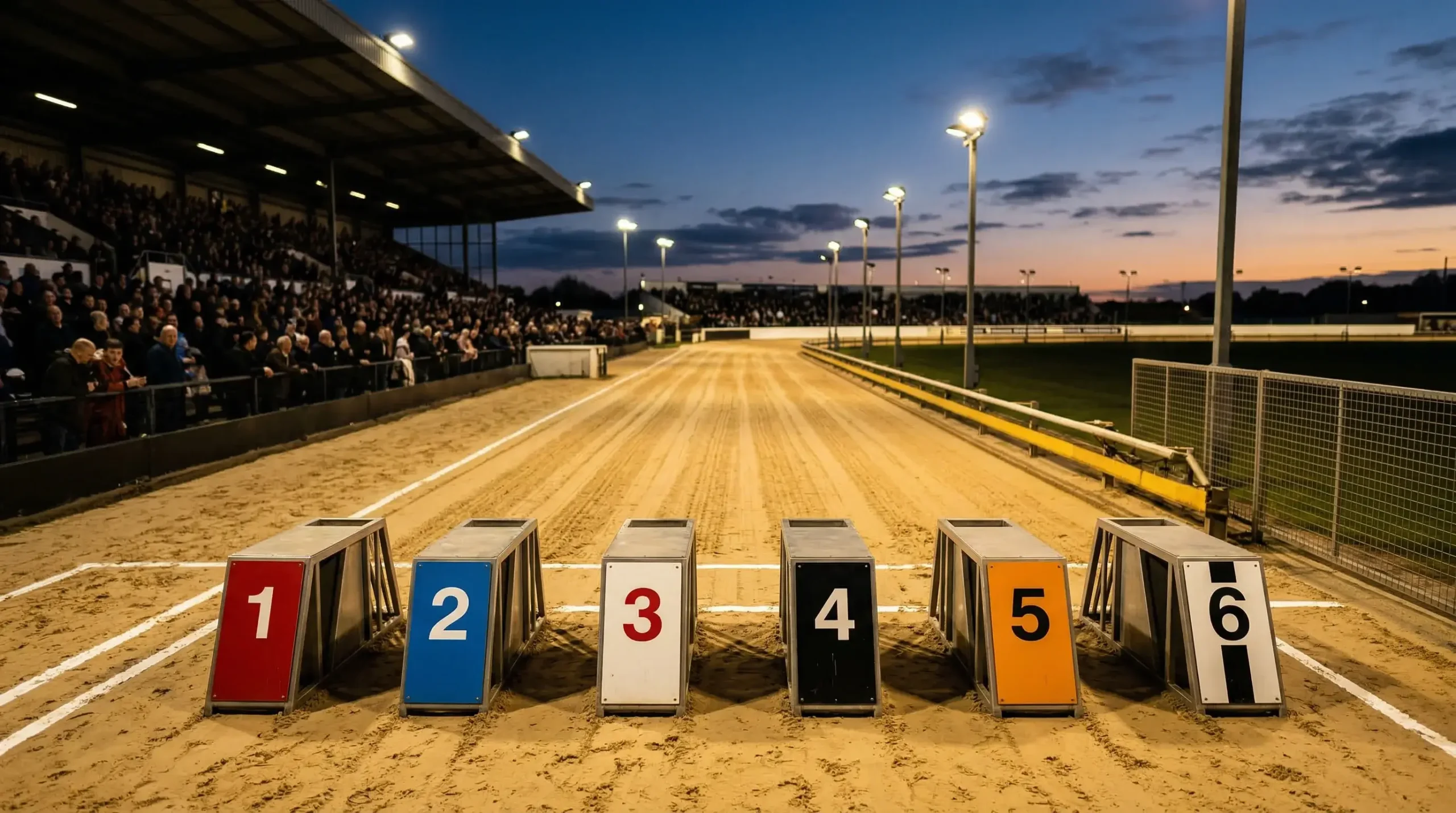
Monmore Green Results: Complete Track Guide, Trap Statistics & Race Data
Monmore Green sits in the middle of Wolverhampton like it has done since 1928 — quietly running greyhounds around a 419-metre oval while the rest of British sport reinvents itself every other season. The stadium holds 1,150 spectators, which sounds modest until you remember that greyhound racing is the sixth most popular spectator sport in the United Kingdom, drawing crowds that many lower-league football clubs would envy. What separates Monmore from a casual night out at the dogs is the depth of data the track generates: five race distances, six traps per race, graded classes from A1 down to A10, and a meeting schedule that runs most weeks of the year.
This guide pulls together the Monmore Green data that matters — trap statistics, race distances, trainer form, the grading ladder, racecard decoding and betting fundamentals — into a single reference. Whether you are cross-checking tonight's racecard or building a longer-term view of how this track behaves, the numbers are here. No filler, no unsourced tips, just what the results actually tell us about one of England's busiest greyhound venues.
As a Premier Greyhound Racing venue, Monmore benefits from corporate-grade broadcast coverage and standardised data feeds — which means a reliable flow of form data and results for anyone willing to study them. That data pipeline is the raw material this entire guide is built on.
The Monmore Numbers That Shape Every Bet
- Monmore's 419-metre oval runs five distances from the 264m sprint to the 835m marathon, each with distinct trap biases and pace profiles that change the value equation.
- Trap 1 wins roughly 18-19% of UK greyhound races — above the 16.66% theoretical average — and at Monmore the inside draw advantage can spike dramatically on individual meetings.
- Favourites convert at just 30-40%, so reading the racecard and understanding the A1-to-A10 grading system are essential before staking real money.
- GBGB welfare data for 2024 shows a track injury rate of 1.07% and a 94% successful rehoming rate, reflecting genuine progress since the sport introduced its welfare strategy in 2018.
- Wolverhampton now hosts two greyhound tracks — Monmore Green and the new Dunstall Park, opened September 2025 — giving punters and visitors more racing options than any other city in England.
Inside the 419-Metre Oval: Monmore Green at a Glance
Track length: 419 metres
First bend: 103 metres from start
Distances offered: 264m, 480m, 630m, 684m, 835m
Capacity: 1,150 seated; 400-space car park
Operator: Premier Greyhound Racing (Entain + ARC)
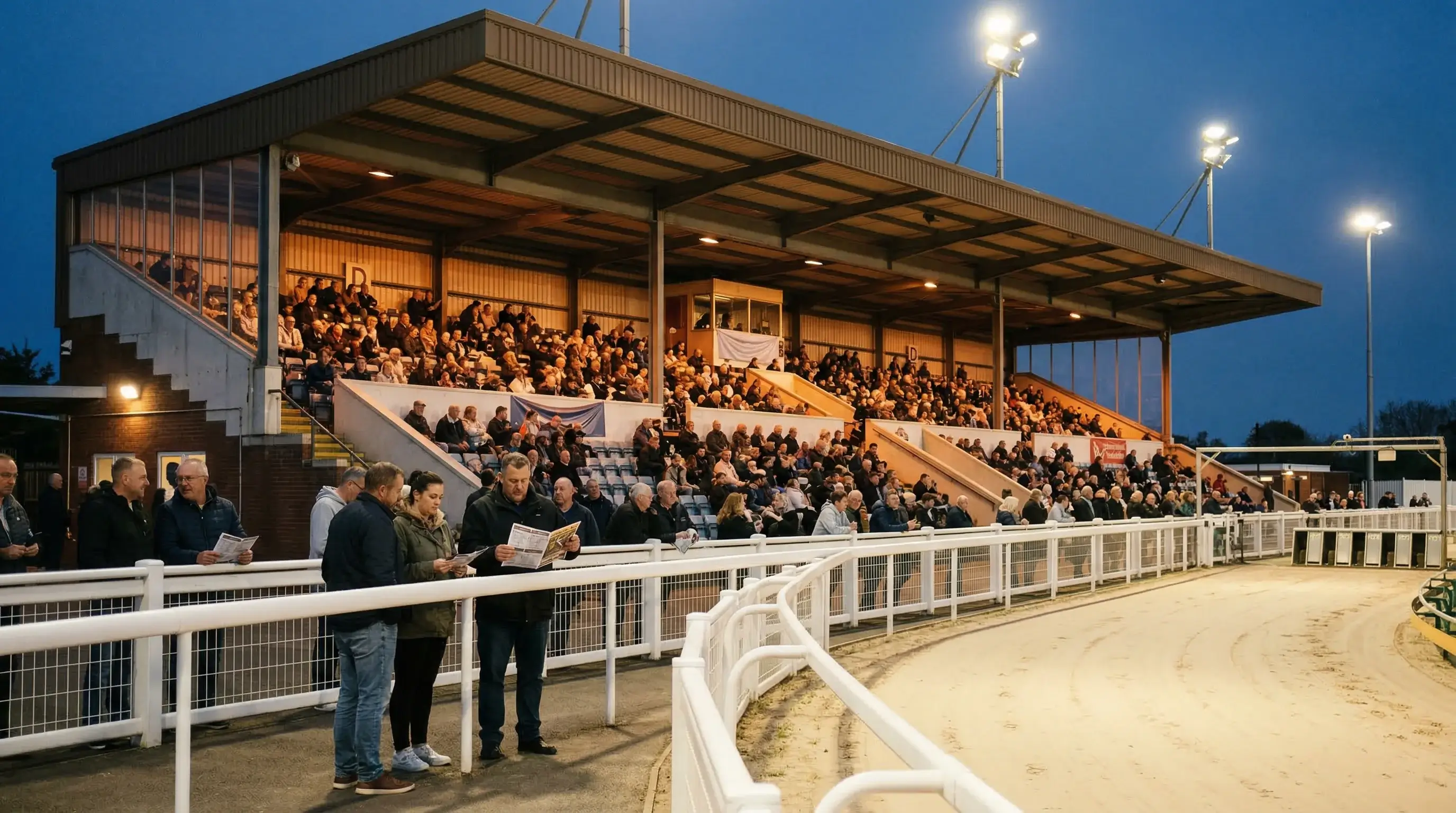
Monmore Green is a tight, flat oval in the Wolverhampton suburb of the same name. The track circumference of 419 metres puts it at the smaller end of UK greyhound circuits, and the first bend arrives at 103 metres — meaning early pace and trap position matter more here than at longer-run venues such as Nottingham or Towcester. The surface is sand-based, maintained to GBGB standards, and raked between races to minimise rut formation. A car park for 400 vehicles surrounds the stadium, and the covered grandstand seats 1,150 — a number that regularly fills on Saturday evenings.
The stadium is one of nine UK tracks operating under Premier Greyhound Racing, the joint venture that Entain and Arena Racing Company launched in 2023. PGR's initial investment exceeded £2.5 million in prize money for Open racing alone, and the deal secured broadcast rights that feed Monmore results into every major UK bookmaker's SIS screens. For bettors, this means Monmore races are covered on virtually every high-street betting shop screen and online live-stream platform in England.
The industry behind these screens is larger than most casual visitors realise. Greyhound racing employs approximately 5,400 people across Great Britain — roughly 500 licensed trainers, 3,000 kennel staff and 700 track officials, according to GBGB data. The sport's welfare and integrity infrastructure is partly funded through the British Greyhound Racing Fund, which collected £6.75 million from voluntary bookmaker contributions in the 2024–25 financial year. The UK Government itself acknowledged this scale in 2025, stating that greyhound racing is "the sixth most popular sport in terms of viewership" and makes "an important contribution" to the country's cultural and rural economy. Sir Philip Davies, who took over as GBGB Chairman in 2025, reinforced the point: "I know just how important greyhound racing is to local communities and what an important contribution it makes — both economically and socially" (GBGB).
Interactive Tool
Employment Breakdown Checker, and Registration Decline
Sum the guide's own employment categories against its stated total, and calculate the exact drop in new greyhound registrations since 2021.
Unaccounted People
-
-
Trainers
-
Kennel Staff
-
Officials
-
What this guide states as a breakdown that doesn't add up: "Greyhound racing employs approximately 5,400 people across Great Britain — roughly 500 licensed trainers, 3,000 kennel staff and 700 track officials." Summing those three categories gives 4,200, not 5,400 — a gap of 1,200 people (22.2%) the guide never flags.
Percentage Decline
-
-
2021 Registrations
-
2024 Registrations
-
Absolute Drop
-
What this guide gives as two figures without the gap: "5,133 new greyhounds were registered with GBGB... down from 6,769 in 2021." The percentage decline is never calculated — it's 24.2%, a drop of 1,636 dogs.
Monmore Green is not a relic. It is a data-rich, commercially backed venue sitting inside a sport that the UK Government recognises as a significant employer and spectator draw. Every result generated here feeds into the broader PGR ecosystem — and every number in this guide originates from that data pipeline.
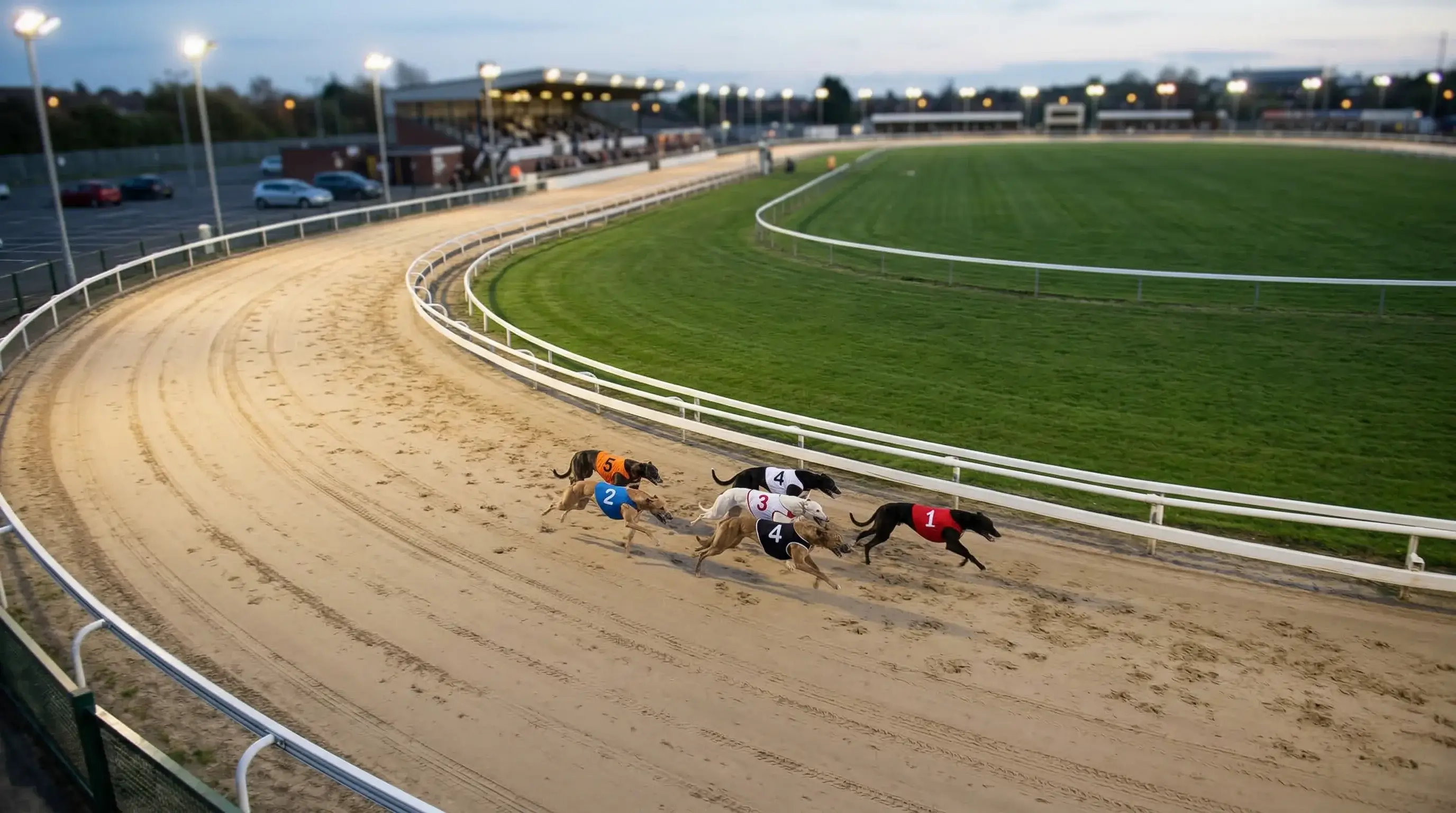
Understanding the physical track is the first step towards reading its results with any confidence. The 419-metre circumference, the tight bends, the 103-metre run to the first turn — all of these shape which dogs win and from which traps. The sections that follow break those variables down distance by distance, trap by trap, and grade by grade.
Five Distances, Five Different Races: 264m to 835m
Monmore offers five standard race distances, each producing a different style of contest. The distance a greyhound runs determines how many bends it negotiates, how much early speed matters versus stamina, and — critically for punters — how much influence the trap draw has on the outcome. This is where Monmore Green data starts to diverge from generic greyhound advice.
264m — The Two-Bend Sprint
The shortest distance at Monmore is a pure dash from the traps to the first bend and through a second before hitting the line. At 264 metres, there is almost no time to recover from a slow break. Dogs drawn on the inside have a shorter path to the rail on the first bend, and the 103-metre run to that bend — relatively generous for a sprint — still favours quick starters. Sprint specialists at Monmore tend to be lighter, reactive dogs with explosive early pace. Form over longer distances is a poor predictor here; the 264m is its own ecosystem.
480m — The Standard Four-Bend Race
The 480-metre trip is the bread and butter of Monmore's race card. Most graded races — the A1-through-A10 contests that make up the majority of any meeting — are run over this distance. Dogs negotiate four bends, which increases the importance of racing line and bend technique. The trap draw still matters, but a strong bend runner from an outside box can compensate in ways that a sprint dog cannot. This is the distance where the Monmore Green data set is deepest, and where trap statistics offer the most reliable patterns over time.
630m — The Middle-Distance Test
At 630 metres, the emphasis shifts from pure speed to a combination of pace and stamina. Dogs face more than a full circuit of the track, which means an extra two bends compared to the standard trip. Early speed still helps at the first bend, but dogs that go too hard too early can fade badly in the closing stages. Middle-distance form at Monmore tends to be more consistent than sprint form because the extra distance filters out one-dimensional speedsters.
684m — Extended Middle Distance
Only 54 metres longer than the 630m, the 684m trip nonetheless changes the race complexion. That extra ground adds one more opportunity for positional changes and slightly favours dogs with a staying pedigree. Finishes over 684m at Monmore tend to be tighter than at 630m because the pace levels out across the field in the closing stages.
835m — The Marathon
The longest distance at Monmore demands genuine stamina. At 835 metres, greyhounds cover roughly two full laps, which means navigating more bends than any other trip at the track. Pace collapse is a real factor: dogs that lead through the first circuit often tire in the second, opening the door for held-up runners. Marathon races appear less frequently on the card than the 480m or 264m, so the form sample is smaller. Punters betting on 835m races should pay close attention to recent performance at the distance rather than relying on form at shorter trips.
Each of Monmore's five distances behaves differently, and trap statistics, running styles and form indicators change accordingly. Treating a 264m sprint and an 835m marathon as the same type of race is the fastest way to lose money at this track.
When Monmore Races: 2026 Meeting Schedule
Monmore Green runs both afternoon and evening meetings across the week. The schedule has evolved over recent years, and the 2026 calendar reflects the current balance between BAGS (Bookmakers' Afternoon Greyhound Service) fixtures and evening Open or graded racing. Afternoon meetings typically take place on Monday, Tuesday, Wednesday and Friday, serving the betting shop market through SIS broadcast. Evening cards — the sessions most trackside visitors attend — usually fall on Thursday and Saturday.
The distinction between BAGS and evening racing matters for punters. Afternoon BAGS meetings generally feature lower-grade cards, often with smaller fields and less competitive depth. Evening meetings attract stronger runners, larger crowds and marginally better prize money. If you are checking Monmore results for form purposes, it is worth noting whether a performance came under BAGS conditions or in an evening fixture, because the grading context differs.
First race on an afternoon card generally goes off between 11:30 and 12:00, while evening meetings typically begin around 18:30 or 19:00 depending on the season. Meetings run approximately 10 to 12 races, with intervals of roughly 15 minutes between each. A complete evening session usually wraps up by 21:30.
Admission in 2026 is £7 for adults at evening meetings, with free entry for under-18s. Afternoon BAGS meetings are not open to the general public as standard — they are broadcast-only events for the off-course betting market. Check the Monmore Green social media accounts or the Entain listings for the most current fixture schedule, particularly around public holidays and the spring racing season when the calendar can shift.
Trap Statistics at Monmore: What the Numbers Show
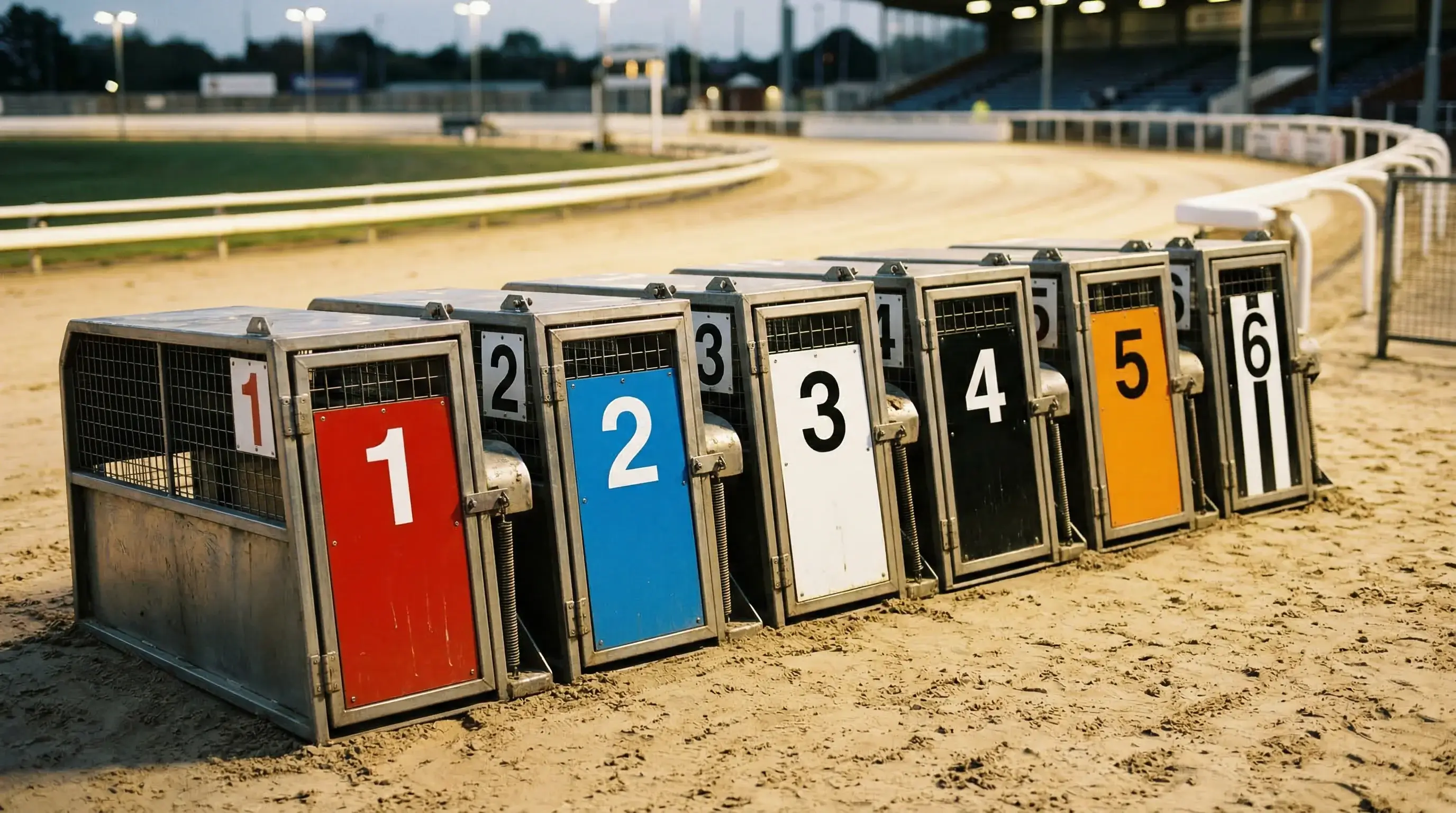
Every greyhound race at Monmore starts from one of six traps, numbered 1 (red jacket) through 6 (black and white stripes). In a perfectly fair system, each trap would produce a winner 16.66% of the time. In practice, no greyhound track in Britain hits that theoretical balance — and Monmore is no exception. Track bias is real, measurable and worth understanding before you look at any racecard.
Across UK tracks generally, Trap 1 averages a win rate of approximately 18-19%, comfortably above the expected share. The reason is geometry: the dog in Trap 1 is closest to the inside rail and has the shortest path to the first bend. At Monmore, where that first bend arrives after just 103 metres, the advantage is amplified. The inside runner can claim the rail with minimal interference, while dogs breaking from Traps 5 and 6 need to cover more ground and often encounter crowding as the field converges on the turn.
The extent of this bias can spike dramatically on any given night. Data from BannedSystems records a single Monmore meeting where Trap 1 won seven of twelve races — a 58% strike rate, more than three times the theoretical average. That is an extreme example, but it illustrates a broader truth: on tight tracks like Monmore, the rail advantage is not trivial. It is structural.
Trap Performance by Distance
The magnitude of trap bias shifts depending on the race distance. Over the 264m sprint, where there are only two bends and the race is effectively decided in the first 50 metres, the inside traps hold the largest edge. Dogs in Traps 1 and 2 have fewer opportunities to be overtaken, and the brevity of the race limits the ability of wide runners to recover position.
Over the standard 480m trip, the picture becomes more nuanced. Four bends provide more positional changes, and a strong bend runner drawn in Trap 4 or 5 may overcome the initial disadvantage by finding space on the outside of the first turn. Still, the aggregate data tends to favour the lower-numbered traps over a large sample. The key word is aggregate — individual meetings can and do deviate.
At the marathon distance of 835m, the sheer number of bends and the longer race duration dilute the trap draw advantage. Stamina, pace judgement and racing temperament matter more than starting position. If you must back an outsider at Monmore, the 835m is the distance where the trap draw is least likely to be the deciding factor.
Using Trap Data Wisely
Trap statistics are a tool, not a system. Blindly backing Trap 1 in every race at Monmore will not produce a profit because the bookmaker prices already account for the known bias. Where trap data adds genuine value is in identifying mispriced runners — a Trap 1 dog with strong early pace whose odds look generous, or an outside-box runner whose form suggests it can overcome the positional disadvantage but is being underrated by the market.
Trap 1 holds a measurable edge at Monmore, especially over shorter distances, but the edge is already priced into the market. The real value lies in combining trap data with form, distance suitability and trainer patterns to identify where the odds do not reflect the actual probability.
Trainer Form at Monmore: Who Runs the Kennels
Trainer identity is one of the most underused data points on a greyhound racecard. Most casual punters glance at the form figures, check the trap draw and move on — but the trainer tells you something about how a dog has been prepared, what condition it is likely in, and whether the kennel specialises in the distance being raced.
Across the UK, approximately 500 licensed trainers operate under GBGB regulation, supported by around 3,000 kennel staff. That is a substantial workforce, but the number of trainers who regularly run dogs at Monmore is much smaller — typically a core group of Midlands-based kennels supplemented by occasional visitors from further afield. Regular Monmore trainers include established names whose greyhounds appear on the racecard week after week, building up a form record that becomes statistically meaningful over time.
What Trainer Form Tells You
A trainer's strike rate — the percentage of runners that win — is a blunt but useful metric. A kennel running at 20% or above over a sustained period at Monmore is performing well; 15% is solid; anything below 10% suggests either a low-grade string or dogs that are not running at their peak. More telling than the headline rate is how a trainer performs at specific distances. Some Monmore kennels consistently produce good sprinters over 264m but struggle with middle-distance runners. Others specialise in staying types. If you see a trainer switching a dog to an unfamiliar distance, that can be a warning sign — or, occasionally, a signal that the trainer has spotted something in home trials.
Profit and Loss: The Sharper Metric
Strike rate alone can be misleading because it does not account for the odds at which winners go off. A trainer who wins 25% of races but only with short-priced favourites may produce a negative profit-to-loss record for backers. Conversely, a trainer with a 12% strike rate whose winners include regular double-figure-priced surprises could be profitable to follow. Tracking profit-to-loss at Monmore — either through manual records or using services that aggregate historical data — gives a cleaner picture of which kennels offer actual betting value rather than just a reassuring percentage.
Pay attention to trainer moves within a meeting: if the same kennel has two runners on a card and one is stepped up a grade while the other drops down, the intended runner is usually the promoted one. The downgraded dog may be running for fitness or experience. These patterns are not always visible from the form figures alone, but they become obvious if you follow trainer activity across consecutive meetings.
The A1-to-A10 Ladder: How Monmore Grades Its Runners
Greyhound grading exists to produce competitive races — not to rank dogs from best to worst in some universal league table, but to group runners of similar ability so that every contest is a genuine contest. At Monmore, the system spans from A1 at the top to A10 at the bottom, with separate categories for Open races and puppy events sitting outside the standard ladder.
How the Ladder Works
A greyhound entering the Monmore grading system is initially assessed based on its trial times and, if available, its form from other tracks. The racing office assigns a grade, and from that point movement up or down the ladder depends on results. A dog that wins is promoted — typically by one or two grades, depending on the winning margin and time. A dog that finishes consistently out of the places will be demoted. The system is fluid and recalibrated after every meeting, which means a dog's grade at Monmore is always a reflection of its most recent form at this specific track.
This matters for punters because a dog graded A5 at Monmore is not necessarily the same quality as an A5 at Romford or Hove. Each track grades independently based on the strength of its own kennel population. Monmore's grading depth — with ten standard tiers — allows for finer separation than some tracks offer, which in theory produces tighter races and less predictable outcomes.
The Economics of Grading
Behind the grades sits a prize structure. Total UK greyhound prize money reached £15,737,122 across all licensed tracks, with higher grades commanding larger prizes. At Monmore, A1 and A2 races carry the strongest purses from the standard graded card, while A9 and A10 races carry the smallest. Open races — where dogs qualify by time rather than grade — sit above the standard ladder and attract the best runners and the biggest prize pots. At the apex, the English Greyhound Derby carries a £175,000 winner's purse — the single largest prize in UK greyhound racing. This economic incentive keeps competitive dogs in higher grades and ensures that the grading system reflects genuine ability rather than just accumulated appearances.
The pipeline feeding the grading system is fed by new registrations. In 2024, 5,133 new greyhounds were registered with GBGB, of which 15.5% were British-bred and the remaining 84.5% imported from Ireland. That registration number is down from 6,769 in 2021, reflecting a broader contraction in the greyhound population that tightens competition at every level of the grading ladder.
What Grading Tells a Punter
A dog dropping a grade or two is not automatically a good bet — it may have been demoted because it is genuinely out of form, injured or ageing. Equally, a dog rising through the grades on the back of consecutive wins may be about to meet a level of competition where its advantage evaporates. The grading system is a framework, not a prediction engine. Read it as context for the form figures, not as a shortcut to the winner.
Decoding a Monmore Racecard in 90 Seconds
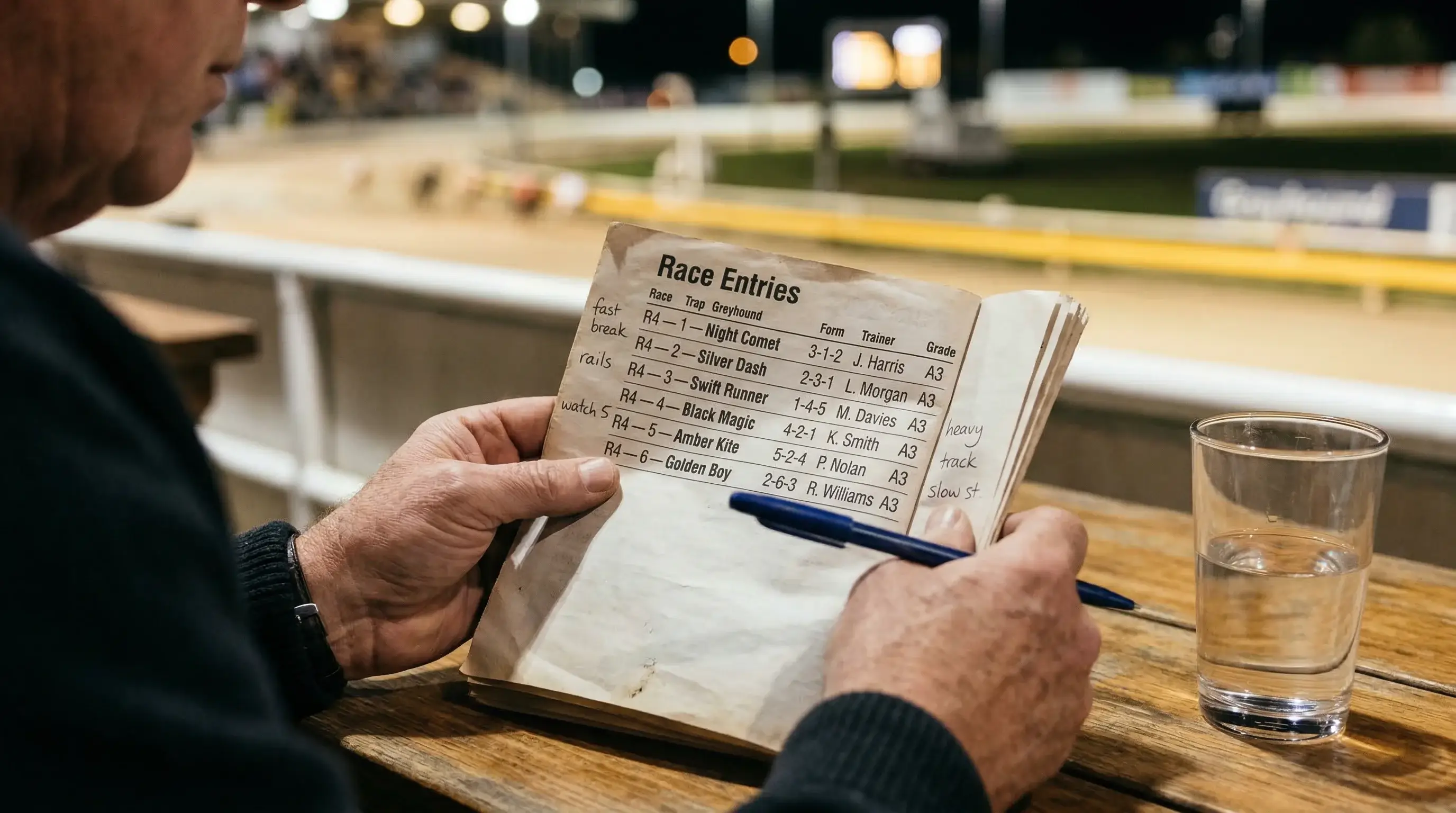
A Monmore racecard looks like a wall of numbers until you know where to look. Each line represents one of six runners and contains compressed information about form, time, weight, trap draw, trainer and comment. Once you can read this shorthand, the racecard stops being intimidating and becomes the single most useful tool for assessing a race.
The Key Fields
Trap and jacket colour. Trap 1 is always red, Trap 2 blue, Trap 3 white, Trap 4 black, Trap 5 orange and Trap 6 black and white stripes. This colour coding is universal across UK greyhound racing, and it is the first thing to match when watching a race live.
Form figures. The sequence of digits to the right of the dog's name records its finishing positions in its last six runs, reading left to right from oldest to most recent. A form line of 321143 tells you the dog finished third, second, first, first, fourth and third in its last six outings. A dash or hyphen indicates a race where the dog did not finish — either because it was bumped, fell or was withdrawn. Letters can appear too: m for middle runner, w for wide runner, and other abbreviations noting race incidents.
Best time. Usually listed for the specific distance of today's race. This is the fastest time the dog has recorded over this trip, not necessarily at Monmore. Compare best times across the field, but remember that times from different tracks are not directly comparable because of surface and circuit differences.
Weight. Shown in kilograms or pounds depending on the source. Weight fluctuations of more than half a kilogram between races can indicate fitness changes, illness or simply that the dog ran on a different day of its feeding cycle. Large unexplained weight swings should raise a flag.
Trainer. The trainer's surname appears on the racecard line. At Monmore, knowing the trainer tells you about kennel competence, distance specialisms and preparation patterns — information that the form figures alone do not convey.
Comment. A brief race-by-race description from the judge or data compiler: things like "led to bend two", "crowded first bend" or "stayed on well". Read the comments across the full form sequence, not just the last run. Patterns of crowding or slow starts may suggest a persistent issue; patterns of strong finishes may suggest the dog is improving.
A racecard is a compressed data set. Treat each field as one variable in a larger equation rather than fixating on any single number. The dogs whose form, trap draw, distance suitability and trainer all align are the ones worth studying further.
Betting on Monmore: Odds, Markets & Staking Basics
Betting on Monmore races is straightforward in principle but requires discipline in practice. The first thing any punter should absorb is a calibrating statistic: favourites win only 30-40% of UK greyhound races. That means the most obvious selection on any racecard loses more often than it wins. If you are betting on Monmore without a clear edge — without form analysis, trap data and a staking plan — you are simply handing money to the bookmaker at a slower pace than at a roulette table.
Odds Formats at Monmore
The standard odds format at UK tracks is fractional — 5/1, 3/1, 7/2 and so on. The Starting Price (SP) is the final on-course odds at the moment the traps open, determined by the on-track market. Board prices, shown before the off, may differ from SP and can be taken at the advertised odds with most bookmakers. Tote pools offer an alternative: your payout depends on the total pool and the number of winning tickets, so the odds are not known until the race is settled. Each format has its place, but most Monmore punters bet at SP or take a board price with an online bookmaker.
Markets: Win, Forecast, Tricast and Each-Way
A win bet is the simplest: pick the race winner. A forecast requires naming the first and second in the correct order — harder to land but paying significantly more. A tricast extends this to first, second and third. Each-way betting pays a reduced fraction (typically one quarter of the win odds) if your selection finishes first or second. Each-way is popular with punters who want a return even when their selection does not win, though the maths can work against you at shorter prices.
The broader betting market around greyhound racing is contracting: inflation-adjusted betting turnover on the sport fell by 23% between 2021 and 2024. Mark Moisley, GBGB's Commercial Director, put it bluntly: "Revenue from bookmakers is declining year-on-year and has done for a number of years. If it continues at the rate it's going, we'll have issues sooner rather than later" (Huck Magazine). That financial context does not change the mechanics of placing a bet at Monmore, but it does explain why prize money, track investment and field quality are under pressure — factors that ultimately affect the results you are betting on.
Staking: Keep It Flat Until You Have an Edge
The simplest approach for anyone starting out at Monmore is level staking: the same amount on every bet, regardless of confidence. This removes the temptation to chase losses with larger stakes and gives you a clean data set to assess whether your selections are actually producing a profit. Percentage staking — where each bet is a fixed percentage of your current bankroll — is a step up in sophistication that adjusts automatically for winning and losing streaks. Value-based staking, where you increase your bet size only when the perceived probability exceeds the implied probability in the odds, is the most theoretically sound approach but demands honest, disciplined assessment of each race.
Responsible staking is not optional. Set a session budget before you arrive at Monmore or log in online, and stop when it is gone. Greyhound racing generates many betting opportunities in a short time — twelve races in three hours — and the pace can make it easy to exceed your limits without noticing.
From 10,000 Fans in 1928 to a Greyhound-Only Future
Monmore Green opened on the evening of 11 January 1928, barely two years after greyhound racing arrived in Britain. That first night drew 10,000 spectators — a remarkable turnout for a sport that did not exist on these shores three years earlier. Seven races were run. The first winner was a dog called Arrow Tranby, who won the 500-yard event in 32.08 seconds at odds of 6/1. Wolverhampton had its dog track, and it has not stopped running since.
Arrow Tranby's winning time of 32.08 seconds in January 1928 would be uncompetitive even in the lowest Monmore grades today — a reminder of how far the sport's athletics have progressed in nearly a century of breeding and training.
The early decades were boom years. Greyhound racing was cheap entertainment in an era with few alternatives, and Monmore drew crowds that would be inconceivable now. But the track's history is not a smooth arc. In 1963 a fire damaged the grandstand, forcing significant rebuilding. Through the post-war decades, Monmore operated alongside speedway — the Wolverhampton Wolves motorcycle team shared the stadium from the earliest days, creating a dual-sport venue that became a local institution.
The corporate era arrived in 1974 when Ladbrokes acquired the stadium, aligning Monmore with the betting industry that would increasingly define its commercial model. The move to BAGS broadcasting in the early 1980s opened Monmore races to the off-course betting market nationwide, turning a local venue into a fixture on every bookie's afternoon screen. SIS coverage followed in the 2010s, bringing streaming and real-time data feeds to online platforms.
The most seismic recent change came in 2023. Entain, which by then controlled Monmore through its ownership of Ladbrokes Coral, announced that speedway at Monmore Green would end after the 2023 season. The Wolverhampton Wolves, who had raced motorcycles here for 95 years, were displaced. Leo Walker, Entain's Transformation Director for Retail, explained the logic: "Following the launch of Premier Greyhound Racing, we have taken a decision to centre our resource and investment on greyhound racing at the track" (FIM Speedway).
Monmore Green is now a greyhound-only venue for the first time in its history. That decision, driven by PGR's investment priorities, shapes everything about the track's current operation — from the race schedule to the surface maintenance to the data output that punters rely on.
The transition was not universally welcomed — speedway fans lost a venue with deep emotional ties — but it clarified Monmore's identity. In 2026, the track exists as a dedicated greyhound racing facility, backed by Premier Greyhound Racing's commercial model and feeding its results into the UK-wide betting ecosystem. Approaching its centenary in 2028, Monmore has survived fires, corporate takeovers, the collapse of attendances from their post-war peak, and the loss of its sister sport. The dogs keep running.
Welfare on the Track: What the 2024 Data Says
Greyhound welfare is the most contested topic in the sport, and it deserves a data-driven examination rather than an emotional one. GBGB publishes annual injury and retirement statistics for all licensed tracks, including Monmore, and the 2024 data set provides the most recent picture of where the sport stands.
Injury Rates
In 2024, GBGB recorded 3,809 injuries across 355,682 individual race runs — an injury rate of 1.07%, the lowest in the history of the data series. To put that in context, the rate has fallen consistently since systematic recording began, and the 2024 figure represents meaningful progress for a sport where running at speed on a curved track carries inherent physical risk.
The track fatality rate — dogs that died as a direct result of racing injuries — was 0.03%, with 123 fatalities across all UK venues. That rate has halved since 2020, when it stood at 0.06%.
Retirement and Rehoming
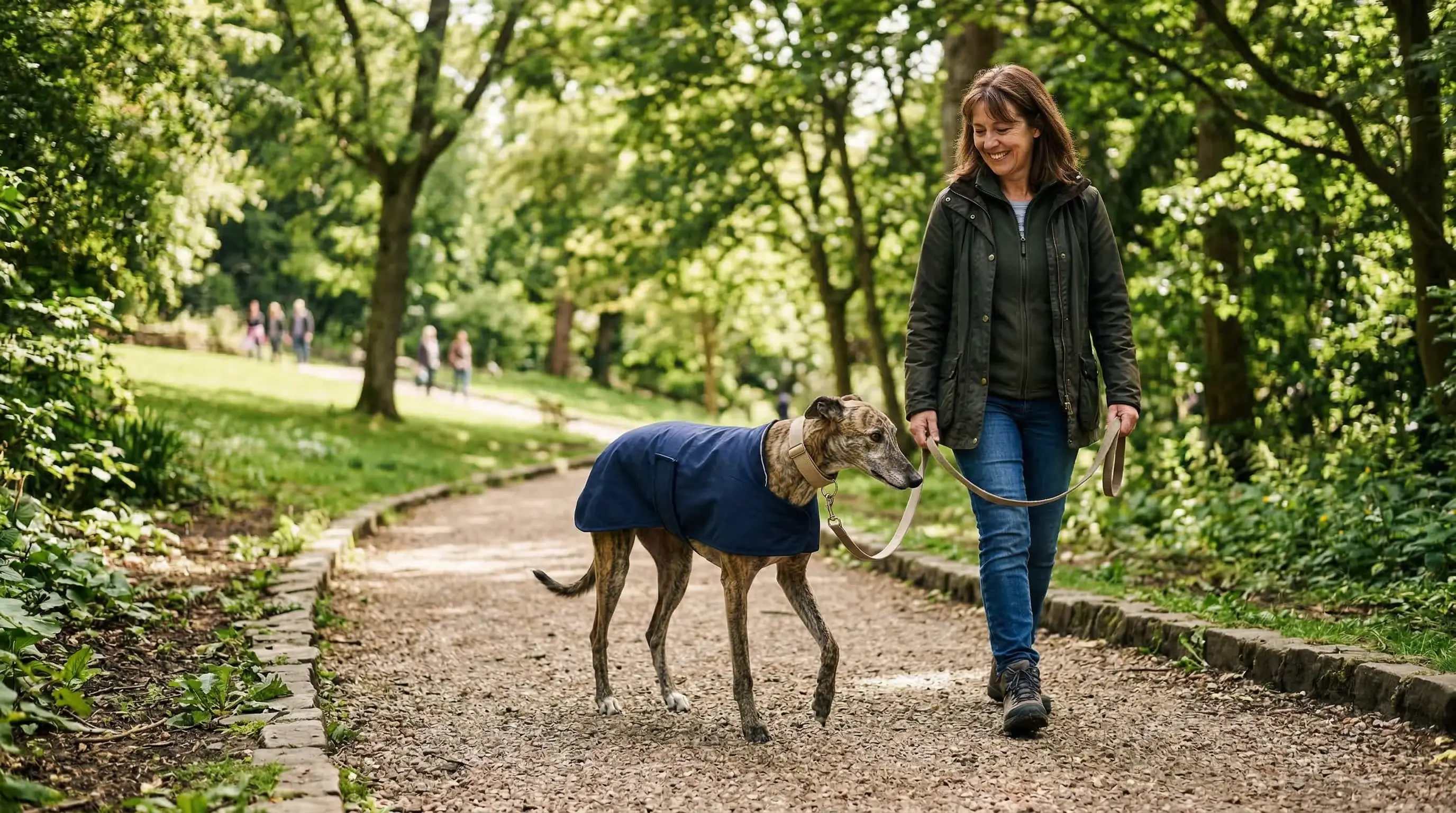
The sharper question for many people is what happens to greyhounds after they stop racing. The 2024 data shows that 94% of retired greyhounds — 5,795 dogs — were successfully rehomed through the GBGB Greyhound Retirement Scheme, charities or private adoptions. That is up from 88% in 2018. In 2025, GBGB raised the Greyhound Retirement Scheme grant from £400 to £420 per dog, and adoptions from approved GRS centres rose 37% in the first half of 2025 compared to the same period in 2024. The most striking figure in the welfare data concerns economic euthanasia — dogs put to sleep because no home or ongoing use could be found. In 2018, 175 greyhounds were euthanised for economic reasons. By 2024, that number had fallen to three. A 98% reduction in six years.
Mark Bird, the outgoing GBGB Chief Executive, pointed to this trajectory when the 2024 data was released: "There is much to be pleased and encouraged by in this year's data. It shows that the initiatives we have introduced in recent years are now embedded and are helping to consolidate the significant progress we have made since 2018 across all measures" (GBGB).
Welfare is not a settled debate. Advocacy groups such as GREY2K note that cumulative figures between 2017 and 2024 include more than 35,000 total injuries and over 1,300 track fatalities across UK greyhound racing. The year-on-year improvement is genuine, but the aggregate toll is not trivial. Punters who want to engage responsibly with the sport should weigh both the direction of travel and the absolute numbers.
The Regulatory Context in 2026
The welfare debate has a legislative dimension. Wales announced in early 2025 an intention to ban greyhound racing, and in April 2025 Scottish MSP Mark Ruskell introduced a bill to prohibit oval-track greyhound racing in Scotland. At Westminster, however, the UK Government confirmed in 2025 that it has no plans to ban the sport, recognising its contribution to employment and cultural life. On the ground, GBGB has intensified oversight: routine kennel inspections have increased 73% since the welfare strategy launched, with each licensed trainer receiving an average of three field visits in 2024. For Monmore, which sits squarely in England, the immediate regulatory threat is minimal — but the direction of policy in the devolved nations adds long-term uncertainty to the sport's operating environment.
Planning Your Visit to Monmore Green
Address: Sutherland Avenue, Wolverhampton, WV2 1EQ
Evening admission (2026): £7 adults / Free for under-18s
Parking: On-site, 400 spaces, free
Typical evening meeting: 10-12 races, first race approximately 18:30-19:00
Monmore Green is a ten-minute drive from Wolverhampton city centre, just off the A4150 ring road. The car park holds 400 vehicles and is usually adequate for evening meetings, though Saturday cards can fill up early. If you are travelling by public transport, the nearest bus routes run along Bilston Road — check the West Midlands Network site for current timetables, as weekend services may be reduced.
The stadium has an on-site restaurant that serves a full evening menu alongside the racing. Restaurant packages typically include a reserved table, meal and racecard, and should be booked in advance through the Monmore events team — especially for Saturday fixtures or corporate group bookings. Outside the restaurant, there is a bar area and trackside viewing. The dress code is relaxed; you will see everything from suits to trainers depending on the occasion.
Admission at £7 for adults with free entry for under-18s makes Monmore one of the cheapest live sporting events in the West Midlands. For families, the atmosphere on a Saturday evening is accessible and low-pressure — children can watch the dogs, get close to the action and enjoy the spectacle without the intensity or crowd density of a football ground. Racecards are available at the entrance for a small charge and are worth picking up even if you are not planning to bet, since they contain the form data and trap information that this guide is built around.
Check the Monmore Green social media accounts or the Entain racing calendar for the latest fixture information before travelling, particularly around bank holidays or seasonal breaks in the spring 2026 schedule when meetings may be rearranged or cancelled.
Frequently Asked Questions About Monmore Green
What distances do they race at Monmore Green?
Monmore Green offers five standard race distances: 264 metres (a two-bend sprint), 480 metres (the standard four-bend trip and the most commonly raced distance), 630 metres, 684 metres (both middle-distance tests) and 835 metres (the marathon). The first bend at Monmore arrives at 103 metres from the start, which is a key factor in how each distance plays out — shorter trips place more emphasis on early pace and trap draw, while longer races reward stamina and bend technique. Most graded races on a typical meeting card are run over 480m, with sprints and marathon events appearing less frequently.
Which trap wins the most at Monmore?
Trap 1 (the red jacket, closest to the inside rail) has the highest aggregate win rate at Monmore, consistent with the broader UK pattern where Trap 1 averages approximately 18-19% of wins compared to the theoretical 16.66% per trap. At Monmore, the tight 419-metre oval and the relatively short 103-metre run to the first bend amplify this inside-rail advantage. However, the bias varies by distance — it is strongest over the 264m sprint where there are only two bends, and weakest over the 835m marathon where the number of bends dilutes the trap draw influence. Individual meetings can produce extreme deviations, so treat aggregate trap data as a guide rather than a guaranteed edge.
What days does Monmore Green race and what time does it start?
In 2026, Monmore Green runs afternoon BAGS meetings on Monday, Tuesday, Wednesday and Friday, with the first race typically around 11:30 to 12:00. Evening meetings — the sessions open to the public — usually take place on Thursday and Saturday, with the first race at approximately 18:30 to 19:00. Meetings typically feature 10 to 12 races with intervals of about 15 minutes, so an evening card wraps up around 21:30. Admission for evening meetings is £7 for adults, and under-18s enter free. Check the Monmore Green social media channels or the Entain racing calendar for the latest fixtures, as schedules may change around public holidays and during the spring 2026 season.
