
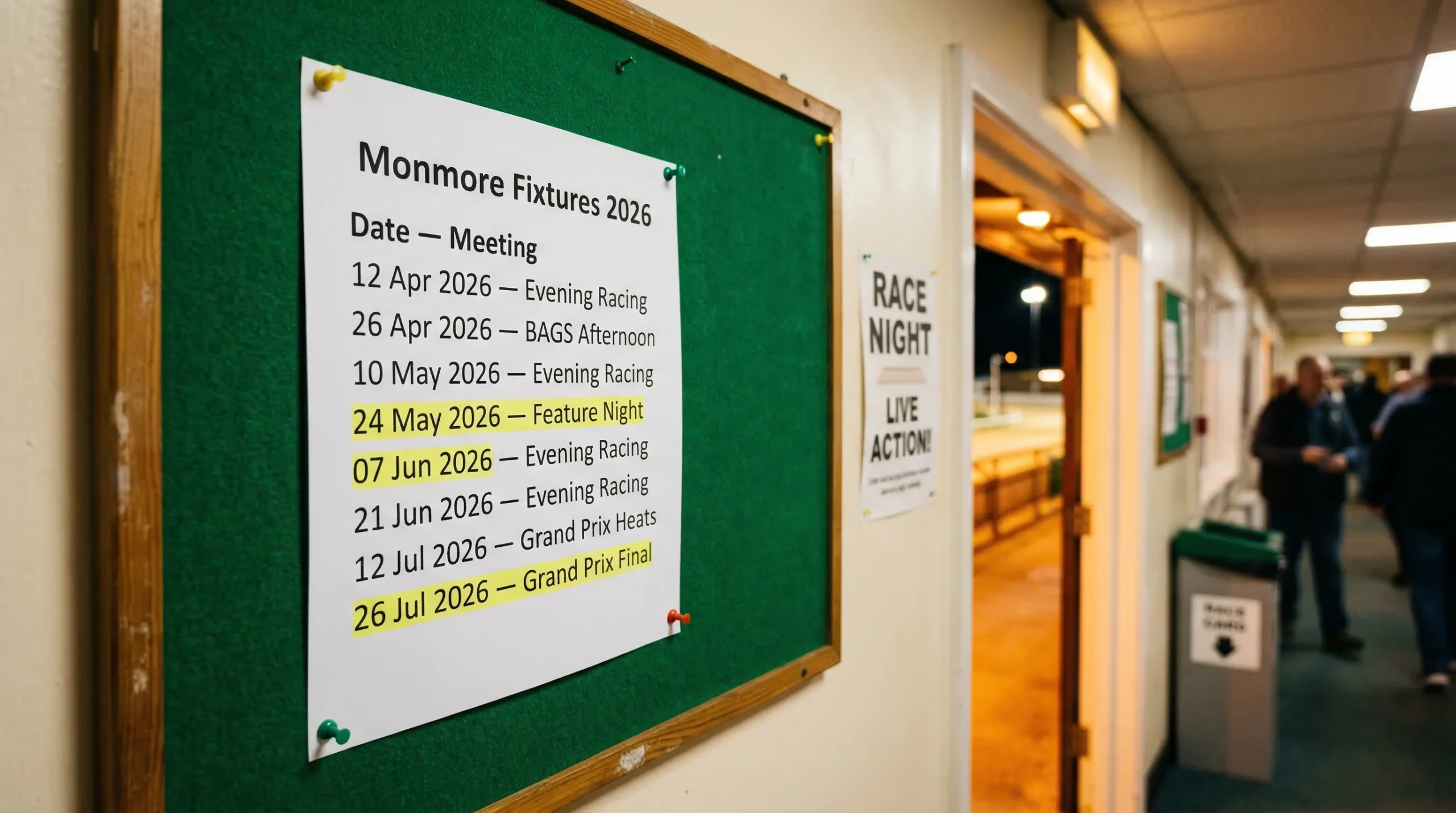
- Monmore's Weekly Schedule: Which Days, Which Format
- Afternoon BAGS vs Evening Open: What Changes
- First Race to Last: What Time to Arrive and When It Ends
- Key Monmore Events in 2026: Gold Cup, Puppy Derby and More
- Fixture Changes, Abandonments and Where to Check Updates
- Planning Your Visit Around the Monmore Calendar
Monmore Green runs greyhound racing multiple days a week, most weeks of the year. That consistency is one of its defining features — and one of the reasons it matters to the UK betting landscape. As one of nine tracks in the Premier Greyhound Racing network, the Entain and ARC joint venture that manages media rights and fixture allocation for a significant portion of the licensed circuit, Monmore’s schedule feeds directly into the national greyhound product available to punters through bookmaker shops, apps, and live-streaming platforms. The full picture is in our Monmore Green results guide.
But Monmore’s fixtures are not all the same. Afternoon meetings and evening meetings operate under different structures, attract different types of racing, and serve different audiences. A Tuesday afternoon BAGS card is a fundamentally different product from a Saturday evening open meeting, even though both take place on the same 419-metre oval. The grading, the prize money, the crowd, the atmosphere, and even the quality of the fields can vary significantly between the two formats.
This guide maps Monmore’s 2026 fixture schedule: which days the track races, what format each meeting follows, what time the first and last races go off, which key events punctuate the calendar, and what happens when fixtures are changed or abandoned. Whether you are planning a night at the dogs or building a betting strategy around the Monmore calendar, the schedule is the starting point. Everything else follows from knowing when the traps open.
Monmore’s Weekly Schedule: Which Days, Which Format
Monmore’s typical weekly schedule in 2026 splits between afternoon and evening fixtures. Afternoons — generally Monday, Tuesday, Wednesday, and Friday — host BAGS meetings: the Bookmakers’ Afternoon Greyhound Service fixtures that provide a steady stream of greyhound racing for the betting market during shop hours. These are the meetings that fill bookmaker screens between the morning horse racing and the evening cards, and they account for the bulk of Monmore’s annual fixture count.
Evening meetings run on Thursday and Saturday nights. These are Monmore’s flagship sessions — the meetings that attract spectators to the stadium, that host the track’s open and feature races, and that carry the strongest fields across the grading bands. Thursday evenings have a long tradition at Monmore and remain one of the track’s best-attended regular fixtures. Saturday nights are the premium slot, often featuring higher-grade racing, larger crowds, and — on selected dates — feature events like the Gold Cup and Puppy Derby.
Entry to evening meetings at Monmore costs seven pounds for adults, while children under 18 enter free, based on current 2026 pricing. That price includes access to the main grandstand and trackside viewing areas. Restaurant packages and hospitality options are available at higher price points for those who want a more structured evening. The afternoon BAGS meetings typically do not charge admission because they are primarily designed for the off-track betting market rather than for live spectators, though racegoers can attend in person.
The weekly schedule is not fixed in stone. BAGS fixture allocation is managed centrally, and Monmore’s afternoon slots can shift depending on the broader UK greyhound fixture grid. If another track drops a meeting — due to weather, maintenance, or operational issues — Monmore may pick up an additional afternoon fixture. Conversely, if the grid is well covered, Monmore might have a rare blank afternoon. Evening meetings are more stable, with Thursday and Saturday slots held consistently throughout the year.
For punters who bet remotely, the distinction between afternoon and evening meetings matters primarily in terms of field quality and form reliability. Afternoon BAGS meetings tend to feature graded racing across the full A1-to-A10 spectrum, with fields assembled from Monmore’s regular racing population. Evening meetings may include open races — events where dogs from different grades and different tracks are invited to compete — which produces less predictable fields but potentially more exciting racing. The form data generated by afternoon meetings is the backbone of the analysis available for evening selections, because the same dogs often race across both formats.
For visitors planning a trip to Monmore, the choice between Thursday and Saturday evening depends on personal preference. Thursday tends to be slightly less crowded and offers a more relaxed atmosphere. Saturday is busier, louder, and more likely to feature special events. Both offer the same core experience: live greyhound racing on Monmore’s 419-metre oval, with on-course betting, food and drink facilities, and the particular energy that comes from watching competitive sport unfold in real time, a few metres from where you are standing.
Afternoon BAGS vs Evening Open: What Changes
The difference between a BAGS afternoon and an open evening at Monmore goes deeper than the time on the clock. BAGS meetings exist primarily to serve the off-track betting market. The Bookmakers’ Afternoon Greyhound Service was established decades ago to provide bookmaker shops with a product to offer during the afternoon hours, and it remains one of the commercial pillars of UK greyhound racing. At Monmore, BAGS afternoons feature 12 or 13 races of graded competition, broadcast via SIS (Sports Information Services) to bookmaker outlets across the country.
The commercial model behind BAGS is straightforward. Bookmakers pay for the right to broadcast and take bets on the racing, and that revenue flows through to the tracks and the sport’s funding bodies. Premier Greyhound Racing, the Entain and ARC joint venture that manages media rights for nine UK tracks including Monmore, invested over 2.5 million pounds in open racing prize money as part of its commitment to raising the profile of the sport. The PGR model ensures that Monmore’s BAGS meetings are available through major bookmaker channels, which means the racing reaches a far larger audience than the 1,150-seat stadium could accommodate in person.
Lord David Lipsey, Chairman of Premier Greyhound Racing, captured the ambition behind the model when he described the venture as believing that greyhound racing has “a huge potential both as a sport and a betting market, offering stakeholders a sustainable and commercially valuable product in the long term,” as reported by Casino.org. That vision depends on the BAGS schedule delivering a consistent, reliable product — races that start on time, fields that are competitively graded, and results that feed the betting market without interruption.
Evening meetings operate on a different wavelength. The crowd changes. Thursday and Saturday nights at Monmore draw racegoers who are there for the experience as much as the betting — couples, groups of friends, corporate hospitality parties. The atmosphere is louder, the stakes feel higher, and the quality of racing is often a notch above the afternoon product because evening cards are more likely to include open races and feature events.
Open races are structured differently from graded races. In graded racing, dogs are matched against opponents of similar recent form, producing fields where every runner has a credible chance. In open races, the invitation is broader — dogs from different grades, sometimes from different tracks, compete for higher prize money. The result is less predictable racing, which is part of the appeal for spectators but creates a different challenge for punters. Form analysis for open races requires wider research, because the dogs in the field may not have faced each other before and their most recent form may have been set in very different conditions.
From a betting perspective, afternoon BAGS meetings at Monmore tend to offer more stable form lines, more predictable field compositions, and more data to work with. Evening meetings offer the excitement of open competition and the possibility of larger-priced winners, but at the cost of reduced certainty. Both formats have their place in a punter’s calendar. The key is understanding which product you are betting on and adjusting your approach accordingly.
First Race to Last: What Time to Arrive and When It Ends
Timing at Monmore follows the patterns common to UK greyhound racing, with some track-specific details worth noting. Afternoon BAGS meetings typically begin with the first race around midday, though the exact start time can vary depending on the day of the week and the position of the meeting within the national BAGS schedule. Most afternoon cards comprise 12 to 13 races with intervals of approximately 12 to 15 minutes between each race, which means the final race usually goes off in the late afternoon, roughly three to three-and-a-half hours after the first.
Evening meetings at Monmore start later, with the first race typically scheduled for early evening — usually between 6:30 and 7:30 PM depending on the meeting type and time of year. The card follows a similar format: 12 or 13 races with regular intervals. The final race of an evening meeting generally runs between 9:30 and 10:30 PM. If you are planning to attend a Thursday or Saturday evening at Monmore, arriving 30 to 45 minutes before the first race gives you time to settle in, check the racecard, watch the first dogs in the parade ring, and place early bets before the card begins.
The interval between races is not dead time. It is when the groundstaff harrow and grade the sand surface, when the next batch of dogs are paraded for inspection, and when the betting markets open for the upcoming race. For punters, the interval is your working window — the time to assess the form for the next race, compare your assessment to the available prices, and decide whether to bet or sit it out. Experienced Monmore racegoers develop a rhythm: watch the current race, note how the dogs handled the track, then use the interval to prepare for the next.
Race timing can shift on specific occasions. Feature events like the Gold Cup or Puppy Derby may carry slightly different schedules, with the main event placed as a centrepiece of the evening card rather than running in its usual chronological slot. On dual-event nights, where a particularly significant race anchors the card, the build-up may include extended parade times and on-track presentations. These are exceptions rather than the norm, but they are worth noting if you plan to attend a feature meeting and want to time your arrival for the main event.
For remote punters who are not attending in person, the timing matters for a different reason: it determines when the races are available to watch and bet on through bookmaker platforms. Afternoon cards feed the lunchtime-to-afternoon betting window, which is the period when many bookmaker shops are busiest for greyhound action. Evening cards overlap with the post-work betting window, and they typically attract higher betting volumes and more competitive markets. Knowing when the first race runs helps you plan your betting schedule, allocate time for form study, and avoid the rushed decision-making that comes from arriving unprepared to a card that has already started.
Key Monmore Events in 2026: Gold Cup, Puppy Derby and More
Monmore’s fixture calendar is anchored by a handful of feature events that elevate the track above its regular graded programme. These are the nights when prize money increases, when the quality of the fields rises, and when the track draws attention from beyond its regular audience. They are also the nights that test a punter’s ability to assess open competition, where dogs from different backgrounds converge in races that the normal grading system does not govern.
The Monmore Gold Cup is the track’s most prestigious competition — an open event that attracts some of the best greyhounds racing on the UK circuit. Gold Cup night at Monmore carries an atmosphere that regular meetings cannot match. The fields are stronger, the betting markets are deeper, and the racing itself tends to be more competitive because the entry criteria select for quality rather than grade. For punters, Gold Cup night is an opportunity to watch top-class racing at a venue they know, but it is also a night where form from regular graded meetings may not fully apply. Dogs entering the Gold Cup may have been prepared specifically for the event, with trial runs and conditioning programmes targeted at peak performance on the night.
The Puppy Derby is Monmore’s showcase for younger dogs — greyhounds in the early stages of their racing careers. Puppy events carry a different analytical challenge: the form book is thinner because the dogs have fewer races behind them, and improvement is harder to predict than in older, established runners. A puppy that finished third in a trial three weeks ago may be a completely different proposition tonight after another few weeks of physical development and track experience. The uncertainty makes puppy events popular with punters who enjoy finding value in unpredictable fields, but it also makes them dangerous for those who rely heavily on form data that may not yet be robust.
The Trafalgar Cup and other named competitions fill out the annual calendar. These events vary in format — some are single-night knockout events, others are staged over multiple rounds with heats, semi-finals, and a final. Multi-round events create their own form dynamics. A dog that wins its heat convincingly may face a significantly stronger field in the semi-final, and the timing between rounds can affect conditioning. Trainers managing dogs through a multi-round competition are making tactical decisions about workload, rest, and preparation that do not apply to regular graded racing.
For context on the prize money scale, the biggest single prize in UK greyhound racing is the English Greyhound Derby, which offered 175,000 pounds to the winner in 2025, as confirmed by the GBGB. Monmore’s feature events do not approach that figure, but they sit comfortably within the sport’s overall prize structure — a structure that distributed more than 15.7 million pounds across all UK competitions in the most recent reported year. Feature nights at Monmore represent the track’s contribution to the upper tier of that distribution, offering prize money that attracts quality entrants without competing directly with the sport’s flagship events at larger venues.
Attending a feature night at Monmore requires no special arrangement beyond the standard seven-pound admission. The experience is the same venue, the same track, the same facilities — but with better racing, bigger crowds, and an energy that the regular Tuesday afternoon BAGS meeting does not generate. If you are going to visit Monmore once in 2026, a Gold Cup or Puppy Derby night is the evening to choose.
Fixture Changes, Abandonments and Where to Check Updates
Greyhound fixtures are not immune to disruption. Weather is the most common cause of changes at Monmore — heavy rain can waterlog the sand surface to the point where racing is unsafe, and extreme cold can freeze the track. When conditions make racing impossible, the meeting is abandoned, and the scheduled races are either rescheduled to a later date or cancelled outright. Abandonments are frustrating for punters who have studied the card and planned their bets, but they are a reality of a sport that takes place outdoors on a natural surface.
The UK’s greyhound fixture grid is managed with limited redundancy. With only 18 licensed stadiums operating across the country, the loss of a single meeting has a proportionally larger effect on the national schedule than it would in a sport with hundreds of venues. When Monmore abandons an afternoon fixture, the BAGS product loses one of its regular contributors, which can affect the betting schedule at bookmaker shops that rely on a continuous stream of racing content. The track closures of 2025 — Crayford in January, Perry Barr in August, Swindon later that year — reduced the fixture grid further, making each remaining track’s contribution more significant.
Fixture changes can also occur for non-weather reasons. Track maintenance, kennel availability, scheduling conflicts with feature events, and operational decisions by the PGR network can all result in meetings being moved, added, or dropped. These changes are typically communicated through the GBGB’s official channels and replicated by bookmaker platforms that list greyhound racing fixtures.
For punters, staying informed about fixture changes is essential. The most reliable sources for up-to-date Monmore fixture information are the track’s official social media accounts, the GBGB website, and the fixture sections of major bookmaker apps. Specialist greyhound racing sites also carry fixture updates, though they may lag behind official sources by a few hours. If you are planning to attend Monmore in person, checking the fixture status on the morning of the meeting is a sensible precaution — particularly in winter months when weather-related abandonments are more common.
Rescheduled meetings can create interesting form dynamics. If a meeting is abandoned partway through the card, dogs that were due to race later in the evening will not have run. When those dogs reappear at the next fixture, they may be fresher or more wound-up than expected, depending on how the trainer has managed the gap. Similarly, dogs that raced in the early part of an abandoned meeting may be at a slight disadvantage if they are asked to race again quickly. These are marginal considerations, but at a sport where margins matter, every edge is worth noting.
Planning Your Visit Around the Monmore Calendar
If you are visiting Monmore Green for the first time, the calendar is your starting point. A Saturday evening meeting offers the fullest experience: the strongest fields, the best atmosphere, and the highest chance of catching an open or feature race on the card. Thursday evenings are a close second, with slightly smaller crowds but the same quality of racing and facilities. For a quieter, more analytical experience — the kind where you can study the form in peace and watch the racing without the noise of a full house — an afternoon BAGS meeting is worth considering, though the atmosphere will be more functional than festive.
Admission to evening meetings at Monmore is seven pounds for adults, with free entry for under-18s. That seven pounds buys you access to the full venue: the trackside viewing areas, the grandstand, the bars and food outlets, and the on-course bookmakers and Tote facilities. Restaurant and hospitality packages are available for those who want a seated dining experience alongside the racing. These options tend to sell out for feature nights, so booking ahead is advisable if a Gold Cup or Puppy Derby evening is your target.
Transport to Monmore is straightforward. The stadium sits in the Wolverhampton area with parking for around 400 vehicles on site. Road access is good, and the venue is reachable by public transport from Wolverhampton city centre. If you are driving, arriving 30 to 45 minutes before the first race ensures you can park comfortably and have time to settle in before the card begins. Watching them is covered in live racing and TV.
The Monmore fixtures and schedule in 2026 offers something for every type of racegoer. Regular punters who follow the track week-in, week-out will find the afternoon BAGS meetings provide the deepest data and the most consistent form lines. Occasional visitors looking for a memorable night out should target an evening feature event. And anyone interested in the broader shape of UK greyhound racing will find that Monmore’s calendar — regular, well-structured, and anchored by a handful of quality events — represents one of the most reliable products on the circuit.
