
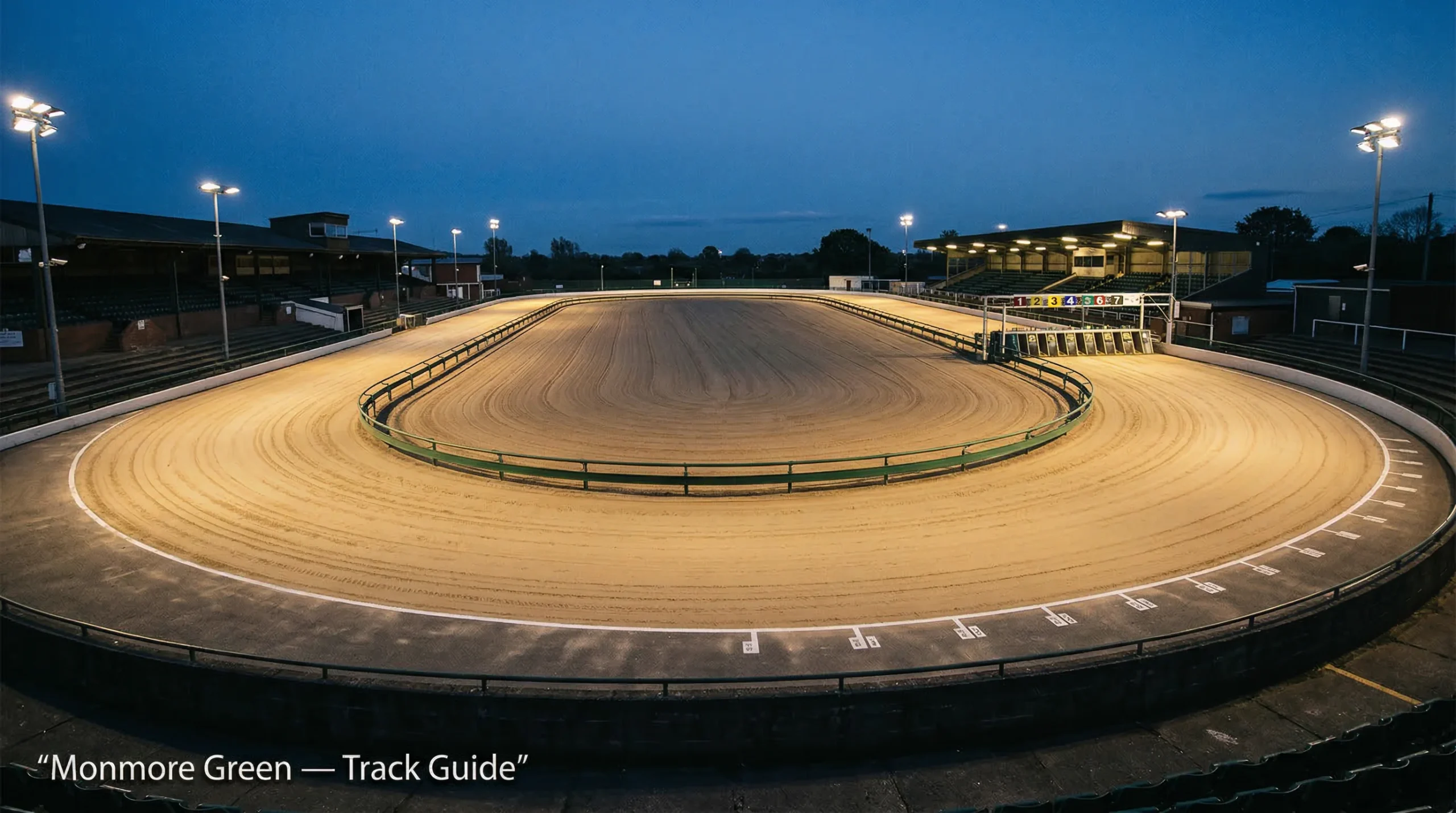
Every greyhound track has a personality. The dimensions, the bend radii, the surface material, the distance from boxes to the first turn — these are not incidental details. They define how races unfold, which running styles thrive, and where the margins of advantage sit. At Monmore Green in Wolverhampton, that personality is shaped by a 419-metre sand oval with a capacity of 1,150 spectators, five race distances ranging from 264 to 835 metres, and a first bend that arrives 103 metres from the starting boxes. These numbers, sourced from BettingOdds.com, are not decorative statistics. They are the architectural blueprint of every race run at the track. The full picture is in our Monmore Green results guide.
Monmore’s track layout sits in a particular spot on the UK greyhound spectrum — neither the tightest circuit in the country nor the most expansive, but a configuration that produces its own distinct running characteristics. The bends are tight enough to reward inside-drawn dogs, the straights are long enough to let fast dogs stretch out, and the range of distances means the track hosts everything from explosive two-bend sprints to gruelling eight-bend marathons in the same evening.
This guide examines Monmore’s physical infrastructure as an engineer might: dimensions first, then distance-by-distance analysis, then the mechanics of the bends and running lines, then surface conditions, and finally a comparison with other UK ovals. If you want to understand why races at Monmore play out the way they do, this is where to start.
419 Metres of Sand and Science: The Physical Track
The headline number is 419 metres — the total circumference of Monmore’s racing oval. That places Monmore in the middle tier of UK greyhound tracks by size. It is not as compact as some of the smaller circuits where the bends come thick and fast, nor is it as expansive as the larger ovals where dogs have more room to spread out. The 419-metre circumference creates a track where both speed and agility matter, where early pace is valuable but not always decisive, and where the bends are tight enough to create genuine positional advantages for inside-drawn runners.
The first bend at 103 metres from the starting boxes is one of the defining features of Monmore’s layout. That distance determines the initial dynamic of every race: the sprint from traps to turn, where six dogs jostle for position before the track curves. At 103 metres, there is enough straight to allow genuine pace differentiation — fast-breaking dogs will have time to establish clear daylight before the bend, while slower starters will already be losing ground. But 103 metres is not so long that the first bend becomes irrelevant. At tighter tracks where the first turn arrives sooner, the break from the boxes is almost everything. At larger tracks where the first straight is longer, dogs have more time to settle into stride. Monmore occupies the middle ground, which makes the interaction between early speed, trap draw, and bend-negotiation skills consistently important.
The track surface is sand — the standard for UK greyhound racing. Sand tracks require regular maintenance between races: harrowing to level the surface, watering to maintain consistency, and grading to ensure even depth across the track width. Monmore’s groundstaff manage the surface throughout each meeting, and the condition of the sand affects race times, running styles, and even the degree of track bias on any given night. More on surface conditions later, but it is worth noting here that the 419-metre oval is not a static environment. It changes with the weather, the season, and the wear patterns created by racing.
Facilities around the track include parking for approximately 400 vehicles and a spectator capacity of 1,150. The stadium is a purpose-built greyhound venue — following the closure of speedway operations in 2023, Monmore became exclusively a greyhound track for the first time in its history. That transition, managed by parent company Entain, freed up operational resources that had previously been split between two sports. The physical track itself was not altered by the speedway departure, but the focus on a single sport has meant that groundkeeping, scheduling, and facility management are now entirely oriented toward greyhound racing.
For punters and racegoers, the 419-metre oval translates into a viewing experience where the action is always close. From most vantage points in the stadium, you can see the entire track without obstruction. The bends pass directly in front of the main grandstand area, which means you can watch how each dog negotiates the turns — a detail that matters more than casual spectators might expect. Experienced Monmore regulars watch the bends as carefully as the finishing line, because that is where positions shift, where inside-drawn dogs consolidate their advantage, and where the race is often won or lost before the final straight.
Distance by Distance: What Each Race Length Demands
Monmore stages races over five distances: 264, 480, 630, 684, and 835 metres. Each distance uses the same oval but asks fundamentally different questions of the dogs that run it. Understanding what each race length demands is essential for anyone trying to assess form, trap draw, and likely race dynamics.
The 264-metre sprint is the shortest trip on the card. The dogs break from the boxes on the back straight, negotiate two bends, and finish on the home straight. The entire race lasts around 15 to 16 seconds. At this distance, the break from the traps is paramount. A dog that exits cleanly and reaches the first bend at 103 metres in front will almost certainly hold its lead, because there is simply not enough race left for a slower-starting rival to make up the deficit. Sprint races at Monmore are high-octane and chaotic — the field is still bunched through the first bend, and interference is common because every dog is at maximum speed in close quarters. The inside draw is at its most valuable here, because two tight bends in quick succession give the inside-drawn runner an almost unassailable geometric advantage if it breaks level with or ahead of the field.
The 480-metre trip is Monmore’s bread and butter. This is the standard distance that dominates the racecard, run over four bends — a complete lap of the oval plus an additional section. It is the distance at which graded racing operates most frequently and the distance at which the deepest form data exists. At 480 metres, the first bend still matters — the 103-metre run gives fast breakers an early advantage — but the additional two bends introduce more opportunity for positional changes. A dog that is headed at the second bend can rally down the back straight and challenge again at the third. Middle-drawn runners — Traps 3 and 4 — tend to perform relatively better at this distance than in sprints, because the longer race gives them time to find racing room without the extreme early-speed bias that dominates shorter trips.
The 630-metre distance moves into middle-distance territory. The race covers one and a half laps of the oval, negotiating six bends. Here, stamina becomes a meaningful factor alongside speed. A dog that leads from the traps in a 630-metre race needs to sustain that speed through six turns, which is demanding both physically and tactically. Dogs drawn wide have more time and space to find a position than in sprints or standard distance races, and the field tends to string out through the middle stages as slower dogs drop back and stronger ones move forward. Form at 630 metres tends to be more predictable than at 264 metres because the longer trip reduces the impact of random incidents at the first bend.
The 684-metre distance is close to the 630 but not identical. The extra 54 metres add roughly one more half-bend to the race, and at this level of endurance, that additional distance can separate dogs that handle six bends from dogs that handle six-and-a-half. In practice, the 684-metre trip is the distance where the gap between early-speed types and genuine middle-distance dogs becomes most apparent. A fast sprinter that can stretch to 630 may find 684 a bridge too far if it lacks the stamina to sustain pace through the final turn. Conversely, a confirmed stayer may find 684 short enough that it cannot fully deploy its finishing kick. The 684 is an in-between distance — often overlooked by punters who focus on the more popular 480m and 264m trips — but it rewards careful form assessment because the margin between competing demands is narrow.
The 835-metre marathon is the longest race Monmore offers. Eight bends. Two full laps of the oval and then some. At this distance, the race becomes a test of sustained galloping ability rather than explosive speed. Early pace still matters — a dog that leads from the traps dictates the tempo — but the importance of the trap draw diminishes relative to shorter distances because the sheer length of the race creates more opportunities for positional changes. Pace collapse is a genuine phenomenon at 835 metres: a dog that leads through the first four bends may fade dramatically through the second lap as its energy reserves deplete. Identifying dogs with genuine staying ability — as opposed to fast dogs entered at a longer distance — is the key skill for anyone betting on Monmore marathons. The form book helps, but the specific demands of 835 metres mean that dogs can look entirely different at this trip compared to their performance over 480 metres or shorter.
Bends, Camber and Running Lines at Monmore
The bends are where Monmore races are won and lost. On a straight, every dog covers the same distance. On a bend, the dog running closest to the inside rail travels the shortest path, while the dog running widest travels the longest. The difference in distance depends on the tightness of the bend and the width of the racing surface — and at Monmore, that difference is large enough to be measured in race outcomes.
Track camber — the slight banking of the surface through the turns — helps greyhounds maintain speed as they change direction. Monmore’s bends are cambered to assist cornering, but the degree of camber is moderate. This means that dogs running at full speed through the turns still experience significant lateral force, which requires them to lean inward and decelerate slightly relative to their straight-line pace. The effect is more pronounced for dogs running wide, because a wider arc means a longer path at higher lateral force. Dogs on the rail experience less deceleration, which compounds their positional advantage on every bend.
Running lines at Monmore are not fixed. A dog drawn in Trap 1 will almost always take the rail into the first bend, but what happens after that depends on the pace scenario. If the Trap 1 dog leads comfortably, it will hold the rail through every subsequent bend, saving ground continuously. If it is headed by a faster-breaking rival from Trap 2 or 3, the Trap 1 runner may be forced slightly off the rail, losing part of its geometric advantage. Similarly, a Trap 6 dog that shows devastating early speed may cross the entire field and take the rail into the second bend, effectively neutralising its wide starting position at the cost of the energy expended in crossing.
The documented example of Trap 1 winning 7 of 12 races at a Monmore meeting — a 58 percent strike rate — illustrates how the rail advantage can dominate an entire evening’s racing when conditions align. On that occasion, as reported by BannedSystems, the inside-drawn dogs found the rail cleanly in race after race, and no wide-drawn rival had the pace to challenge them before the first turn. That is an extreme outcome, but it reflects a real structural feature of the track: when inside dogs break well, Monmore’s bends amplify their advantage with each turn they negotiate.
For punters, the practical implication is that bend performance should be part of your racecard assessment. A dog that consistently runs tight to the rail through the bends — visible in comment lines and in replay footage — is a dog that extracts maximum benefit from Monmore’s geometry. A dog that runs wide, either by choice or because of crowding, is covering extra ground that does not show in the raw form figures. Two dogs with identical finishing times may have run very different races depending on their running lines, and the bends are where those differences accumulate.
Watching replays of previous Monmore races, if available through bookmaker platforms or At The Races, is one of the most underused tools in greyhound form analysis. The racecard tells you the result. The replay shows you how the dog negotiated the bends — whether it held its line, whether it was pushed wide, whether it saved ground on the rail or wasted energy fighting for position. At a track like Monmore, where the bends are tight enough to create real differences, that visual information is worth more than any statistic.
Track Surface and How Conditions Change the Race
Monmore’s racing surface is sand — a material that responds to weather, maintenance, and usage in ways that directly affect race outcomes. Unlike a synthetic all-weather surface, sand changes character depending on moisture content, temperature, and the volume of racing it has absorbed during a meeting.
In dry conditions, the sand is firm and fast. Times are quicker, early-pace dogs hold their speed deeper into the race, and the inside-rail advantage tends to be at its most pronounced because front-running dogs on the rail can sustain their position without fading. Dry, fast tracks at Monmore favour strong early-pace runners drawn on the inside — the exact combination that produces the most lopsided trap-bias results.
Rain changes everything. Wet sand is heavier, which slows overall times and increases the energy cost of running at speed. Dogs that rely on explosive acceleration from the traps are disproportionately affected because their running style depends on maintaining peak velocity for longer than the surface allows. Closers — dogs that run at a more measured pace early and accelerate late — tend to perform better on a wet track because their style is less dependent on raw speed and more on sustained effort. Rain also redistributes the sand surface, creating unevenness that groundstaff work to correct between races but cannot fully eliminate during a meeting.
Temperature has a subtler effect. Cold nights tend to produce firmer sand, which can mimic dry conditions even when the surface is not particularly dry. Warm evenings, especially in summer, can produce a looser, more giving surface that saps energy. The difference is not dramatic enough to override other factors, but over a large sample of Monmore meetings, seasonal patterns in race times are detectable. Winter meetings often produce faster times than summer meetings at the same distance and grade, partly because of surface conditions and partly because cooler air is denser, which reduces drag on the dogs at speed.
Groundstaff at Monmore maintain the surface throughout each meeting, harrowing the sand between races to restore evenness and watering when conditions require it. The quality of surface maintenance is one of the less visible but more consequential factors in race quality. A well-maintained track produces fairer racing because the surface is consistent across its width, meaning dogs running wide are not penalised by deeper or looser sand on the outer portions. Poor maintenance can exaggerate the inside-rail advantage by leaving the outer track in worse condition than the inner — a factor that attentive racegoers can sometimes identify by watching how dogs handle the bends in early races on the card.
How Monmore’s Layout Compares With Other UK Ovals
The UK’s licensed greyhound racing circuit currently comprises 18 GBGB-regulated stadiums, according to Racing Post. That number was higher as recently as early 2025, before the closure of Crayford, Perry Barr, and Swindon trimmed the network. Each surviving track has its own dimensions, its own bend geometry, and its own racing character. Understanding where Monmore sits within that landscape helps frame the track-specific data in a broader context.
At 419 metres, Monmore’s circumference is mid-range for a UK oval. Romford, one of London’s busiest tracks, is a tighter circuit where the bends come faster and the inside-draw advantage is even more extreme. Sheffield’s Owlerton is a larger oval with more sweeping turns, which tends to produce flatter trap-bias distributions because the bend geometry is less punishing for wide runners. Nottingham and Hove sit somewhere in the middle, each with its own unique characteristics shaped by decades of racing history and occasional redevelopment.
The newest entrant to the UK greyhound scene sits just a few miles from Monmore. Dunstall Park Greyhound Stadium, built within the grounds of Wolverhampton Racecourse, opened on 19 September 2025 — the first new licensed greyhound track in the UK in over a decade. Dunstall Park offers distances from 270 to 925 metres, a range that exceeds Monmore’s 264-to-835 span, and the shared racecourse venue can accommodate up to 25,000 spectators across its horse and greyhound racing facilities — a scale that dwarfs Monmore’s intimate 1,150-seat stadium. Chris Black, General Manager at Dunstall Park, described the opening as marking “a historic moment for our sport” and invited everyone from seasoned enthusiasts to first-time racegoers to experience it.
The presence of two greyhound tracks in the same city is unusual in modern UK racing and creates an interesting dynamic for punters. Dogs that race at Monmore may also appear at Dunstall Park, and vice versa, but the two tracks are different enough in layout that form at one venue does not translate directly to the other. Dunstall Park’s longer available distances — particularly the 925-metre marathon — cater to stayers that Monmore’s 835-metre maximum does not quite stretch to. Conversely, Monmore’s established grading system and deep form database give it an advantage in the quality of available data for bettors.
On 7 March 2026, Dunstall Park staged the first combined horse racing and greyhound racing fixture in UK history — a milestone that underscores the venue’s ambition to integrate greyhound racing into a broader racing entertainment offer. Monmore, by contrast, is a purist’s track: greyhound racing and nothing else. The two venues complement rather than compete, and punters who follow the Wolverhampton greyhound scene in 2026 have more racing — and more data — available to them than at any point in the city’s history.
Monmore Track Records by Distance
Track records at Monmore represent the fastest times ever recorded at each distance under racing conditions. They are not targets that dogs routinely approach — they are the outer boundary of what has been achieved at this venue, and they set the context for what “fast” means on this particular oval.
Records at UK greyhound tracks are set by exceptional dogs in exceptional conditions: fast-going sand, minimal interference, a clean break, and the talent to sustain near-maximum speed from start to finish. Most dogs racing at Monmore on a regular Thursday or Saturday evening will run several seconds slower than the track record at their distance. That gap is normal and expected. The record is the ceiling; the average is the floor. The useful information lies in understanding how far from the ceiling a particular dog’s time sits, because that tells you something about the quality of the run relative to the best the track has ever seen.
Monmore’s history of recorded times stretches back to its opening on 11 January 1928, when a greyhound named Arrow Tranby won the first-ever race at the stadium — a 500-yard contest — in a time of 32.08 seconds at odds of 6/1, as documented in the stadium’s historical records. That time, nearly a century old, was set on a track that has been resurfaced, reconfigured, and maintained countless times since. Modern records are run on a surface and at distances that bear little resemblance to 1928, but the historical thread connects today’s races to the opening night when 10,000 spectators packed into the stadium to watch the first cards. The shortest trip is analysed in the 264m sprint.
For punters, track records are useful as a calibration tool. If the A1 record at 480 metres is, say, 28.50 seconds, and the dog you are assessing has run 29.10 at A5 level, you know that dog is roughly six-tenths off the best time ever set at the track. That gap implies a substantial class difference — the kind of gap that would need to close significantly if the dog were to compete at the top grade. Records ground your expectations. They prevent you from overrating a dog whose fast time was set in a weak grade, and they help you appreciate a dog whose slower time was set in a strong one.
