
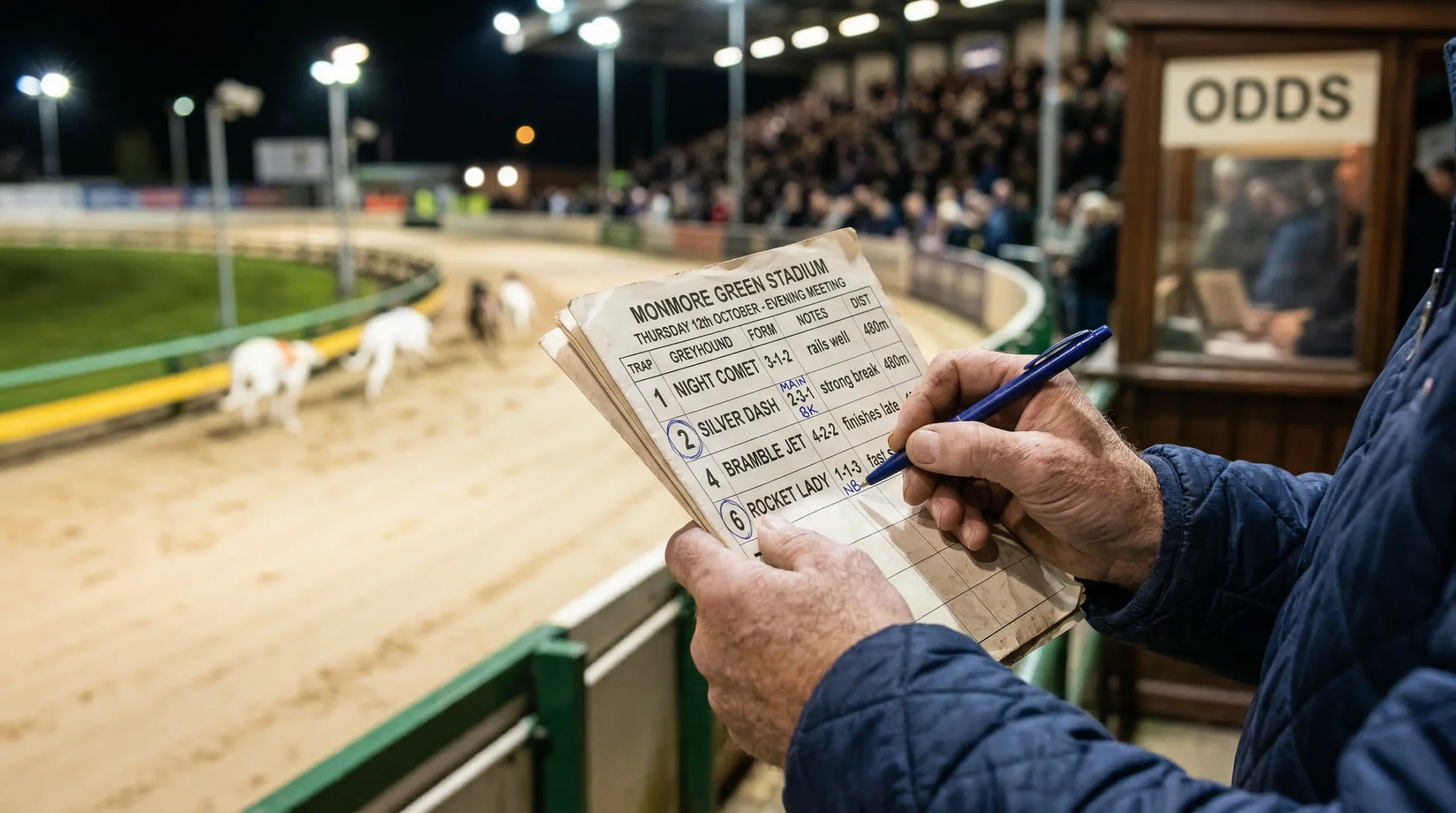
- How Monmore Odds Work: SP, Board Prices and Tote Pools
- Using Form to Build a Selection: A Practical Walkthrough
- Forecast, Tricast and Each-Way: Which Market Fits Your Style
- Staking Strategies: Level, Percentage and Value-Based Approaches
- Where to Bet on Monmore: Bookmaker Options for UK Punters
- The Edge Is Discipline: Managing Your Bankroll at Monmore
Here is an uncomfortable truth about betting on Monmore greyhounds: the favourite wins only 30 to 40 percent of the time. That number, drawn from analysis of UK greyhound racing by LifeUnexpected, means that the shortest-priced dog in most races loses more often than it wins. If your entire approach to betting on Monmore is “find the favourite and back it,” you are signing up for a strategy that fails in the majority of races before you even consider the price. The full picture is in our Monmore Green results guide.
That does not mean betting on greyhounds is a losing proposition by default. It means the process matters more than the pick. How you read the odds, how you assess form, which markets you choose, and how much you stake on each selection — these are the variables that separate punters who stay in the game from those who empty their bankroll in a month.
Betting on Monmore is not about predicting winners with certainty. It is about making decisions under uncertainty and getting the maths right often enough that the profitable bets outweigh the losing ones over time. This guide walks through the entire process: from understanding what the odds actually represent, through building a selection from the form book, to choosing a staking plan that protects your bankroll on the nights when nothing goes right. No guarantees. No secret systems. Just the framework that gives you the best chance of making informed decisions at a track where the margin between success and failure is thinner than most people realise.
How Monmore Odds Work: SP, Board Prices and Tote Pools
If you are going to bet on greyhound racing at Monmore, you need to understand what the numbers on the screen or the board actually mean. There are three main types of price you will encounter, and each one works differently.
Board prices are the odds displayed by on-course bookmakers before and during the race. At Monmore, you will see these at the trackside boards if you attend in person, or listed in bookmaker apps if you are betting remotely. Board prices are live — they move as money comes in. If a lot of punters back a particular dog, its price shortens. If a dog attracts little interest, its price drifts. Board prices are the closest thing greyhound racing has to a real-time market. They reflect the weight of money and, indirectly, the collective opinion of everyone who is betting on the race.
Starting Price, or SP, is the price returned to you if you take SP rather than a fixed price before the off. SP is determined at the moment the traps open, based on the board prices available at that instant. The advantage of taking SP is simplicity: you do not need to watch the market or time your bet. The disadvantage is that you lose control. If a dog’s price shortens dramatically before the race — because a large bet comes in, or because it has looked sharp in the parade — your SP will be shorter than the early price you could have taken. Conversely, if a dog drifts, your SP may be longer. Taking SP is a gamble on the market as well as on the race.
For punters who want to lock in a price, fixed odds are the alternative. Most online bookmakers offer fixed odds on Monmore races, which means you take the price at the moment you place your bet and that price is guaranteed regardless of what happens to the market before the off. If you assess a dog at 5/1 and the price shortens to 3/1 by the time the traps open, you still get paid at 5/1 if it wins. Fixed-odds betting rewards punters who do their homework early and take a view before the market catches up.
Then there is the Tote pool, which operates on an entirely different principle. Rather than betting against a bookmaker at fixed odds, Tote bets go into a shared pool. After the result, the pool is divided among the winning tickets, minus the operator’s deduction. The Tote is available at Monmore on race nights and through the Tote website. The appeal of pool betting is that the returns can sometimes exceed what bookmakers offer, particularly on less fancied runners where the pool is not heavily loaded. The downside is that you do not know your return until after the race — the dividend depends on how much money went into the pool and how it was distributed across the runners.
Understanding these three pricing mechanisms matters because they shape when and how you bet. If you are confident in your selection and the early price looks generous, fixed odds reward decisiveness. If you prefer to let the market settle and are comfortable with the uncertainty, SP is the low-maintenance option. And if you like the idea of outsized returns on longshots without needing a bookmaker to lay the price, the Tote pool is worth exploring. At Monmore, all three options are available for most races, which means the question is not whether you can bet — it is which mechanism best fits the way you want to play.
Using Form to Build a Selection: A Practical Walkthrough
Odds tell you what the market thinks. Form tells you what has actually happened. Building a selection at Monmore starts with the racecard, and the racecard is a compressed record of every runner’s recent history. Knowing how to read it — and what to prioritise — is the foundation of any serious betting approach.
Start with the form figures. These are the sequence of numbers showing each dog’s finishing position in its most recent races, read from left to right with the most recent run on the right. A dog showing 1-1-2-1 has been consistently competitive. A dog showing 5-6-4-6 has been struggling. But the numbers alone are not enough. You need context: what track was each run at, what distance, what grade, and from which trap?
A dog that finished third at Romford over 400 metres from Trap 6 is in a completely different situation to the same dog running at Monmore over 480 metres from Trap 2. Track geometry, distance, and draw all affect performance. When you see form figures, your first question should be: how relevant is this form to tonight’s race? A recent run at Monmore over the same distance is the most informative data point. A run at a different track over a different distance is the least.
Next, look at times. Greyhound racecards display finishing times and, where available, sectional times — the split between the boxes and the first bend, and the time from the first bend to the finish. At Monmore, the first-bend split is measured at 103 metres. A dog with a fast first-bend split is an early-pace runner — the kind that benefits most from an inside draw. A dog with a slower split but a strong finishing time is a closer — the kind that may be less affected by trap position but more dependent on finding clear running in the middle stages of the race.
Trainer form is another layer. Some kennels consistently produce runners that perform above expectation at Monmore. Others send dogs that tend to underperform relative to their form elsewhere. Over time, regular Monmore punters develop a sense of which trainers to trust at the track. The racecard lists the trainer for each runner, and cross-referencing that with recent strike-rate data can highlight dogs that the market might be undervaluing.
Weight changes are often overlooked. Greyhounds are weighed before each race, and the racecard shows the dog’s current weight alongside its recent weight history. A dog that has gained significant weight since its last run may have lost fitness. A dog that has dropped weight sharply could be undertrained or dealing with a health issue. Small fluctuations — a pound or less — are normal and usually insignificant. Larger swings warrant attention, especially if the weight change coincides with a change in form.
Putting it all together for a single Monmore race looks something like this: scan the form figures for each runner, filter for relevance to tonight’s distance and track, check the times to assess each dog’s running style, factor in the trap draw using the bias data that applies to this particular distance, glance at the trainer’s recent record, and note any weight anomalies. The goal is not to predict the winner with certainty — remember, the favourite loses more often than it wins — but to identify dogs whose chance of winning is either higher or lower than the market price implies. That is where betting value lives.
Forecast, Tricast and Each-Way: Which Market Fits Your Style
Win betting — backing a dog to finish first — is the simplest greyhound market and the one most punters start with. But it is far from the only option at Monmore. Forecast, tricast, and each-way markets all offer different risk-reward profiles, and choosing the right one depends on how much certainty you have in your assessment and how much volatility you can tolerate.
A forecast bet requires you to predict the first and second finishers in the correct order. A reverse forecast covers both permutations — your two selections finishing first and second in either order — for double the stake. The appeal of forecast betting is the payout. Because you are predicting two positions rather than one, the returns are substantially higher than a win bet. At Monmore, where six-dog fields are the norm, a correctly called straight forecast can return multiples of your stake that would be impossible to achieve on a win bet alone.
The trade-off is obvious: forecasts are harder to land. Even if you have a strong opinion on the likely winner, nailing the second dog in the correct sequence adds a layer of difficulty. Reverse forecasts mitigate this by covering both orders, but they cost twice as much. The punters who do well with forecasts at Monmore tend to focus on races where they have a strong view on two specific runners and where the field composition makes it likely that those two dogs will fill the first two places regardless of which one finishes in front.
Tricast bets extend the same principle to the first three finishers in exact order. The payouts can be significant — a low-stake tricast on an open race can return hundreds of pounds — but the difficulty of predicting three positions in sequence makes tricasts a high-variance bet. Combination tricasts, which cover all six possible orderings of your three selections, reduce the precision required but multiply the stake by six. Tricasts suit punters who are comfortable with long losing runs in exchange for occasional large paydays.
Each-way betting takes a different approach to the risk problem. When you bet each-way on a greyhound at Monmore, you are placing two bets of equal size: one on the dog to win, and one on the dog to place (typically finishing first or second, though the terms vary by bookmaker). If your dog wins, both bets pay out — the win part at full odds and the place part at a fraction of the odds, usually a quarter or a fifth. If your dog finishes second but does not win, you lose the win part but collect on the place part.
Each-way betting is particularly useful at Monmore for dogs you rate highly but are not confident will win outright. If you have identified a runner with strong form and a favourable draw but the race includes one dog that looks genuinely superior, an each-way bet gives you a return even if your selection finishes second. The reduced place odds mean each-way betting is not as profitable on short-priced favourites — the place return on a 2/1 shot at a quarter the odds is 1/2, which barely covers the extra stake. Each-way value tends to sit in the 4/1 to 10/1 range, where the place fraction still returns a meaningful payout.
The greyhound betting market has seen contraction in recent years. According to Gambling Commission data reported by Racing Post, real-terms betting turnover on greyhound racing fell by 23 percent between 2021 and 2024. That decline has not eliminated the market — greyhound betting remains widely available through bookmaker shops, apps, and on-course facilities at Monmore — but it has reduced the overall liquidity. For forecast and tricast pools in particular, lower turnover can sometimes mean less stable payouts. Punters should be aware that the market they are betting into is smaller than it was a few years ago, which can affect both the prices on offer and the depth of the pools.
Staking Strategies: Level, Percentage and Value-Based Approaches
Picking winners is half the job. The other half — the half that most punters neglect — is deciding how much to stake. A good staking plan does not turn bad selections into profit, but it prevents good selections from being wiped out by inevitable losing runs.
Level staking is the simplest approach. You bet the same amount on every selection regardless of price, form strength, or confidence level. If your unit stake is five pounds, every bet is five pounds. The virtue of level staking is that it removes emotion from the equation. You cannot convince yourself to double up on a “certainty” that then loses, because every bet is the same size. Over a long series of bets, level staking produces a clear, easy-to-track record of profit or loss. The downside is inflexibility — you stake the same on a strong value selection at 6/1 as on a marginal call at 3/1, which means you are not maximising return when your edge is largest.
Percentage staking addresses this by tying your bet size to the current size of your bankroll. Rather than betting a fixed amount, you bet a fixed percentage — say, 2 percent. If your bankroll is 500 pounds, your first bet is 10 pounds. If you win and the bankroll grows to 520, your next bet is 10.40. If you lose and the bankroll drops to 490, your next bet is 9.80. Percentage staking automatically adjusts your exposure: when you are winning, you bet more; when you are losing, you bet less. This self-correcting mechanism makes it almost impossible to go broke from a single losing streak, because each subsequent bet is smaller than the last as the bankroll shrinks.
Value-based staking takes a more aggressive approach. Instead of betting a flat amount or a flat percentage, you vary your stake according to the perceived edge on each bet. If you believe a dog has a 25 percent chance of winning but the odds imply only a 15 percent chance, the gap between your assessment and the market’s assessment is your edge. Value-based stakers bet more when the edge is large and less when it is small. The Kelly Criterion is the most well-known formula for this: it calculates the optimal stake as a function of the edge and the odds. In practice, most punters who use value-based staking apply a fraction of Kelly — half or quarter Kelly — to reduce the volatility that full Kelly produces.
The financial backdrop to greyhound racing adds weight to the importance of staking discipline. Joe Scanlon, Chairman of the BGRF, offered a frank assessment of the industry’s financial trajectory: “This is a very long way from our historic highs, in real terms, of ten to fourteen million or, as in one exceptional year, over twenty million. Whilst we learn to make every pound work twice as hard we shall nevertheless reach a point where income is simply not enough to match our ambitions.” — Joe Scanlon, Chairman, BGRF. The same logic applies to individual bettors. Your bankroll is finite. Making every pound work requires a plan.
For most punters starting out at Monmore, level staking or conservative percentage staking (1 to 2 percent of bankroll) is the sensible choice. These approaches are easy to implement, easy to track, and they prevent the catastrophic losses that come from chasing or staking emotionally. As your record builds and your confidence in your ability to assess value grows, you can consider moving toward a value-weighted approach. But the foundation is always the same: know how much you can afford to lose, set a unit size that lets you absorb a losing run without going bust, and stick to it.
Where to Bet on Monmore: Bookmaker Options for UK Punters
Monmore Green is part of the Premier Greyhound Racing network — a joint venture between Entain and ARC that holds media rights across nine UK greyhound tracks. That corporate structure has practical consequences for how and where you can bet on the racing.
Entain-owned brands — including Ladbrokes and Coral — have the most comprehensive Monmore coverage. Because Entain is half of the PGR venture, its retail and online platforms carry live pictures, full racecards, and competitive pricing on Monmore meetings as standard. If you bet with Ladbrokes or Coral, you will find Monmore racing available for virtually every fixture, with live streaming included for funded accounts. The initial PGR investment exceeded 2.5 million pounds in open racing prize money alone, and the media-rights deal ensures that PGR-affiliated bookmakers have first-tier access to the product.
Independent bookmakers and other major chains also cover Monmore, though the depth of coverage varies. William Hill, Betfred, and bet365 all offer greyhound markets, and Monmore fixtures are generally available on their platforms. However, live streaming may be limited or require additional conditions such as a minimum account balance or a qualifying bet. For punters who value watching the race live before, during, or after their bet, checking the streaming terms with your bookmaker is worth doing before committing.
On-course betting at Monmore itself is available on race nights. Trackside bookmakers offer board prices, and there is typically a Tote facility for pool betting. Betting on-course gives you the advantage of watching the dogs in the parade, assessing their condition and demeanour before the race, and taking a price in the final moments before the off. The atmosphere at Monmore on a Saturday night is part of the appeal for many punters — the combination of live racing and live betting in a single venue is something that online platforms cannot fully replicate.
For punters who prefer exchanges over bookmakers, greyhound racing does feature on Betfair and similar platforms, though liquidity is generally lower than for horse racing. Monmore races attract exchange betting activity, particularly on evening meetings and feature events, but afternoon BAGS fixtures may see thinner markets. If you are an exchange bettor, checking the available liquidity before the race is essential to ensure you can get matched at a reasonable price.
The bookmaker you choose affects your experience in subtle ways: the odds you are offered, the streaming quality, the availability of early prices versus SP-only markets, and the range of exotic bets like forecast and tricast. There is no single correct choice. The right bookmaker for you depends on whether you prioritise price, convenience, live coverage, or market depth. What matters most is that you understand the relationship between the PGR media model and bookmaker coverage — it is the reason some operators offer better Monmore coverage than others, and it is worth factoring into where you place your bets.
The Edge Is Discipline: Managing Your Bankroll at Monmore
Every section of this guide has been about process: how to read odds, how to assess form, how to pick a market, how to size your stakes. The final step is the one that holds everything together — and it is the one that most punters skip. Discipline is not a personality trait. It is a practice. And at Monmore, where a full Saturday evening card can put twelve betting opportunities in front of you in under three hours, the discipline to say “no” to a bad bet is worth more than any form analysis.
Start with a bankroll. This is the total amount of money you have set aside specifically for betting on greyhounds. It is not rent money, not savings, not money you need for anything else. It is the fund from which all bets are drawn and to which all winnings return. The size of the bankroll determines your unit stake, and your unit stake determines how many losing bets you can absorb before you are out. A bankroll of 200 pounds with a 2 percent staking plan means a four-pound unit. That gives you 50 units of runway — enough to survive a bad run and still be in the game when your form assessment starts connecting.
The most destructive habit in greyhound betting is chasing losses. You lose three races in a row, the frustration builds, and you double your stake on the fourth race to “get it back.” This is the fastest way to destroy a bankroll because it compounds the damage of a losing streak. If your staking plan says four pounds, the fourth bet should be four pounds regardless of what happened in the first three. The numbers either work over the long run or they do not. No single bet should be large enough to determine the fate of your entire bankroll.
Remember that favourites at Monmore win only 30 to 40 percent of the time. That means even the best-fancied dogs lose more often than they win. If you accept that reality before you start, losing runs become expected rather than frustrating. A well-managed bankroll with disciplined staking can sustain a 60 percent loss rate and still produce profit over hundreds of bets, provided the average return on winning bets exceeds the cost of the losing ones. That is the arithmetic of value betting. It does not work on every night. It works over time. The markets themselves are explained in how odds work.
Set limits before you arrive at Monmore or open your betting app. Decide in advance how many races you will bet on, how much you will stake per race, and at what point you will stop — either for the night or entirely. These are not rules imposed on you by anyone else. They are rules you set for yourself, because you understand that betting on Monmore should be engaging, analytical, and occasionally profitable, but never reckless. The punters who last in this game are not the ones with the best systems. They are the ones with the steadiest hands.
