
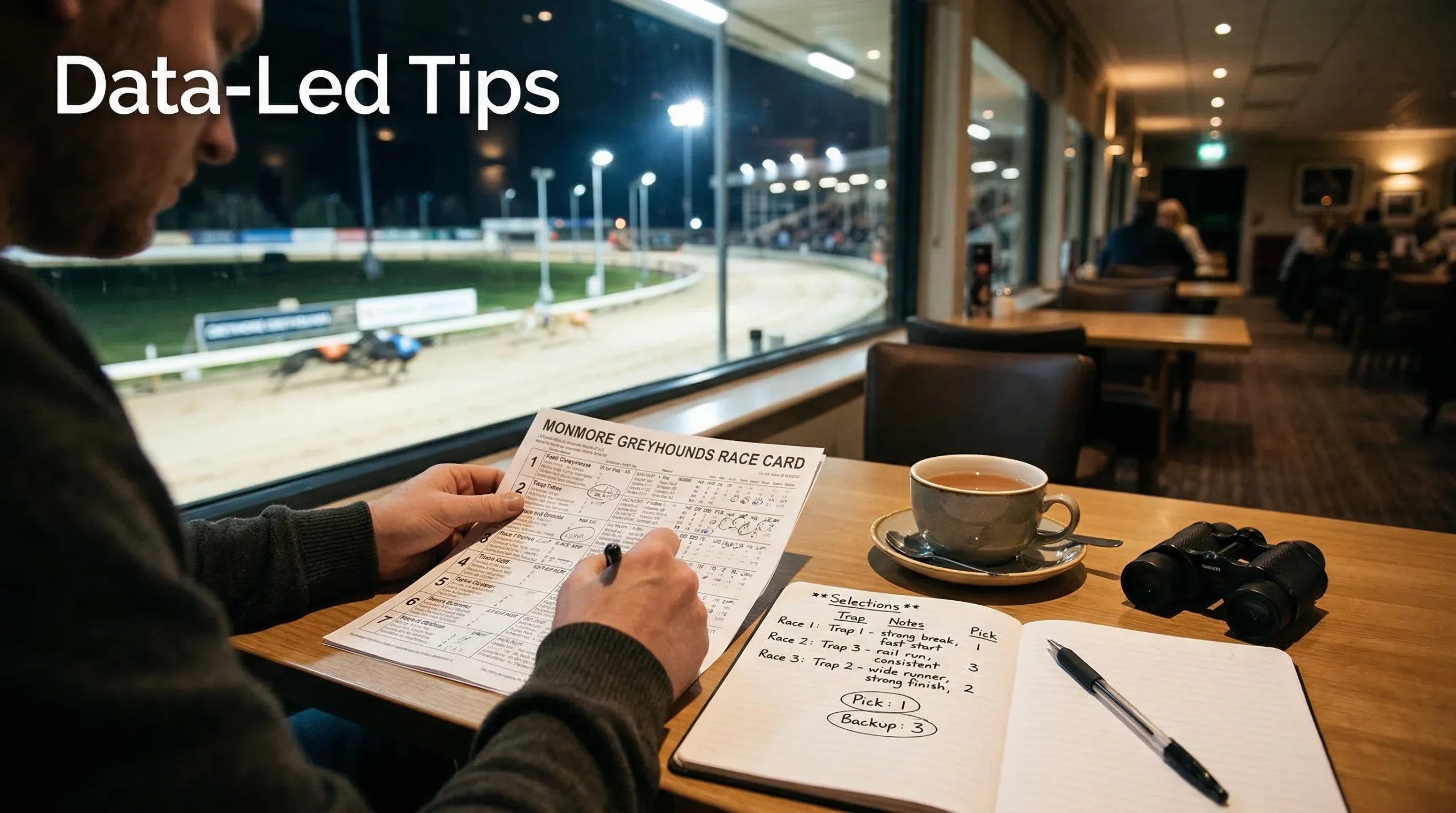
The internet is full of greyhound tips. Free selections, paid subscriptions, social media accounts promising nightly winners — the supply is endless and the quality is, to put it diplomatically, uneven. Most tipping services rely on one of two approaches: either they follow the market and recommend favourites dressed up with confident language, or they throw darts at the card and hope that the occasional big-priced winner disguises a poor overall record. Neither method holds up to scrutiny. The wider context is set out in our Monmore Green results guide.
A data-led approach to Monmore selections is different. It does not promise winners. It builds a process — a repeatable method for assessing each race, identifying the most likely outcomes, and then checking whether the odds on offer represent value. The distinction matters because favourites win only 30 to 40 percent of UK greyhound races, which means the majority of races are won by dogs that the market did not rank first. Capturing some of that 60 to 70 percent is where the profit lies, and the only way to do it consistently is through a disciplined, information-based process.
This guide outlines a four-step method for Monmore selections, explains why price matters more than predictions, and flags the most common mistakes that lead bettors astray.
A Four-Step Process for Monmore Selections
Step one is the trap draw. Before you look at form, before you check the trainer, the first piece of data worth examining is which trap each dog has drawn. At Monmore, the inside traps hold a measurable advantage across most distances, particularly at the standard 480m where the run to the first bend is only 103 metres. This does not mean you should automatically back inside draws — it means you should note which dogs benefit from the draw and which face a structural headwind. The trap draw sets the context for everything that follows.
Step two is recent form. Read the last four to six runs for each dog in the race, paying attention to finishing positions, race times, trap drawn, distance, grade, and race comments. The aim is not to find the fastest dog on paper but to understand the trajectory of each runner. A dog that has posted three improving runs is in different shape to one that has declined over its last three outings, even if their best times are similar. Look for patterns rather than isolated results: consistent finishing in the first three from favourable draws is a stronger signal than one win surrounded by poor runs.
Step three is trainer and distance suitability. Check whether the trainer has a positive record at Monmore — not just overall, but at the specific distance. A trainer who excels at 480m may have a poor record at 264m because their dogs are not sprint types. Similarly, check whether the dog has raced at the distance before. A greyhound with five 480m runs being entered at 630m for the first time is a risk, regardless of how good its 480m form looks. If the trainer is making a deliberate distance switch, it might be based on inside knowledge about the dog’s stamina — or it might be an experiment that does not work out.
Step four is putting it all together into an assessment and comparing that assessment to the odds. This is where the process becomes genuinely useful. If your analysis says a dog has a strong chance — inside draw, improving form, distance-proven, from a reliable kennel — but the market prices it at 7/2 or 4/1, there may be value. If the same dog is 4/6 favourite, the market already agrees with you, and backing it at that price leaves no margin for the times it loses. The four-step process gives you a framework for identifying the most likely contenders, but the betting decision is always about whether the price compensates for the risk.
One point worth emphasising: this process does not have to take long. With practice, scanning a six-dog racecard takes three to four minutes per race. Across a twelve-race card, that is forty to fifty minutes of preparation — easily manageable if you study the card an hour before the first race. The work is front-loaded, and once you have assessed every race, you can watch the evening unfold with a clear plan rather than scrambling to make decisions as each race approaches.
Value Over Prediction: Why Price Matters More Than Picks
The concept of value is the single most important idea in betting, and it is the one that separates long-term winners from long-term losers. Value exists when the odds on a selection are higher than the true probability of that selection winning. If a dog has a 30 percent chance of winning and the bookmaker is offering 4/1 — which implies a 20 percent chance — the bet has value. If the same dog is offered at 2/1 — implying a 33 percent chance — it does not, because the price already reflects the dog’s true probability.
Identifying value requires an honest assessment of each runner’s chances, which is exactly what the four-step process described above produces. The challenge is that your assessment is subjective and the market is efficient. Bookmakers have access to the same data you do, and their prices reflect the collective wisdom of every bettor in the market. Most of the time, the odds are roughly right. The opportunities lie in the gaps — the races where your assessment highlights a factor that the market has not fully priced in.
Those gaps are more likely to appear in certain types of races. Lower-grade events, where form data is sparser and public attention is lower, tend to offer more value than top-grade races where the market is closely watched. Afternoon BAGS meetings, with smaller betting volumes, can produce inefficiencies that evening cards do not. Races at non-standard distances — 264m sprints, 630m middle-distance events — attract less betting interest than the 480m, and the odds can be looser as a result.
The broader context matters too. As Mark Moisley, GBGB’s Commercial Director, has noted, revenue from bookmakers is declining year on year and has been for some time. That shrinking market has implications for bettors: with less money flowing through the pools, the odds can become more volatile, and pockets of value appear more frequently in less liquid markets. The overall 23 percent decline in greyhound betting turnover over three years has thinned the market, but for data-led bettors who know where to look, a thinner market can actually create more opportunity rather than less.
One practical tip: record your bets. Keep a simple spreadsheet with the date, race, selection, odds, stake, and result. After fifty bets, review the data. Are you finding value, or are your winners coming at prices that do not compensate for the losers? The numbers will tell you more about your process than any amount of intuition, and they will highlight whether your approach to data-led tips for Monmore is working or needs adjustment.
Common Tipster Mistakes and How to Avoid Them
The most common mistake in greyhound tipping — whether you are following someone else’s tips or generating your own — is chasing losses. A bad run of results is inevitable in any form of betting. Six losers in a row at Monmore does not mean your process is broken; it means variance is operating as expected. The worst thing you can do is respond by increasing stakes, abandoning your method, or switching to a “guaranteed” tipping service that promises to fix everything. Discipline through losing runs is where most bettors fail, and it is where the patient ones pull ahead.
The second mistake is overvaluing last time out. A dog’s most recent run is the freshest data point, but it is also a single observation. If a greyhound finished sixth last time but won its three previous races, the sixth-place finish is the anomaly, not the pattern. Novice tipsters fixate on the last run and miss the wider trend, which often produces the best value because the market also tends to overreact to recent results.
Ignoring the draw is another frequent error. Some tipsters select dogs purely on time and form without considering the trap. A dog with brilliant form and a wide draw is a riskier proposition than a slightly weaker dog with an inside draw, and failing to account for that structural factor leads to selections that look good on paper but underperform on the track. The draw is the first factor: trap statistics.
Finally, avoid tipping services that present their selections without reasoning. A tip is only useful if you understand why it was made, because understanding the reasoning allows you to evaluate whether the logic holds for tonight’s specific conditions. A service that says “back Trap 3 in race four” without explaining the form, the draw, or the price is asking you to trust a stranger’s judgement without evidence. Data-led tips for Monmore should always come with their workings attached — and if they do not, the tips are not worth following.
