
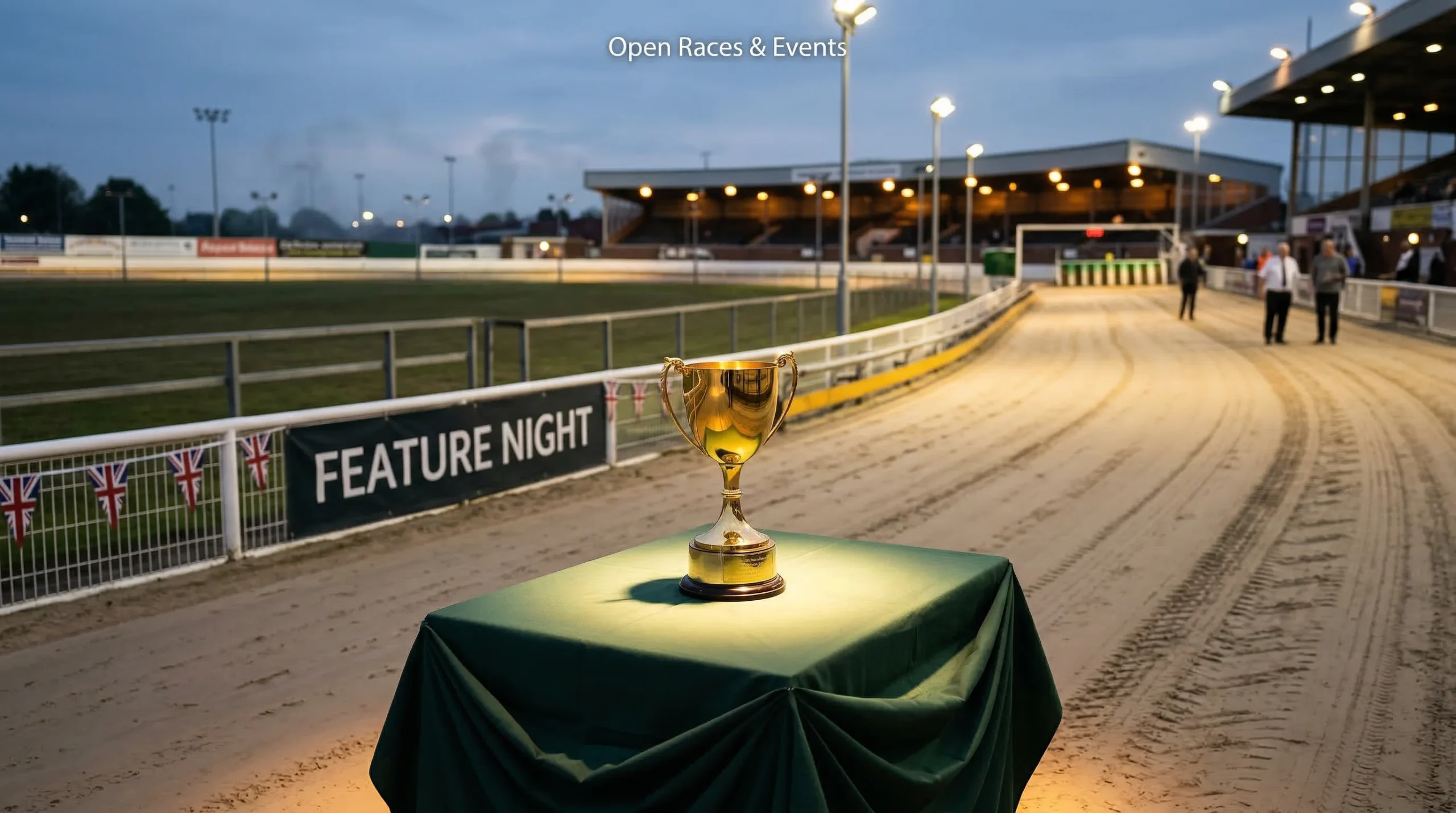
Most racing at Monmore Green follows the grading structure — A1 through A10, dogs matched by ability, results feeding back into the promotion and demotion cycle. Open races break that structure entirely. They sit outside the grading ladder, accept entries from any runner regardless of grade, and typically offer the biggest prize money on the card. When Monmore stages a feature event, the racing takes on a different quality — sharper fields, higher stakes, and an atmosphere that lifts the venue beyond its usual Thursday-and-Saturday rhythm. The wider context is set out in our Monmore Green results guide.
The national benchmark for greyhound prize money is the English Greyhound Derby, which offers £175,000 to the winner. Monmore’s own feature events do not reach those heights, but they represent the pinnacle of racing at the track, attracting stronger entries, larger crowds, and a betting market that is noticeably more competitive than on a routine meeting. This guide covers what those events are, how open racing differs from graded competition, and what to expect if you attend a feature night.
Gold Cup, Puppy Derby and Trafalgar Cup: What Each Race Means
Monmore’s calendar is punctuated by several feature events that carry the track’s most prestigious titles. The Gold Cup is the headline event — a competition run over the standard 480m distance that draws the best dogs available to the track and offers prize money that dwarfs a regular graded race. The Gold Cup at Monmore is typically run as a series of heats followed by a final, spread across two or three meetings, which gives the event a tournament feel that single-race cards cannot replicate.
The Puppy Derby targets younger greyhounds, usually dogs in their first or second season of racing. This event identifies emerging talent and often provides the first significant competitive test for dogs that trainers believe have the potential to graduate to higher levels of the sport. The Puppy Derby format mirrors the Gold Cup’s heat-and-final structure, and the early rounds can produce upsets as inexperienced dogs encounter the pressure of feature-night racing for the first time.
The Trafalgar Cup and other named events fill out the calendar, offering variety in terms of distance, entry criteria, and prize money. Some feature races are open to all comers; others restrict entries by age, grade, or distance speciality. Each event has its own character, and the most dedicated Monmore followers track the calendar to identify which feature nights offer the strongest racing and the best betting opportunities.
The total prize money distributed across UK greyhound racing reached £15,737,122 in recent years, and feature events at individual tracks like Monmore account for a meaningful share of that figure. The financial incentive drives trainers to prepare their best dogs specifically for these competitions, which means the quality of entries is consistently higher than on a standard card. As Lord Lipsey, chairman of Premier Greyhound Racing, has noted, the venture sees greyhound racing as having huge potential both as a sport and a betting market, offering stakeholders a sustainable and commercially valuable product in the long term. Feature events are the shop window for that ambition — the nights when the product is at its strongest and the argument for the sport’s future is most convincing.
For bettors, feature races demand a different analytical approach. The fields are stronger and more evenly matched than in regular graded racing, which means margins are thinner and upsets more frequent. Form from graded races provides a baseline, but the step up in quality means that a dog dominating A3 company may find itself outpaced in an open event against dogs that race at A1 and A2 level at other tracks. Treating feature races with the same assumptions as a Tuesday afternoon A7 is a reliable way to lose money.
Open Racing vs Graded: Why Feature Nights Are Different
The structural difference between open and graded racing is simple: graded races are restricted by ability band, open races are not. But the practical implications run deeper than the entry criteria suggest.
In graded racing, the field is designed to be competitive within a narrow range. An A4 race at Monmore should feature six dogs of roughly similar ability, which is why the grading system exists. Open races abandon that principle. A field might include a dog that has been winning A2 races at Monmore alongside one that has been campaigning at A1 level at another track, plus a young improver that has never faced this quality of opposition. The result is a more unpredictable contest where raw class differences can produce wider winning margins — or, when the class dogs cancel each other out, shock results.
Open races also carry no grading consequences. A dog that wins a graded race is typically promoted one grade; a dog that wins an open event is not. This has tactical implications for trainers. Some enter their dogs in open events between graded races to maintain race fitness without risking an unwanted promotion. Others use open events as a genuine competitive test, targeting the bigger prize money and the prestige of a feature-night victory.
The betting market at open events is typically more efficient than at graded meetings because the higher profile attracts more money and more attention. Odds tend to be tighter, and the prices are less likely to contain the obvious mis-pricings that can appear on a quiet afternoon BAGS card. For bettors, this means that finding value at feature events requires sharper analysis and a willingness to be patient — the edge, when it exists, is narrower.
What to Expect on a Feature Night at Monmore
Feature nights at Monmore draw larger crowds than regular meetings, and the atmosphere reflects the occasion. The restaurant is typically fully booked, the trackside areas are busier, and the general energy level in the stadium rises noticeably. If you are planning to attend a feature event, booking a restaurant table well in advance is advisable — waiting until the week of the event is usually too late for a Saturday Gold Cup final.
Admission remains at the standard £7 for adults, which represents excellent value for a night that offers the best racing the track produces all year. The card will often include additional races around the feature event, plus presentations and on-track activity that extend the evening beyond the usual schedule. Arriving early gives you time to study the racecard, assess the parade ring, and soak in the pre-race atmosphere before the first heat or final gets under way.
From a betting perspective, feature nights are where the market is at its most efficient. The increased attention means more money flows through the pools, more punters are studying the form, and the odds more accurately reflect each dog’s true chance. Finding value on the feature race itself can be harder than on a routine Tuesday afternoon card. However, the undercard races on a feature night — the lower-graded events that fill the gaps between heats — can sometimes offer better opportunities, precisely because the crowd’s attention is focused on the main event rather than on race three or race seven. Graded racing is explained in the grading system.
For anyone new to Monmore, a feature night is an ideal introduction. The racing is at its most exciting, the crowd adds an element that quieter meetings lack, and the event format — with heats building toward a final — creates a narrative arc across the evening that makes each race feel connected to the next. Whether you are there for the betting or just for the spectacle, Monmore’s biggest races deliver the best version of what the stadium has to offer.
