
- Win Rates by Trap at Monmore: The Complete Breakdown
- How Distance Changes the Trap Equation: 264m to 835m
- Why Trap 1 Has an Edge: Rail Advantage and Bend Geometry
- Night-to-Night Variance: Why One Meeting Doesn't Make a Pattern
- Turning Trap Stats Into Betting Decisions
- What Monmore's Traps Tell You That Form Alone Cannot
Every greyhound race at Monmore Green begins the same way: six dogs load into six traps, the hare flies past, the lids snap open. What happens next is not random. Across UK tracks, Trap 1 — the red jacket, hugging the inside rail — wins roughly 18 to 19 percent of all races, according to analysis from TheGameHunter. That might not sound dramatic until you compare it to the theoretical baseline. Six traps, equal chances — you would expect each one to produce winners at 16.66 percent. The gap between 16.66 and 19 is where money changes hands. The full picture is in our Monmore Green results guide.
Monmore is a 419-metre oval in Wolverhampton with a first bend at 103 metres, and that geometry matters more than most punters realise. The distance from box to bend, the tightness of the turns, the sand composition under the dogs’ feet — all of it bends the probability curve in ways that raw form figures do not capture. Trap data at Monmore is not a substitute for reading form. It is the context that form needs to make sense.
This article breaks down win rates by trap across every Monmore distance, explains why the inside draw carries an advantage that physics makes almost inevitable, and shows you how to weigh that advantage against the noise of single-meeting results. If you have ever wondered whether trap position is worth factoring into your selections, the short answer is yes. The longer answer is what follows.
Win Rates by Trap at Monmore: The Complete Breakdown
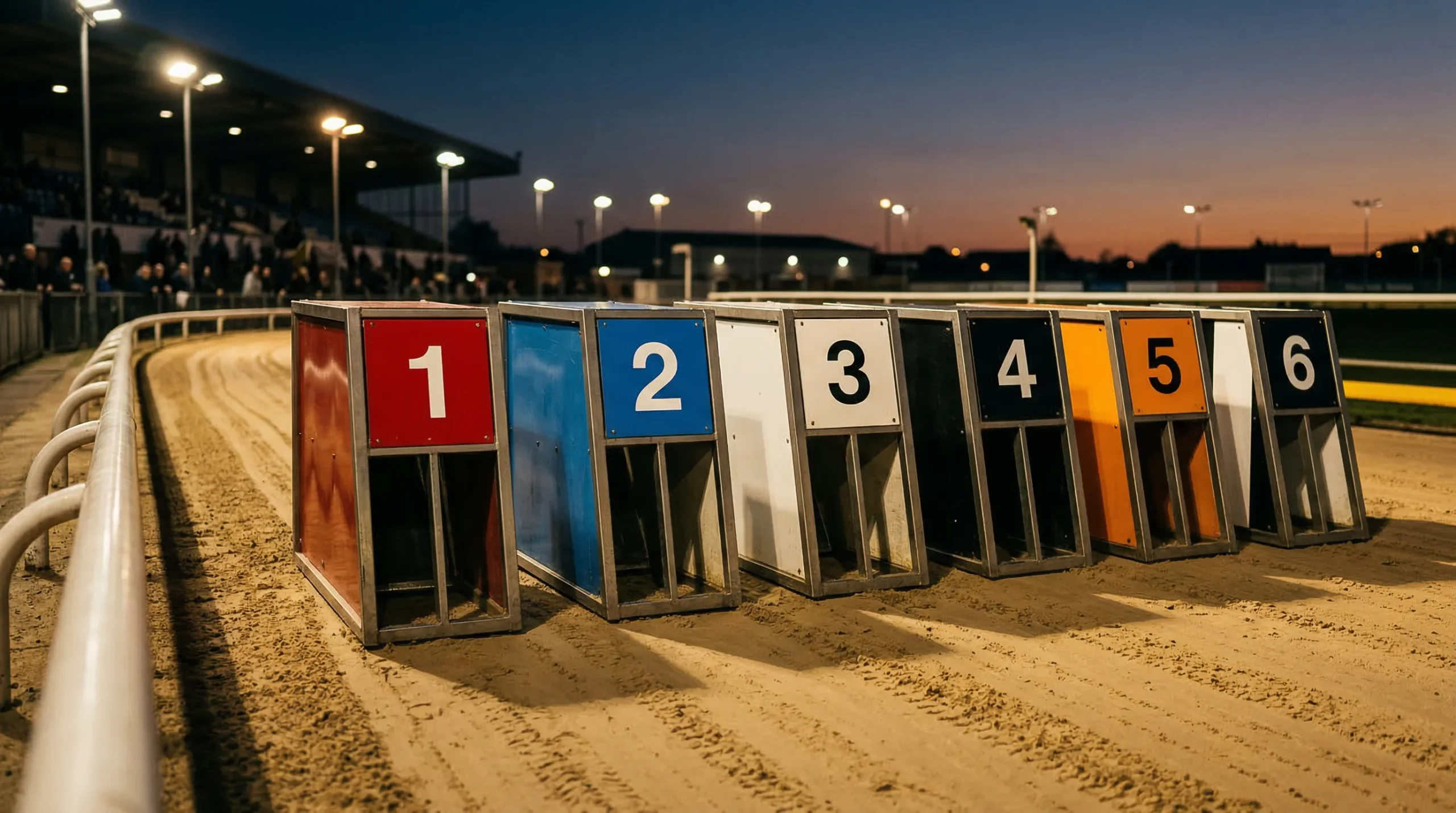
Before diving into the numbers, a quick primer on what we are actually measuring. Win rate by trap is the percentage of races won from each starting position over a defined sample — typically hundreds or thousands of races. At Monmore, the six traps wear the standard UK colours: red for Trap 1, blue for 2, white for 3, black for 4, orange for 5, and striped black-and-white for Trap 6. The colour is cosmetic. The position is not.
Across the full UK greyhound circuit, the long-run averages paint a consistent picture. Trap 1 sits at the top of the distribution, winning around 18 to 19 percent of races. Traps 2 and 3 cluster near the expected 16 to 17 percent mark. Trap 4 tends to sit fractionally below expectation. Traps 5 and 6, the widest draws, typically return the lowest win rates, often hovering between 13 and 15 percent depending on track geometry and distance. These numbers shift from venue to venue — a wide, sweeping oval with gentle bends will compress the gap between inside and outside; a tight circuit with sharp turns will amplify it.
Monmore falls into the latter category. With a circumference of 419 metres and relatively tight bends, the track rewards dogs that reach the first turn with clear running on the rail. The first bend arrives at 103 metres from the boxes, which is generous enough for early pace to develop but tight enough that dogs drawn wide need to either show devastating speed or accept that they are running extra ground through the turn.
One particularly striking data point comes from BannedSystems, which documented a Monmore meeting where Trap 1 won 7 out of 12 races — a 58 percent strike rate on a single card. That figure is nearly three-and-a-half times the expected rate. It would be a mistake to treat one meeting as a trend, and we will return to the question of variance later, but it illustrates just how pronounced inside-rail dominance can become on a given night at this track.
The broader dataset tells a more nuanced story. Over a meaningful sample of Monmore meetings, Trap 1 outperforms the field but not by the margins that one-night wonders suggest. The advantage is structural, not magical. Dogs drawn in Trap 1 save ground on every bend. At 480 metres — the standard four-bend trip that makes up the majority of Monmore’s card — saving half a length per bend adds up to two lengths across the race. In a sport where margins of victory are measured in decimals of a second, two lengths is an enormous head start.
Traps 2 and 3 benefit from similar mechanics, though to a lesser degree. A Trap 2 dog with good early pace can tuck in behind or alongside the railer and still negotiate the first turn efficiently. Trap 3 represents a middle ground — neither the rail advantage of the inside nor the open-bend challenges of the outside. In terms of pure win rate, Trap 3 at Monmore tends to sit close to the expected 16.66 percent, making it something of a neutral draw.
The outer traps face a different calculus. Trap 5 and Trap 6 runners need to either lead into the bend from raw speed — burning energy in the process — or drop back and try to find room on the outside line, which means covering extra distance. At a track like Monmore where the bends are reasonably tight, the penalty for running wide is real and measurable. It shows up in sectional splits, in overall finishing times, and ultimately in win percentages that sit consistently below the baseline across large samples.
None of this means that wide-drawn dogs cannot win. They do, regularly. A Trap 6 runner with the fastest early pace in the race will still reach the first bend in front and dictate the running. But when you are comparing two dogs of similar ability, the trap draw becomes a tiebreaker — and at Monmore, it breaks in favour of the inside more often than not.
How Distance Changes the Trap Equation: 264m to 835m
Monmore offers five race distances: 264, 480, 630, 684, and 835 metres. Each one changes the relationship between trap position and race outcome because each one changes how many bends the dogs negotiate, how long they spend running in a straight line, and how much the initial break from the boxes matters relative to stamina and late pace.
At 264 metres, the shortest trip on the card, the race is over in roughly 15 to 16 seconds. There are only two bends. The run from boxes to first turn covers 103 metres — which is a huge proportion of the total race distance. In sprint races, the break from the traps is almost everything. A dog that exits cleanly from Trap 1 or 2 and hits the first bend with clear air on the inside rail has an enormous advantage because there are so few bends left to make up ground. The inside bias at 264m is typically the most extreme of any Monmore distance. Trap 1 and Trap 2 regularly outperform the expected rate by the widest margins in sprints, while Trap 5 and 6 suffer the most because there simply is not enough race distance for a wide-running dog to recover lost ground.
At 480 metres, the picture becomes slightly more complex. This is the standard distance — the bread and butter of Monmore’s racecard. Four bends. The dogs cover the full circuit plus an additional straight section. The inside advantage remains significant because four bends means four opportunities for the rail-runner to save ground, but the longer trip also allows for tactical variation. A fast Trap 5 or 6 dog that leads the field into the first bend can dictate the pace and use the back straight to consolidate. Middle traps — 3 and 4 — tend to produce their best relative results at this distance because the race is long enough for dogs with good mid-race pace to overcome a neutral starting position.
The 630-metre and 684-metre trips move into middle-distance territory. Six bends and more. Here, early pace still matters but stamina enters the equation more forcefully. A dog drawn in Trap 1 at 630 or 684 metres has the rail advantage on every bend, and with six or more turns to negotiate, the cumulative ground saved becomes substantial. However, middle-distance races also see more positional changes through the race. Dogs that settle behind the early pace and kick on around the final bends can win from any trap. The inside bias persists at these distances, but the gap between Trap 1 and Trap 6 win rates narrows compared to the sprint. The extra distance gives wider-drawn dogs more time and space to find racing room.
At 835 metres — the marathon distance — the dynamics shift further still. This is the longest race Monmore stages, and it involves eight bends. At this distance, the initial trap draw is arguably less decisive than at any other trip. The sheer length of the race means that early speed matters less than sustained pace and the ability to negotiate bends without losing momentum. Trap 1 still holds a theoretical advantage — eight bends means eight chances to save ground on the inside — but the dogs racing at 835m are stayers by nature. They run at a more measured gallop than sprinters, and the field tends to string out through the middle stages, which creates more racing room for dogs drawn wide.
The practical takeaway for anyone studying trap data at Monmore is straightforward: the shorter the race, the more the trap draw matters. At 264m, trap position is close to the single most important variable in the race. At 835m, it is one factor among many. At 480m, the standard distance that dominates most Monmore cards, trap position sits somewhere in between — significant enough to factor into your analysis, but not so dominant that it overrides everything else in the form book.
Understanding this distance-by-distance variation is what separates punters who use trap data superficially from those who use it as a genuine analytical tool. Blanket statements like “always back Trap 1 at Monmore” ignore the fact that the track effectively hosts five different races with five different bias profiles on any given night. But across all five distances, one factor remains constant: the inside rail is the shortest path around the bends. The question is how much that shortest path is worth.
Why Trap 1 Has an Edge: Rail Advantage and Bend Geometry
The answer lies in physics and track design — forces that show up in every form of oval racing, from athletics to horse racing to greyhounds. At Monmore, the bias toward Trap 1 emerges from three overlapping factors: rail proximity, bend geometry, and canine biomechanics.
Start with the rail. The inside rail at Monmore runs along the entire inner circumference of the 419-metre track. A dog running tight to the rail travels the shortest possible distance around every bend. The further out a dog runs, the wider its arc and the greater the total distance covered. On a single bend, the difference might amount to half a length. On four bends at 480 metres, it compounds to something in the range of one to two lengths. On eight bends at 835 metres, the cumulative disadvantage of running wide becomes even larger in absolute terms, though at that distance other variables dilute its relative impact.
Bend geometry at Monmore amplifies the effect. The track is not a perfect circle — it consists of two straights connected by two semicircular turns. The tightness of those turns determines how sharply a dog must change direction. Tighter bends favour the inside-drawn dog more aggressively because the difference in arc length between the innermost and outermost running lines increases as the radius shrinks. Monmore’s bends are moderate by UK standards, neither the sharp hairpins of a compact track like Romford nor the sweeping curves of a larger circuit. But they are tight enough that the inside-outside differential is meaningful, particularly for dogs that carry their speed into the turns rather than decelerating.
Then there is the biomechanical angle. Greyhounds are built for straight-line speed. When they enter a bend, they lean into the turn — the tighter the bend, the more they lean. Dogs running on the inside rail lean less severely because their arc is gentler, which means they can maintain more of their straight-line speed through the turn. Dogs running wide lean harder, decelerate more, and burn more energy fighting centripetal force. Over a single bend, this effect is subtle. Over the course of a four-bend race, it becomes a measurable fitness drain.
The documented Monmore example — Trap 1 winning 7 of 12 races at 58 percent on a single card — is an extreme illustration of what happens when these factors align with the right draw of runners. On that particular meeting, the dogs drawn in Trap 1 presumably had favourable early pace profiles and faced fields where no wide-drawn runner possessed the sheer speed to overcome the geometric penalty. It would not happen every night. But it happened that night because the structural advantage was real, and the field composition did nothing to counteract it.
Some punters dismiss track bias as something that only matters in theory. The numbers disagree. Across thousands of UK greyhound races, the inside-draw advantage is one of the most persistent and statistically robust patterns in the sport. It does not guarantee winners, and it does not eliminate the need for form analysis. What it does is tilt the odds. And in a betting market where margins are thin, a tilt is worth knowing about.
Night-to-Night Variance: Why One Meeting Doesn’t Make a Pattern
The 58 percent figure is vivid. It sticks in the mind. And that is precisely why it needs to be handled with care. A single 12-race meeting at Monmore is a tiny sample — too small to draw reliable conclusions about long-term trap performance. If you flipped a fair coin twelve times, you would not be shocked to see eight heads. The same logic applies to trap results across one card.
Variance in greyhound racing is high by design. Each race involves only six runners, which means that any single result is heavily influenced by one or two individual performances. A slow break from a class dog in Trap 3. A bump at the first bend between Traps 4 and 5. A dog in Trap 1 that happens to have exceptional early pace that night. These are all random-within-reason events that can swing a meeting’s trap totals dramatically without reflecting any change in the underlying track bias.
The responsible way to use trap data at Monmore is to look at large samples: hundreds of races, ideally spanning different seasons and track conditions. Over a sample of 500 or more races at a given distance, the noise subsides and the structural patterns emerge. Trap 1’s advantage at 480 metres becomes clearly visible. The penalty for wide draws at 264m sharpens into focus. And the relative neutrality of the trap draw at 835m becomes apparent. These are the patterns that deserve to influence your betting — not the results from last Thursday.
Track conditions add another layer of variance. Monmore races on a sand surface that responds to weather. Rain makes the track heavier, which can slow times and reduce the early-pace advantage that benefits inside-drawn dogs. Dry, fast conditions tend to amplify the rail advantage because early speed holds its value longer through the bends. Temperature matters too — cold nights can produce different running conditions than warm ones. A single meeting’s trap results are shaped as much by the weather that afternoon as by the track’s structural geometry.
The temptation to chase patterns in short-term data is strong. If Trap 6 wins three of the first four races on a Saturday night, you will hear someone at the bar declaring that the outside is running well tonight. Maybe it is. Or maybe three dogs drawn in Trap 6 happened to be the best dogs in their respective races. Without a meaningful sample, you cannot distinguish signal from noise. The best approach is to carry the long-term trap data as a background input — a standing adjustment to your probability estimates — and let form, pace, and class do the heavy lifting race by race.
Turning Trap Stats Into Betting Decisions
Knowing that Trap 1 wins more often than Trap 6 at Monmore is useful. Knowing what to do with that information is where the work begins. Trap data is not a betting system. It is one input in a process that also involves form analysis, pace assessment, and — critically — price evaluation.
The starting point is straightforward: when two dogs of roughly equal ability are drawn in different traps, the one drawn inside has a structural advantage. That advantage is worth incorporating into your assessment, particularly at shorter distances where the trap draw carries more weight. If you are looking at a 264m sprint where the Trap 1 dog has solid early pace and the Trap 5 dog has similar speed but needs to negotiate the first bend from a wide position, the inside draw is a genuine edge. It does not make the Trap 1 dog certain to win. But it shifts the probability, and in betting, probability is what you are trading.
The more interesting application comes when trap data conflicts with the market. Greyhound betting markets are not always efficient. Favourites in UK greyhound racing win only 30 to 40 percent of the time, according to data compiled by LifeUnexpected. That means the majority of races are won by non-favourites — and within that majority, some of those winners are dogs whose trap advantage was underpriced by the market. If a Trap 1 runner at 480 metres is showing a longer price than its form and draw merit, that is a potential value opportunity. Conversely, if a Trap 1 dog is sent off as a short-priced favourite purely because punters have latched onto the “always back the red jacket” narrative, the value may actually lie elsewhere in the field.
This is where the commercial reality of greyhound betting matters. As Mark Moisley, Commercial Director of the GBGB, noted in Huck Magazine: “Revenue from bookmakers is declining year-on-year and has done for a number of years. If it continues at the rate it’s going, we’ll have issues sooner rather than later.” The betting market around greyhound racing is contracting. Liquidity in some markets is thinner than it used to be, which means that prices can be less accurate — and that creates openings for punters who do their homework. Trap data at Monmore is one of the tools that can help identify those openings.
A practical framework for integrating trap data into your selections might work like this. First, assess the form of each runner independently — recent finishing positions, times, class level. Second, check the trap draw and adjust your assessment based on the distance being raced. A 264m sprint with a strong early-pace dog in Trap 1 gets a bigger adjustment than an 835m marathon. Third, compare your adjusted assessments to the available prices. If the market has not adequately reflected the inside-draw advantage — or if it has over-reflected it on a dog with poor form — you have found something worth acting on.
The key discipline is to avoid letting trap data override everything else. A bad dog in a good trap is still a bad dog. A Grade A10 runner drawn in Trap 1 against five A5 dogs is not going to win because of rail advantage. Trap position amplifies the chances of a competitive dog; it does not transform an outclassed one. The punters who get the most value from trap data at Monmore are the ones who treat it as a modifier, not a verdict.
What Monmore’s Traps Tell You That Form Alone Cannot
Form figures tell you how a dog has performed. Trap statistics tell you about the environment in which it is about to perform. The two pieces of information answer different questions, and neither one is complete without the other.
A dog’s recent form — its finishing positions, its times, its weight trend — reflects ability, fitness, and class. But form is always recorded in context: at a particular distance, from a particular trap, on a particular track surface. Strip away that context and you lose information. A dog that finished second from Trap 6 over 480 metres at Monmore may have run an objectively better race than a dog that won from Trap 1, simply because the Trap 6 runner covered more ground and overcame a structural disadvantage to get there.
Trap data at Monmore provides the framework for making those adjustments. It tells you that, on balance, a runner drawn on the inside at this track has a quantifiable advantage — larger in sprints, smaller in marathons, and somewhere in between at the standard 480-metre distance. It tells you that this advantage stems from the physical geometry of the 419-metre oval, not from luck or temporary conditions. And it tells you that while one meeting’s results are unreliable as evidence, the long-term patterns are robust enough to inform real betting decisions. Why the bias exists at all is in track bias explained.
Greyhound racing rewards patience and method. The punters who consistently find value at Monmore are not the ones backing Trap 1 in every race, nor are they the ones ignoring trap position entirely. They are the ones who understand the data, accept its limitations, and fold it into a broader assessment of each race. The trap draw is not the answer. It is part of the question — and at Monmore, it is a bigger part than most people think.
