
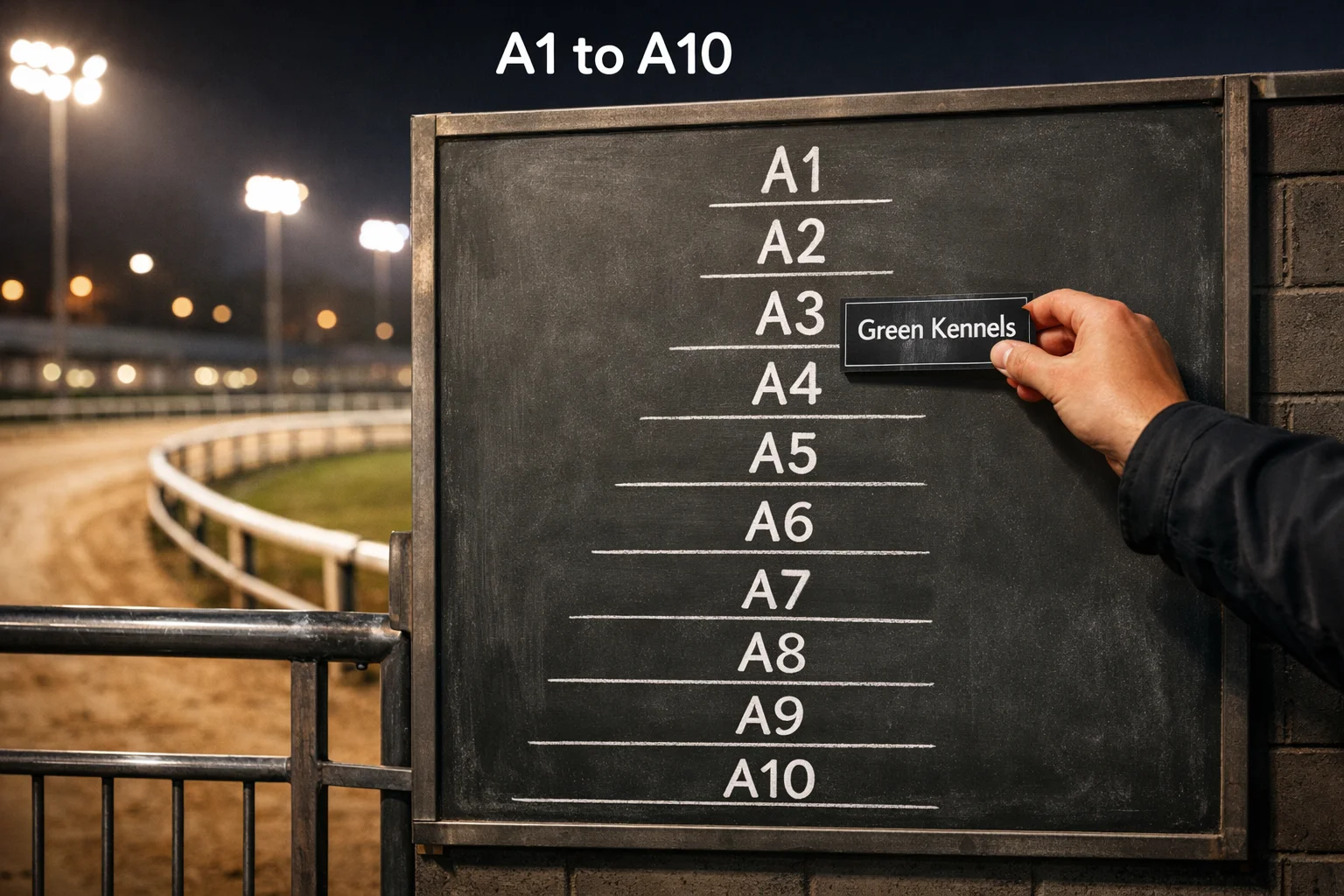
Every greyhound race at Monmore Green is shaped by a system most casual punters never think about. Before a single trap opens, the grading structure has already sorted each dog into a class that reflects its recent form, its winning times, and its competitive level. At Monmore, that structure runs from A1 at the top down to A10 at the bottom, with each rung representing a measurable difference in ability. The wider context is set out in our Monmore Green results guide.
Understanding the Monmore grading ladder is not optional if you take your betting seriously. Grades determine which dogs race against each other, which means they directly affect the competitiveness of a field, the likely pace of a race, and ultimately the value in the odds. A dog dropping from A3 to A5 is not just moving down a number — it is entering a race where the average winning time is slower, the opposition is weaker, and the market dynamics shift accordingly. Get this wrong and you are reading the racecard with one eye closed.
This guide breaks down how Monmore’s A1-to-A10 system works, how dogs move between grades, and why the grading ladder should be one of the first things you check before placing a bet.
What Each Grade Tells You About the Dogs in a Race
The grading system at Monmore Green exists for a straightforward reason: to produce competitive races. Without it, the fastest dogs in the building would run against the slowest, every race would be a procession, and the betting market would collapse into a series of odds-on certainties. Grading prevents that by grouping dogs of similar ability together, which is why a Saturday night A2 race looks and feels entirely different from a Tuesday afternoon A8.
A1 is the top grade. Dogs racing in A1 at Monmore are the fastest, most consistent performers at the track. They have earned their place by posting quick times and winning or placing in higher-graded races. At the other end, A10 contains dogs that have either just arrived at the track, returned from injury, or been demoted through a run of poor results. The gap between A1 and A10 in terms of raw finishing times can be significant — often several lengths over the standard 480-metre distance.
Between those extremes, each grade represents a band of performance. A3 and A4 are typically where you find solid, reliable racers — dogs that win regularly but lack the outright speed to compete at the very top. A5 through A7 form the middle of the pack, where the grading system does its most important work: creating tight, competitive fields where any dog can win on its night. This middle band is where many experienced Monmore punters concentrate their betting, precisely because the margins are thin and the odds are more generous.
The total prize money available across UK greyhound racing reached £15,737,122 recently, and that pot is distributed unevenly across grades. Open races and top-grade events command the highest purses, while lower grades offer modest returns. That financial gradient is not just a curiosity — it is the economic engine that drives the entire promotion and demotion cycle. Trainers are motivated to improve their dogs because higher grades mean bigger prize cheques.
What each grade does not tell you, and this is where many novice bettors stumble, is how a dog arrived at its current grade. An A6 greyhound might be a talented youngster climbing quickly, a former A2 runner on a losing streak, or a dog returning from a six-week layoff. The grade is a snapshot, not a biography. Reading it properly means combining the grade number with recent form, trial times, and the trainer’s pattern — a point we will return to in the betting section below.
How Greyhounds Move Between Grades at Monmore
Greyhounds do not stay in a single grade forever. The system is designed to be fluid, with dogs moving up or down based on their results. At Monmore, this movement follows a set of rules managed by the racing office, and understanding those rules gives you a genuine edge when assessing a racecard.
The basic mechanism is simple. A dog that wins a race is typically promoted one grade — so an A6 winner moves to A5. A dog that finishes consistently near the back of the field gets demoted, dropping one grade. In practice the picture is more nuanced than that. The racing office looks at winning times, the margin of victory, and recent performance over multiple races. A dog that scrapes a win by a short head in a slow A7 race will not necessarily jump straight to A6 if its times do not warrant the move. Equally, a dog that runs well in defeat against higher-grade opposition might hold its current grade rather than dropping.
Promotion after a win is near-automatic at most tracks, including Monmore. Demotion takes a little more patience from the racing office. A dog usually needs two or three poor performances before it drops, which creates an interesting lag effect. A dog that has just been promoted after a strong A5 win might struggle in A4 for two or three races before being sent back down — and during those A4 runs, its odds are often inflated because the market recognises it is out of its depth. Conversely, when that dog returns to A5, it arrives with recent losing form but a proven ability at the grade, which can create overlooked value.
The constant flow of new entrants keeps the grading system in motion. In 2024, 5,133 new greyhounds were registered with GBGB across the UK. Many of those dogs will have started their careers at tracks like Monmore, entering the grading ladder at a level determined by their trial times and their trainer’s assessment. A new arrival with fast trials might go straight into A4 or A5, while one with moderate times starts lower. This inflow of fresh talent means grades are constantly being reshuffled — a dog comfortable in A6 last month might find the competition there has stiffened because three new entrants with strong form have been graded into the same band.
Open races sit outside the grading ladder entirely. These are invitation events where any dog can compete regardless of grade, and they tend to attract the best runners at the track. Monmore’s feature open events offer larger prizes and draw entries from top kennels. For grading purposes, an open race result does not affect a dog’s grade, which is why some trainers strategically enter their dogs in opens between graded races to keep them sharp without risking an unwanted promotion.
Why Grading Matters When You Bet on Monmore
If you ignore the grading system when betting on Monmore, you are essentially ignoring the single biggest structural factor in every race. Grades set the field, and the field determines everything from pace dynamics to the likely margin between first and last.
The first practical application is identifying recently promoted and demoted dogs. A greyhound dropping from A3 to A4 after two poor runs may look like a fading prospect on paper, but if its A3 times were competitive and it simply drew wide traps in both defeats, the demotion represents opportunity rather than decline. The dog is now racing against slower opposition with race fitness intact. These situations produce some of the best value bets at Monmore, particularly in the middle grades where the market pays less attention.
Grade also affects how you read pace in a race. An A2 field at Monmore will generally feature faster early speed and tighter first-bend positioning than an A7 field. This means trap draw advice that works at the top end of the grading ladder may not apply lower down. In high-grade races, the inside traps gain a more decisive advantage because every dog breaks quickly and the first bend becomes congested. In lower grades, where early speed is less uniform, a wide runner with a clean run to the first bend can sometimes overcome the rail bias that dominates at higher levels.
There is also a seasonal dimension to grading at Monmore. The influx of new greyhounds tends to peak in spring and early summer, when young dogs fresh from their rearing farms begin their racing careers. During these months, the lower and middle grades become more volatile — new dogs arrive with unknown form, and the grading office is making assessments based on limited data. For bettors, this period rewards those who do their homework on trial times and trainer patterns, because the market has not yet established a reliable picture of these newcomers. Above the grades sit the open races.
Finally, do not confuse grade with class in absolute terms. Monmore’s A1 is specific to Monmore. An A1 dog at this 419-metre track would not necessarily grade as A1 at a larger circuit with different distances and running characteristics. If a dog transfers to Monmore from another venue, its initial grade at Monmore is based on equivalent times, not a direct carryover. That recalibration process can produce mispriced runners in the opening weeks after a transfer — another edge for anyone paying attention to the Monmore grading ladder.
