
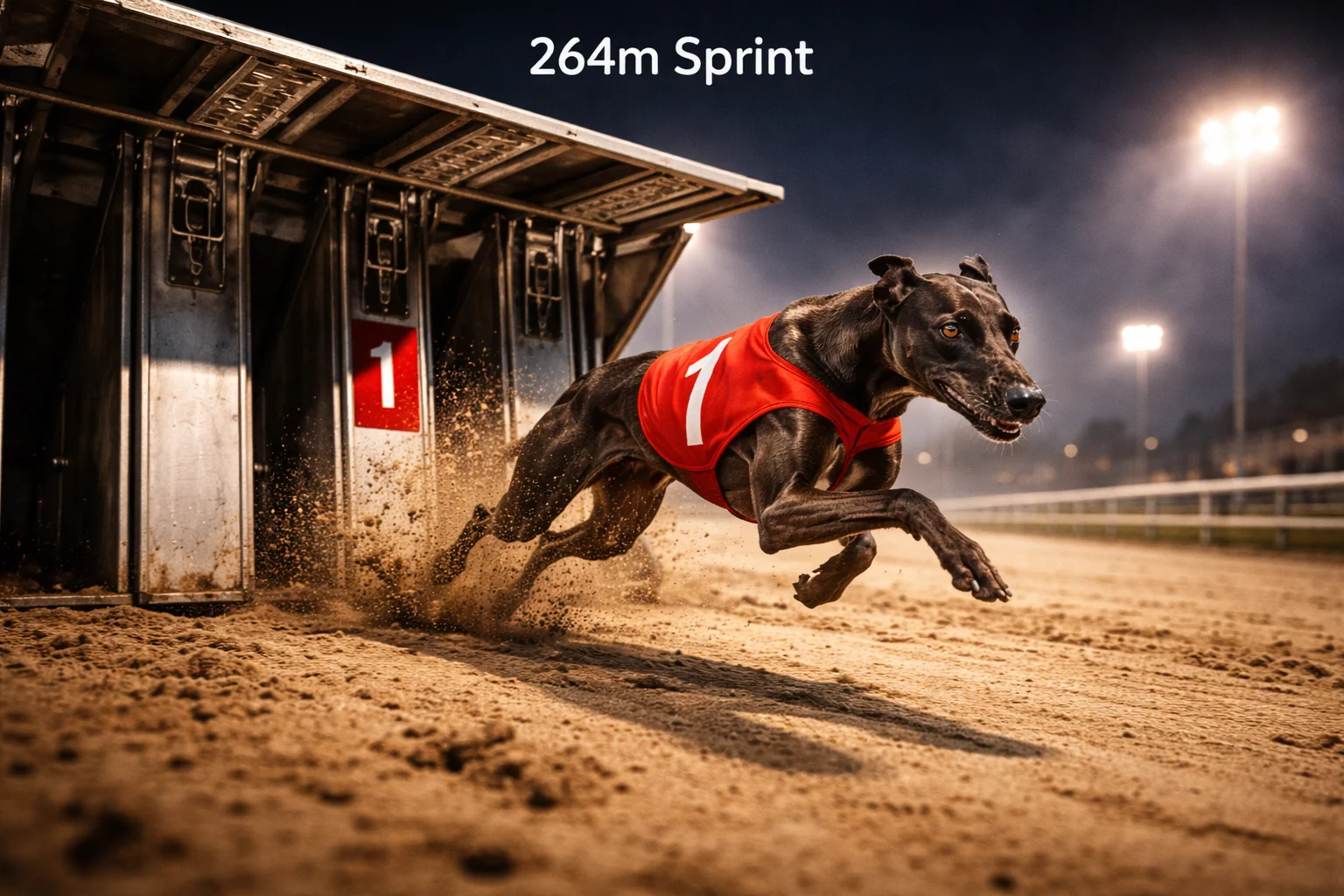
The 264m at Monmore is the shortest distance on the card, and it is nothing like the standard 480m race. Two bends instead of four. A finish line that arrives before most dogs have settled into stride. Races that are over in roughly fifteen seconds, where a slow break from the traps can be the difference between winning and finishing last. The wider context is set out in our Monmore Green results guide.
Sprint racing rewards a very specific type of greyhound — one that explodes from the boxes, hits top speed within two or three strides, and holds that pace through two bends with minimal deceleration. At Monmore’s 419-metre oval, the 264m trip starts on the back straight and covers roughly five-eighths of the track. The first turn still arrives at the same point in the circuit, which means the dynamics of that opening bend remain critical, but everything happens faster and with less room for error.
For bettors, the 264m at Monmore offers a distinct profile: higher volatility, sharper trap biases, and a premium on raw pace that reshapes how you read form and assess the draw.
Trap Performance Over Two Bends: Where Speed Wins
Over two bends, the trap draw matters even more than it does over four. The reason is simple: there are fewer opportunities for the race to reshuffle. In a 480m contest, a dog that gets a poor first bend can recover over the remaining three turns. In the 264m, the first bend is roughly halfway through the race. If you lose position there, you are unlikely to get it back.
The UK-wide average shows Trap 1 winning at around 18 to 19 percent across all distances, but sprint distances tend to push that figure higher at individual tracks. At Monmore, the inside traps benefit from the same rail advantage as at 480m, but the effect is concentrated into fewer bends and a shorter total distance. A Trap 1 runner that leads into the first bend already has the race half won. There is no back straight where rivals can regroup, no third-bend drama — just one more turn and a short run to the line.
Trap 2 is arguably the most interesting draw at 264m. It sits close enough to the rail to challenge for the inside line, and if the Trap 1 dog is even slightly slow to break, the Trap 2 runner can cut across and take the rail before the first bend. When this happens, the Trap 2 dog effectively inherits all of Trap 1’s structural advantages. The data at Monmore reflects this: Trap 2 produces a competitive win rate at 264m, sometimes matching Trap 1 depending on the sample period.
The outside traps face a stark reality in sprint races. Traps 5 and 6 have to cover more ground on both bends, and with only two bends in the race, there is no recovery time. A wide-drawn dog needs exceptional early speed — not just good speed, but class-leading speed — to overcome the geometric disadvantage. In lower-grade 264m races, where the field quality is uneven, a genuinely fast outside dog can sometimes blast to the front and hold on. In higher grades, where every dog breaks quickly, the wide traps are at a pronounced disadvantage that the statistics bear out over time.
Middle traps at 264m present a mixed picture. Trap 3 tends to perform respectably because it can exploit gaps on either side — cutting inside if space opens or holding a line to the outside of tiring rail dogs. Trap 4 is often the most disadvantaged middle draw in sprints at Monmore because it is too far from the rail to claim it and not far enough outside to find clear air. These dogs frequently get caught in traffic at the first bend, a problem that is more costly over two bends than over four simply because there is less race left to recover.
What Makes a Sprint Specialist at Monmore
Not every greyhound is suited to sprint racing, and understanding the profile of a genuine 264m specialist is one of the keys to making sense of Monmore’s shortest distance.
The defining attribute is trap speed — the ability to leave the boxes at maximum acceleration. At 480m, a dog can afford to be a fraction slow out and still compete. At 264m, a slow break is almost always fatal to a dog’s chances. Sprint specialists tend to be dogs that consistently post fast times in the first split, that section of the race from traps to the first timing beam. If a greyhound consistently records the fastest or second-fastest split in its recent races, it has the raw exit speed that 264m demands.
Body type plays a role too, though it is less reliable as a sole indicator. Sprint greyhounds tend to be compact and muscular rather than long and rangy. They are built for explosive power over short distances rather than sustained stamina. That said, there are exceptions — some leggy dogs have the frame to cover ground quickly out of the traps despite not matching the typical sprint build. This is why form data matters more than a visual assessment at the parade ring.
A dog’s racing history tells you a great deal about its sprint credentials. Look for greyhounds that have been consistently campaigned over 264m or similar short distances at other tracks. A dog with six recent runs at 480m suddenly entered over 264m might be an experiment by the trainer — which can go either way — but a dog with a string of 264m races in its form line has been identified by connections as a sprint type. Trainers know their dogs, and if they keep entering one over the short trip, there is usually a reason.
The mental side matters as well. Some greyhounds are naturally keen — they anticipate the traps opening and burst out with aggression. Others are more relaxed, which is fine over 480m but a liability at 264m. A dog described in race comments as a “slow away” or “dwelt” is unlikely to thrive in sprints, no matter how fast it finishes. The race is too short to overcome a tardy exit, and the market tends to punish these dogs accordingly, though occasionally not enough.
Betting the 264m: Volatility and Value Opportunities
The 264m distance at Monmore offers a different betting landscape to the standard trip, and recognising those differences is essential if you want to find value.
The most obvious feature is volatility. Sprint races are more unpredictable than longer distances because one moment — the trap break — has an outsized influence on the result. A dog that breaks a fraction slow is effectively out of contention, regardless of its underlying ability. This means upsets happen more frequently, and favourites have a harder time converting their class advantage into wins. UK-wide data shows that favourites win only around 30 to 40 percent of greyhound races, and at 264m that figure sits at the lower end of the range because the sport’s most unpredictable moment — the break — carries more weight.
For punters, this volatility cuts both ways. Backing favourites at short prices in 264m races is a recipe for frustration because the strike rate does not justify the odds over the long term. However, looking for value at bigger prices becomes more rewarding because the sprint format regularly produces winners from outside the top two in the market. A dog drawn in Trap 2 with good early speed but priced at 4/1 because its recent form at 480m was moderate might represent genuine value if its 264m split times are competitive.
Forecast and tricast betting at 264m tends to produce bigger dividends than at longer distances, precisely because the finishing order is harder to predict. If you are building a perm at Monmore, including 264m races with wider coverage — three or four dogs in your forecast selections rather than two — reflects the inherent unpredictability and can capture the larger payouts that sprint finishes generate. The standard trip is analysed in 480m trap stats.
One tactical note: keep a close eye on the trap draw when a regular 264m dog switches to a different trap from its usual one. Sprint specialists develop habits, and a dog that has won three times from Trap 1 may struggle from Trap 5 even if its raw speed is unchanged. The adjustment to a wider draw in a race where every fraction matters at the start can throw a dog off its pattern, and the market does not always adjust the price enough to reflect that disruption.
