
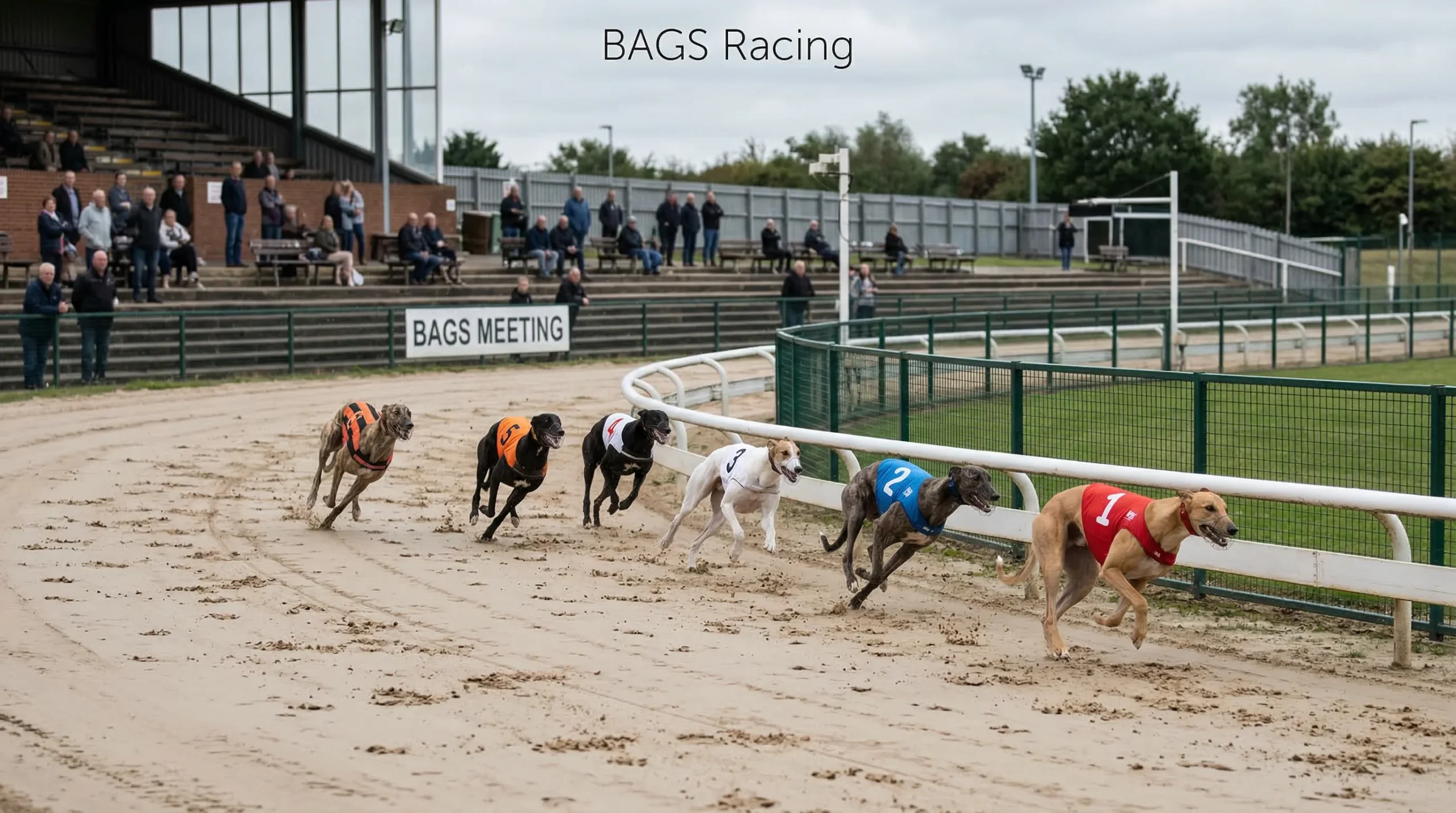
If you have ever placed a bet on afternoon greyhounds in a betting shop, you have almost certainly wagered on a BAGS meeting without knowing it. The acronym stands for Bookmakers’ Afternoon Greyhound Service, and it is the system that has kept many UK greyhound tracks financially viable for decades. BAGS is not a race organiser, a track owner, or a governing body. It is a fixture framework — a way of scheduling afternoon meetings specifically to provide live betting content for bookmakers during hours when no other greyhound racing is available. The wider context is set out in our Monmore Green results guide.
At Monmore Green, BAGS meetings account for the majority of weekly fixtures. They run on weekday afternoons, attract minimal in-person attendance, and are broadcast into thousands of betting shops via satellite. Understanding how BAGS works, how it differs from evening open racing, and what it means for the quality and character of the races you are betting on is an underappreciated part of greyhound literacy. Most punters bet on BAGS meetings every week without grasping the economics behind them, and that lack of understanding can lead to misjudging the nature of the product.
What BAGS Stands For and How the System Works
The Bookmakers’ Afternoon Greyhound Service has its origins in the 1960s, when the betting industry recognised that afternoon hours represented a gap in the live content available to betting shops. Horse racing filled much of the daytime schedule, but there were windows — particularly in the morning and early afternoon — where no live sport was being broadcast. BAGS was created to fill those windows with greyhound racing, giving bookmakers a product to offer their customers during otherwise quiet periods.
The system works through a contractual arrangement between track operators and the broadcasting infrastructure. Tracks agree to stage afternoon meetings on specific days, and in return they receive a fixture fee funded by contributions from bookmakers who benefit from the betting turnover those meetings generate. The races are broadcast live via SIS — the Satellite Information Services network that delivers live pictures and data to betting shops nationwide. Premier Greyhound Racing, the joint venture between Entain and ARC, holds media rights across nine tracks, including Monmore, which means the BAGS fixtures at those venues are managed within a coordinated national schedule.
From a punter’s perspective, BAGS meetings look and feel like any other greyhound card. Six dogs per race, standard distances, normal grading structure, and results that count toward each dog’s form record and grading position. The difference lies behind the scenes: the economics of a BAGS meeting are driven by broadcast fees and betting turnover rather than by gate receipts and trackside spending. This is why attendance at afternoon meetings is typically negligible — the meeting is not designed to attract spectators. It is designed to generate live racing content for a national betting audience.
The fixture rota determines which tracks run on which afternoons. BAGS organisers coordinate across multiple venues to ensure that fixtures are spaced throughout the day, typically with staggered start times so that one meeting’s races interleave with another’s. This creates a continuous stream of content for betting shops: a race every few minutes, alternating between tracks, with no dead airtime. For the shops, this is the product. For the tracks, it is a revenue stream that justifies keeping the lights on and the kennels staffed during the week.
One misconception worth clearing up: BAGS meetings are not lower-quality or less legitimate than evening fixtures. The dogs that run in the afternoon are the same dogs that race in the evening, operating under the same GBGB regulations, with the same stewards, the same trap draw procedures, and the same welfare standards. A dog’s afternoon result counts toward its grading record just as much as a Saturday night performance. The only material difference is the atmosphere — or, more accurately, the absence of it.
BAGS vs Open Racing: Prize Money, Grading and Coverage
The distinction between BAGS and open racing is one that most casual bettors overlook, but it has real implications for the type of racing you are watching and the way you should approach your selections.
Open racing refers to evening fixtures — and occasionally weekend afternoon events — that are promoted as spectator events with full stadium facilities, higher prize money, and, in many cases, feature races that sit outside the normal grading structure. Evening meetings at Monmore on Thursday and Saturday nights are open meetings. They charge admission, attract live audiences, and showcase the track’s strongest runners. The prize money at open meetings is significantly higher than at BAGS fixtures, which means trainers are more likely to enter their best dogs on these cards.
That prize money gap is substantial across the sport. At the top end of open racing, the English Greyhound Derby offers £175,000 to the winner — the largest single prize in UK greyhound racing. Monmore’s own feature events carry purses that, while modest compared to the Derby, are many times larger than the standard BAGS race prize. This financial incentive means that the strongest dogs and the most ambitious kennels gravitate toward open meetings, which in turn means the quality of the racing is generally higher on those cards.
For bettors, this quality differential has practical consequences. Open meetings tend to produce tighter, more competitive fields because the dogs entered are closer in ability. BAGS meetings, by contrast, can feature wider variations in quality within a single race, particularly in the lower grades where a mix of improving youngsters, declining veterans, and inconsistent performers creates unpredictable outcomes. That unpredictability is a double-edged sword: it makes BAGS races harder to call, but it also produces more frequent long-priced winners and bigger forecast returns.
Grading operates the same way at both types of meeting, but the context differs. A dog that wins an A5 BAGS race on a Tuesday afternoon will be promoted in exactly the same way as one that wins an A5 on a Saturday night. However, the composition of the field may differ: an A5 on a Saturday might feature stronger entries from trainers targeting the bigger prize, while the same grade on a Tuesday afternoon might contain dogs that trainers have entered to maintain race fitness between more important engagements.
BAGS Meetings at Monmore: What to Expect
Monmore’s BAGS meetings run on multiple weekday afternoons, making the track one of the more active BAGS venues in the PGR network. The schedule typically covers Monday, Tuesday, Wednesday, and Friday, though the specific days can vary depending on the national fixture rota and any adjustments required by broadcasting schedules or track maintenance.
If you plan to attend a BAGS meeting at Monmore in person, the experience is stripped back compared to an evening card. The crowd is thin — often a handful of regulars plus staff. The atmosphere is functional rather than festive, and the focus is entirely on the racing rather than on entertainment or hospitality. For some bettors, this is actually a positive: without the distractions of a busy Saturday night, you can concentrate on the form, watch the dogs in the parade ring without jostling for position, and place your bets without time pressure. When each card runs is in the fixture calendar.
The racing itself is competitive and legitimate, and the form produced at afternoon BAGS meetings is fully reliable for assessing dogs that reappear on evening cards. In fact, one of the more productive betting angles at Monmore involves tracking dogs that perform well in BAGS races at modest prices, then backing them when they reappear on a busier Saturday card where the market may not yet have caught up with their improving form. The BAGS meeting is where the homework gets done — and the evening meeting is where it pays off.
