
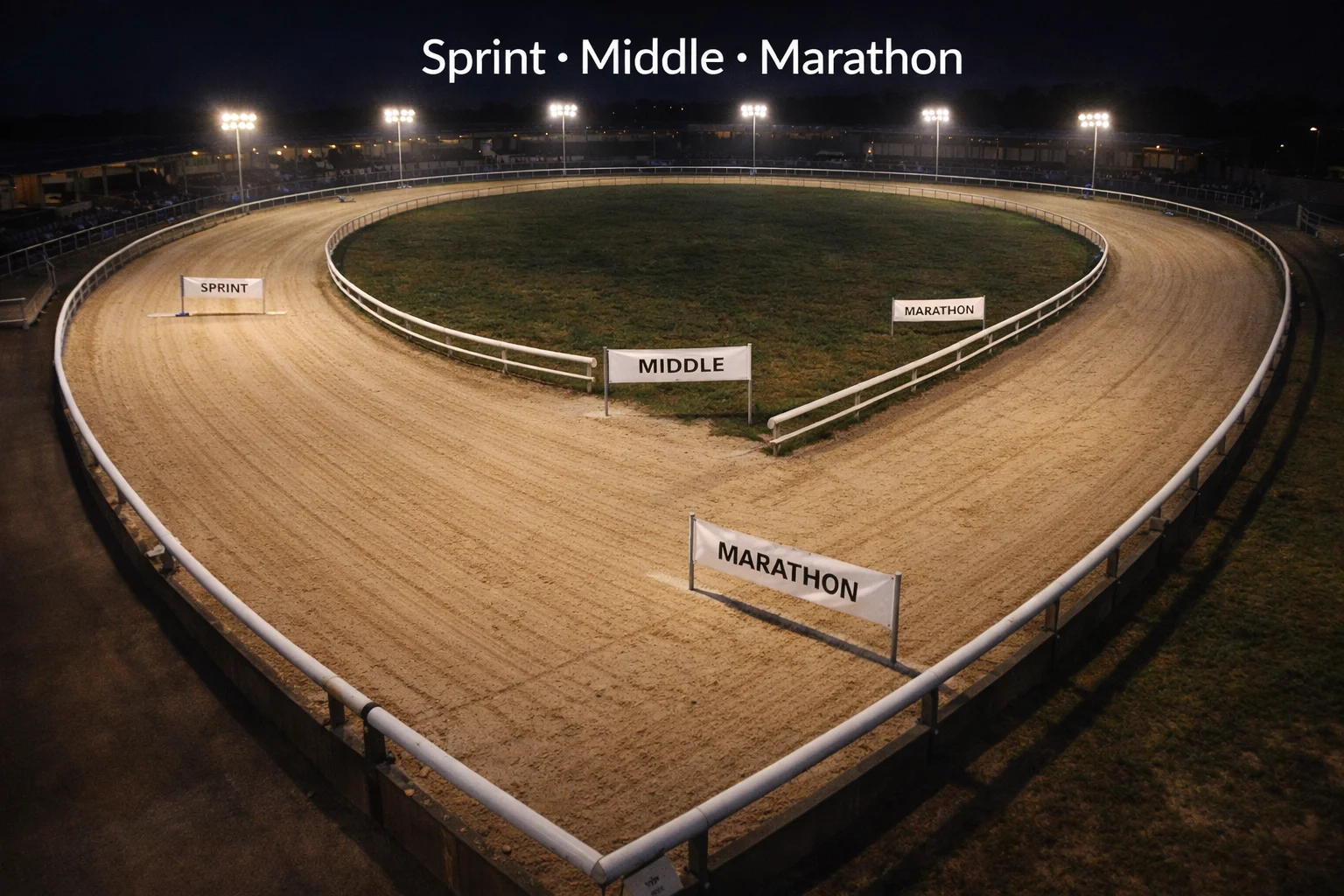
Distance is the first thing that defines a greyhound race, and it is the thing that most casual bettors pay the least attention to. A 264-metre sprint and an 835-metre marathon are not the same sport wearing different clothes. They reward different types of dog, produce different race dynamics, demand different form analysis, and create different betting opportunities. Treating all greyhound races as interchangeable — studying the form, picking the best dog, and placing a bet — ignores the single most important variable on the card. The wider context is set out in our Monmore Green results guide.
UK greyhound racing uses three broad distance categories: sprints, middle-distance, and marathons. The exact distances vary between tracks because each venue has its own circumference, starting positions, and bend configurations. But the categories are universal, and understanding what each one demands from the dogs — and from the bettor — is a foundational skill that transfers across every licensed track in the country.
This guide explains the three categories, shows how distance shapes the way races unfold, and outlines how your betting approach should change depending on whether you are watching a two-bend dash or an eight-bend endurance test.
Three Categories: Sprint, Middle and Marathon
Sprint distances in UK greyhound racing cover anything from approximately 210 metres to 300 metres, depending on the track. These races involve two bends and are over in roughly fifteen seconds. At Monmore Green, the sprint distance is 264 metres, which covers just under five-eighths of the 419-metre oval. Sprints are about one thing above all else: the trap break. A dog that leaves the boxes a fraction slow is effectively out of the race, because there is simply not enough track left to recover. The profile of a sprint greyhound is built around explosive acceleration, fast early speed, and the ability to sustain that speed through two bends with minimal deceleration.
Standard distances — the bread and butter of UK greyhound racing — typically fall between 450 and 500 metres and involve four bends. Monmore’s standard distance is 480 metres, and it accounts for the majority of races on any given card. Four-bend races are the most balanced test of a greyhound’s abilities: they require good early pace to secure position at the first bend, enough speed to maintain that position through the middle of the race, and sufficient fitness to sustain the effort through the home straight. The standard distance is where the grading system does its most effective work, because the four-bend format gives all six traps a reasonable chance while still rewarding the inside draw with a measurable advantage.
Middle-distance races range from approximately 550 to 700 metres and add extra bends — typically five or six — to the equation. At Monmore, this category is represented by the 630-metre and 684-metre distances. These trips introduce stamina as a meaningful variable. Dogs that lead early and tire late — a viable strategy at 480 metres — are exposed over the longer trip. The best middle-distance runners combine speed with the ability to sustain effort, and the races tend to produce more tactical variation than standard-distance events because the longer trip gives dogs more time and space to manoeuvre.
Marathon distances sit above 700 metres and can extend to 925 metres or beyond at some tracks. Monmore’s marathon is 835 metres, covering two full laps plus a portion of a third. Marathon races are the most specialised category. They demand genuine stamina, measured temperament, and the ability to maintain a rhythm over eight bends. The pace dynamics in a marathon are fundamentally different from those in a sprint: the early fractions are relatively moderate, the mid-race period is where separation begins, and the closing stages are dominated by whichever dog has the most energy left in reserve.
How Distance Shapes Running Style, Trap Draw and Form
The trap draw behaves differently at each distance category, and this is the single most important practical implication of greyhound race distances for bettors. At sprint distances, the inside draw is at its most powerful because there are only two bends and no opportunity for positional recovery. At standard distances, the inside advantage is significant but tempered by four bends that allow some reshuffling. At middle and marathon distances, the advantage narrows further because the longer race gives dogs more opportunities to change position and stamina becomes a more dominant factor than starting position.
Running style interacts with distance in predictable ways. Front-runners — dogs that lead from the traps and try to hold that lead to the line — thrive at sprint distances where the race is over before rivals can close the gap. At middle distances and beyond, pure front-running becomes riskier because the effort of leading for 630 metres or more can deplete a dog’s reserves before the finish. Closers — dogs that sit behind the pace and finish strongly — are at their most effective over longer distances, where the extra bends and longer running time give them the space to work through the field.
Form data also reads differently depending on distance. A finishing position at 264 metres reflects a fifteen-second race where the margin between first and last can be just a length or two. A finishing position at 835 metres reflects a fifty-second race where the leading dogs have lapped some of the trailing runners. Times are only meaningful when compared within the same distance category, and ideally at the same track, because track circumference and surface conditions affect absolute times. A 29.50-second 480m time at Monmore is not directly comparable to a 29.50-second time at a track with different geometry.
The opening of Dunstall Park Greyhound Stadium in September 2025 added a new set of distances to the Wolverhampton racing scene: 270, 480, 660, 715, and 925 metres. That wider range — including a 925-metre marathon, ninety metres longer than Monmore’s 835 — demonstrates how distance categories vary between venues. A dog that excels at Monmore’s 835 metres faces a different challenge at Dunstall’s 925, where the extra distance and the different track geometry create a distinct test. This is why greyhound race distances are not just numbers on a card. They are the framework that determines how each race unfolds, and understanding that framework is essential for any bettor who wants to approach the sport systematically.
Matching Your Betting Approach to the Distance
The simplest way to improve your greyhound betting is to specialise by distance rather than trying to master every race on the card. Each distance category has its own logic, its own key indicators, and its own market characteristics. A bettor who understands sprint racing deeply will outperform one who has a shallow understanding of all three categories.
If you are drawn to short, sharp races where the result is decided in the first few seconds, sprint distances are your niche. Focus on trap speed, early pace data, and the draw. Accept that volatility is high and favourites fail more often than at longer distances, and structure your staking accordingly — smaller stakes per race with wider coverage in forecasts and tricasts to capture the unpredictable finishing orders that sprints produce.
If you prefer races with more tactical depth and a greater role for form analysis, standard and middle distances offer the richest material. At 480 metres, the combination of trap draw, recent form, and trainer data gives you a comprehensive toolkit for assessing each race. At 630 and 684 metres, the added dimension of stamina assessment makes the analysis more complex but also more rewarding, because the market tends to be less efficient at distances that attract less public attention. Monmore’s own trips are in the track guide.
Marathon distances are a specialist pursuit. The sample sizes are smaller, the form data is thinner, and the dogs involved are fewer. But for anyone willing to invest the time in understanding pace patterns, sectional splits, and stayer profiles, the marathon offers pockets of value that other distances cannot match. The market is least efficient where it knows the least — and it knows the least about the handful of greyhound race distances that sit at the extreme end of the spectrum.
