
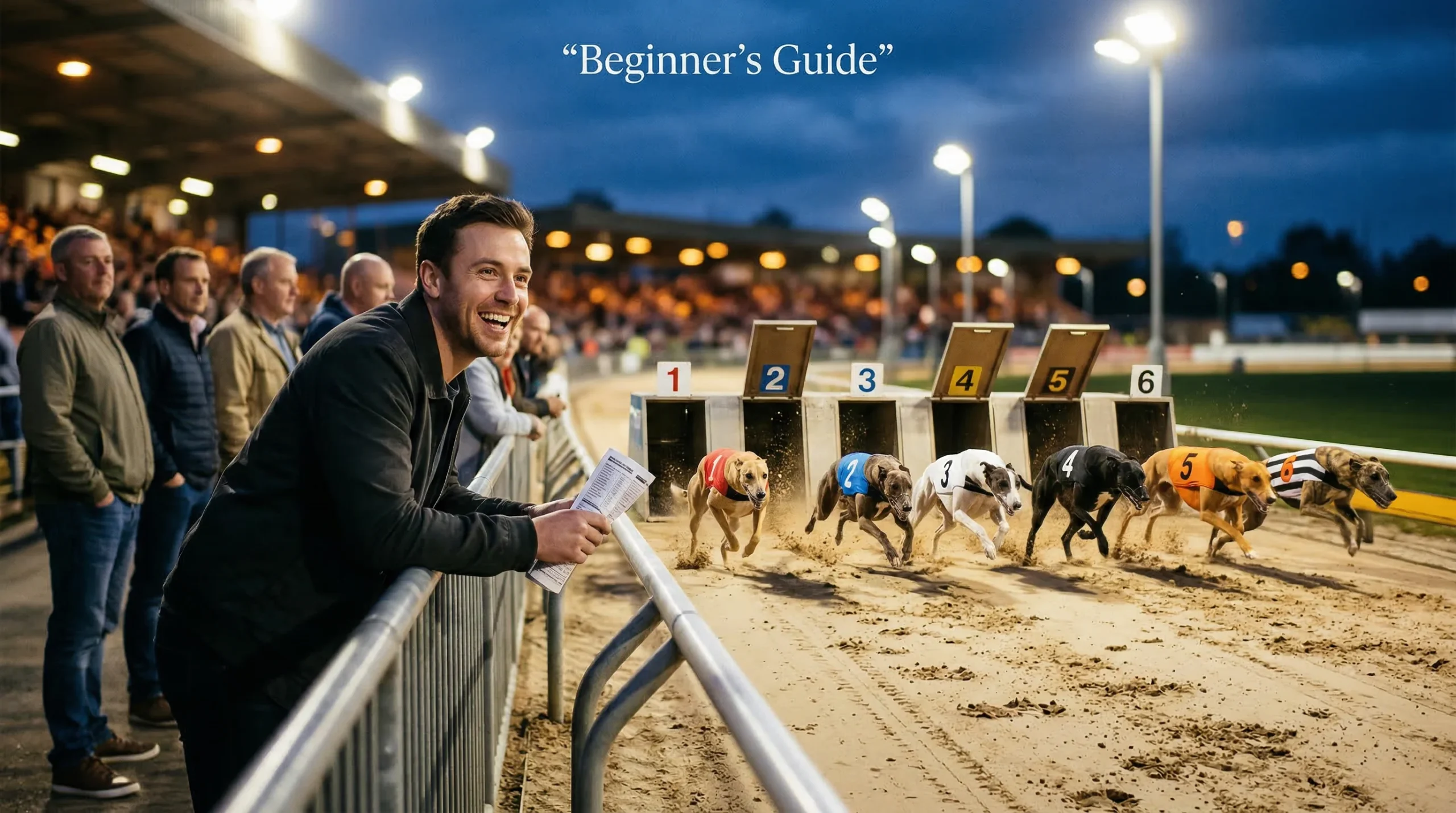
Greyhound racing is one of those sports that looks simple from a distance but reveals layers of complexity the closer you look. For anyone approaching it for the first time, that simplicity is actually an advantage. The basics can be understood in five minutes, and you can enjoy a night at the dogs without knowing a single statistic or studying a single form line. But if you want to understand what is happening and why, a little background knowledge transforms the experience. The wider context is set out in our Monmore Green results guide.
The sport is more popular than many people realise. The UK government has recognised greyhound racing as the sixth most popular spectator sport in the country, providing around 5,400 jobs across Great Britain. That is not a fringe pursuit. It is a substantial part of the national sporting landscape, even if it receives a fraction of the media coverage given to football or horse racing.
This guide covers everything a newcomer needs to know: how a race works from traps to finish line, what the jacket colours and trap numbers mean, and how to place your first bet without feeling lost.
From Traps to Finish Line: How a Greyhound Race Unfolds
A greyhound race starts when the mechanical lure passes the starting traps. The traps open simultaneously, and six dogs burst out in pursuit. The entire event, from traps to finish, lasts between fifteen and fifty seconds depending on the distance, making it one of the fastest spectator sports in existence.
Before the race begins, the dogs are paraded in front of the crowd so that racegoers can see their condition and demeanour. They are then loaded into the starting traps, six metal boxes arranged in a line, numbered one through six from the inside rail outward. Each dog wears a coloured jacket that corresponds to its trap number, which makes it possible to identify individual dogs during the race even at high speed.
The race unfolds around an oval track. At Monmore Green in Wolverhampton, the track measures 419 metres in circumference, and races are run over five distances: 264m, 480m, 630m, 684m, and 835m. The shortest race covers just two bends and is over almost before you have finished your sentence. The longest covers two full laps and part of a third, testing stamina as well as speed.
The first bend is where most races are decided, or at least shaped. Dogs on the inside have a shorter path to the turn and can claim the rail, which saves distance on every subsequent bend. Dogs on the outside have to cover more ground, and unless they possess exceptional speed, they enter the first turn at a disadvantage. This is why trap draw matters so much, and it is one of the first things experienced racegoers check on the card.
After the first bend, the field typically settles into a running order that may persist through the rest of the race. Changes do happen: dogs overtake on the straights, challenge on the outside of bends, or fade as their energy depletes. But the basic shape of the race is often established within the first few seconds. The finish line is on the home straight, and the first dog to cross it wins. Photo finishes are used when the result is too close to call, and results are confirmed within seconds of the race ending.
Jacket Colours, Trap Numbers and the Basic Rules
The coloured jackets worn by greyhounds are standardised across all UK tracks. Trap 1 wears red, Trap 2 wears blue, Trap 3 wears white, Trap 4 wears black, Trap 5 wears orange, and Trap 6 wears black and white stripes. These colours are universal. A red jacket at Monmore means the same thing as a red jacket at Romford, Hove, or any other GBGB-licensed venue. Once you know the six colours, you can follow any greyhound race in the country without needing to check which dog is which.
Trap numbers are assigned by the racing office, not chosen by the trainer. The draw is effectively randomised, though some tracks use a ballot system and others consider recent running style when assigning traps. A dog known as a railer might be drawn in Trap 1 or 2, where its natural running style matches the position. A wide runner might be placed in Trap 5 or 6. Understanding which traps favour which running styles is a core skill in greyhound form analysis.
The basic rules of greyhound racing are minimal. All six dogs must be in the traps before the lure is activated. If a dog is withdrawn before the race due to injury, illness, or a refusal to enter the trap, the race may proceed with fewer runners. During the race, there are no jockeys, no tactics dictated by a human rider, and no routine disqualifications for bumping or crowding. The result stands as the dogs cross the line, and any inquiry is resolved by the track stewards within minutes.
Grading ensures that dogs of similar ability race against each other. New dogs entering a track are assessed through trials and placed in an appropriate grade. Winners are promoted; consistent losers are demoted. This system means that even the lowest-graded race on the card should be competitive, because every dog in the field has been selected to match the others in terms of recent performance.
Placing Your First Bet: A No-Jargon Walkthrough
Betting on greyhound racing is straightforward. At the track, you can place bets at the tote windows or with on-course bookmakers who display their odds on boards near the trackside area. Away from the track, every major UK bookmaker offers greyhound betting through their shops, websites, and mobile apps.
The simplest bet is a win bet: pick a dog, place a stake, and collect if it finishes first. If you are at Monmore for the first time and want to ease into things, a one-pound win bet on a dog you fancy is a perfectly reasonable starting point. There is no minimum expertise required. You can pick based on the colour of the jacket, the name of the dog, or the trap number, and nobody at the track will judge you for it.
If you want a slightly more structured approach, glance at the racecard. Look at the recent form figures, a row of numbers showing where the dog finished in its last few races. A dog with 1-2-1-3 in its recent form has been consistently finishing near the front. A dog with 6-5-6-4 has been trailing the field. This takes thirty seconds to check and gives you a basic sense of which dogs are running well. The vocabulary is collected in the glossary.
Manage your expectations from the start. Favourites win only 30 to 40 percent of UK greyhound races, which means that even the top pick loses more often than it wins. This is normal. Greyhound racing is unpredictable by nature: six dogs running at high speed around tight bends produces surprises regularly, and that unpredictability is part of the appeal. Set a budget for the evening, stick to it, and treat any winnings as a bonus rather than an expectation. Your first greyhound race should be about enjoying the experience. The betting adds a little spice, not the whole meal.
