
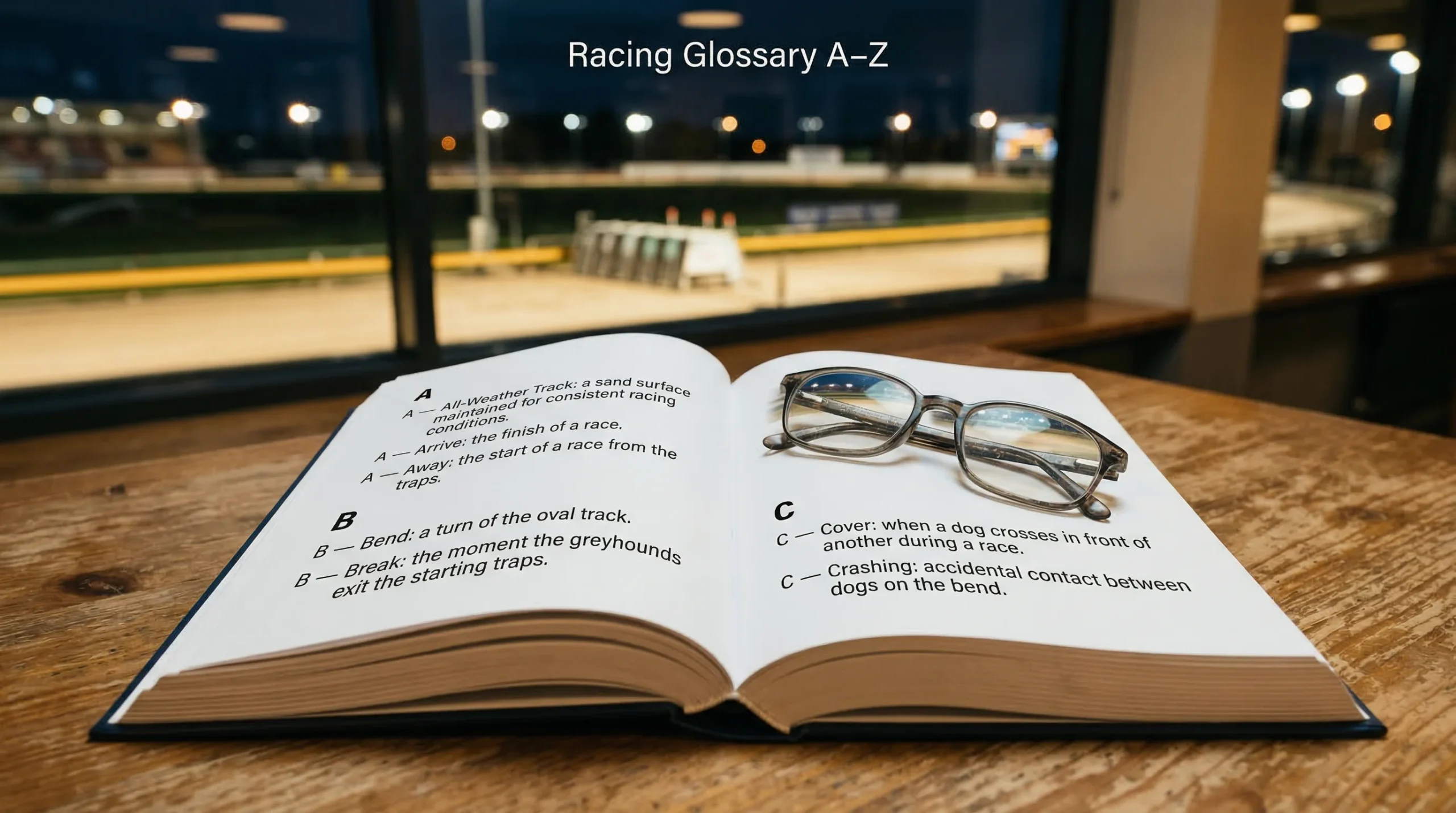
Greyhound racing has its own language. Some of it is shared with horse racing, some of it is unique to the sport, and almost none of it is explained in the places where you first encounter it. Racecards, commentaries, form guides, and betting platforms all assume you already know what the words mean. This glossary is for everyone who does not — and for those who do but occasionally need to check a term they have not seen in a while. The wider context is set out in our Monmore Green results guide.
The UK government has described greyhound racing as a sport that makes an important contribution to the country’s cultural life, providing around 5,400 jobs and ranking as the sixth most popular spectator sport in the UK. A sport of that scale has accumulated a vocabulary to match. Here are the greyhound racing terms you need to know.
A-G: From All-Weather to Grading
All-weather track: A track with a sand-based surface designed to drain quickly and remain raceable in most weather conditions. Monmore Green operates an all-weather surface.
BAGS: Bookmakers Afternoon Greyhound Service. The system that schedules afternoon greyhound meetings for live broadcast into betting shops. Most Monmore weekday meetings run under BAGS.
Bend: A curved section of the oval track. Monmore races range from two bends at 264m to eight bends at 835m.
Board price: The odds displayed by a bookmaker at a given moment. Placing a bet at board price locks in those odds regardless of later market movements.
Box-to-bend: The section of the race from the traps to the first bend. Performance over this section is the most important factor in sprint races.
Closer: A dog that runs behind the pace early and finishes strongly in the closing stages. Closers are most effective at middle and marathon distances.
Comment line: The written description of how a dog ran in a previous race, recorded by stewards. Phrases like slow away, ran on, or checked are standard comment-line terms.
CPD: Continuing professional development. GBGB-mandated training for industry participants covering kennel management, track maintenance, and welfare standards.
Demotion: The downward movement of a dog from one grade to a lower one, typically after a series of poor results.
Distance: The length of the race in metres. Monmore offers five distances: 264m, 480m, 630m, 684m, and 835m.
Draw: The trap position assigned to a dog for a particular race. Also referred to as the trap draw.
Dwelt: A comment-line term meaning the dog was slow to leave the traps.
Each-way: A bet combining a win bet and a place bet. In a six-runner greyhound race, each-way typically pays on first and second.
Forecast: A bet requiring the punter to predict the first two finishers in the correct order.
Form line: The row of figures on a racecard showing a dog’s recent finishing positions, traps, tracks, and times.
Front-runner: A dog that leads from the traps and attempts to hold that lead to the finish line.
GBGB: Greyhound Board of Great Britain. The regulatory body for licensed greyhound racing in the UK.
Grading: The system that sorts dogs into performance bands — A1 through A10 at most tracks — to produce competitive races. The total UK prize fund across all graded and open racing reached approximately 15.7 million pounds.
GRS: Greyhound Retirement Scheme. The GBGB-funded programme that supports rehoming of retired racing greyhounds.
H-P: From Hare to Puppy
Hare: The mechanical lure that the dogs chase. Also called the rabbit. It runs on a rail around the inside of the track.
Homing run: The home straight — the final stretch of track before the finish line.
Injury rate: The percentage of race starts that result in a recorded injury. GBGB reported a 1.07 percent injury rate in 2024.
Kennel: The facility where greyhounds are housed and trained. Also used to refer to a trainer’s operation: a kennel of ten dogs.
Lid: The front panel of a starting trap that opens upward when the race begins. Also used in the phrase trap lids.
Marathon: A race over approximately 700 metres or more. At Monmore, the marathon distance is 835m.
Middle distance: A race between approximately 550m and 700m. Monmore offers 630m and 684m as middle-distance trips.
Nap: A tipster’s most confident selection of the day.
Nursery: A race restricted to inexperienced dogs, usually those with fewer than a specified number of career starts.
Open race: A race with no grade restrictions. Any dog can enter regardless of its current grading, and open events typically carry higher prize money.
Oval track: A closed-circuit track with two straights connected by two bends. Monmore’s oval measures 419 metres in circumference.
Pace collapse: The point in a race where a dog that has been leading begins to decelerate significantly. Most common in marathon races.
PGR: Premier Greyhound Racing. The Entain-ARC joint venture that manages media rights and racing operations at nine UK tracks.
Promotion: The upward movement of a dog from one grade to a higher one, typically triggered by winning a race.
Puppy: In greyhound racing, a dog below a specified age threshold — typically under two years — that is eligible for puppy-restricted events.
Q-Z: From Quarantine to Wide Runner
Quarantine: A period of isolation required for greyhounds imported from Ireland or other countries before they can race in the UK.
Railer: A dog that naturally runs close to the inside rail. Railers benefit most from inside trap draws.
Racecard: The printed or digital document listing all races at a meeting, including form, trap draws, trainers, and weights for each runner.
Retirement rate: The percentage of greyhounds that are successfully rehomed after their racing career ends. GBGB reported 94 percent in 2024.
Reverse forecast: A bet that covers both possible finishing orders of two selected dogs in the first two positions.
Sectional time: The time recorded for a specific section of a race, such as the split from traps to the first bend. Used to assess early pace and stamina.
SIS: Satellite Information Services. The broadcast network that delivers live greyhound racing pictures and data to betting shops across the UK.
SP: Starting price. The official odds of each runner at the moment the traps open, determined by an independent assessor.
Sprint: A race over approximately 210m to 300m, involving two bends. At Monmore, the sprint distance is 264m.
Stayer: A greyhound suited to marathon distances, possessing stamina and the ability to sustain pace over multiple laps.
Steward: An official responsible for ensuring that races are run fairly and in accordance with GBGB regulations.
Strike rate: The percentage of a trainer’s runners that win. A 20 percent strike rate means one winner in every five runners.
Tote: The pool betting system where all stakes are combined and dividends are calculated by dividing the pool among winning tickets.
Track bias: A measurable tendency for certain trap positions to win more frequently than statistical expectation, caused by track geometry and surface conditions.
Trap: The starting box from which a greyhound begins a race. Also refers to the trap number and associated jacket colour.
Trial: An unofficial race used to assess a new or returning dog before it enters the grading system.
Tricast: A bet requiring the punter to predict the first three finishers in the correct order.
Weight: A greyhound’s racing weight, recorded on the racecard. Consistent weight is generally a positive indicator of condition. The terms appear first in the form guide.
Wide runner: A dog that naturally runs on the outside of the track rather than hugging the rail. Wide runners face a distance disadvantage but may avoid crowding on the bends.
