
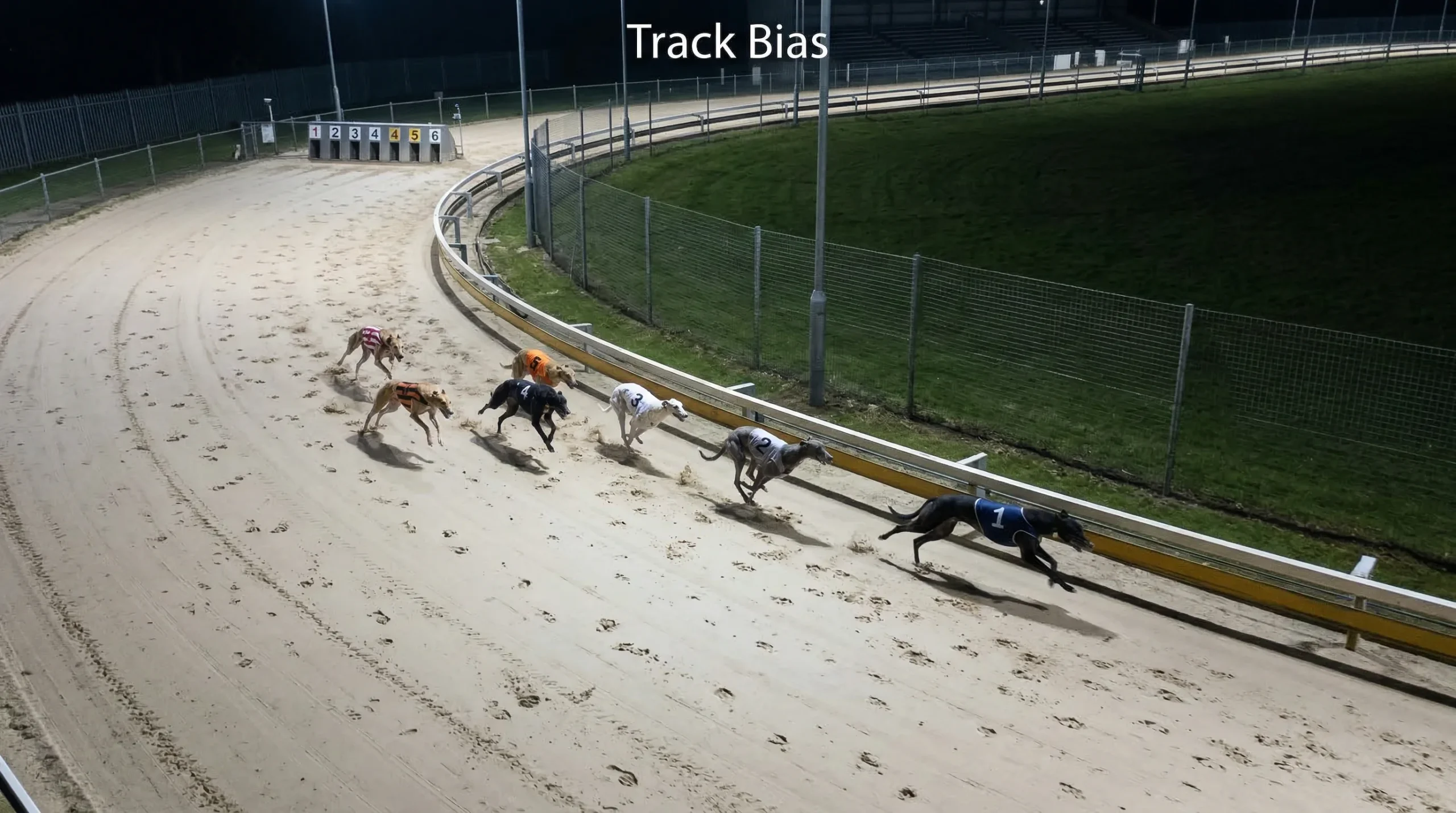
If you have ever wondered why certain traps win more often than others at a greyhound track, you have already stumbled onto the concept of track bias. It is one of the most important factors in greyhound racing and one of the least understood by casual bettors, who often dismiss it as coincidence or attribute it to the quality of individual dogs rather than the geometry of the circuit they are running on. The wider context is set out in our Monmore Green results guide.
Track bias is real, measurable, and persistent. Across UK greyhound tracks, the data shows that Trap 1 wins at a rate of approximately 18 to 19 percent — comfortably above the 16.66 percent you would expect if all six traps were perfectly equal. That gap is not a statistical accident. It is the product of physics, engineering, and the way greyhounds naturally run on an oval track. Understanding why it exists and how it varies between tracks and conditions is one of the most direct routes to better betting decisions.
This guide explains the mechanics behind track bias in greyhound racing, examines a real-world example from Monmore Green, and shows how to incorporate bias data into your selections without falling into the trap of oversimplifying it.
The Physics Behind Track Bias: Rails, Sand and Bend Camber
Track bias originates from a simple physical fact: greyhound tracks are ovals, and on an oval, the inside lane is shorter than the outside lane. A dog running on the rail — the innermost position — covers less ground on every bend than a dog running wide. Over two bends, the difference might amount to a couple of metres. Over four bends, it grows. Over eight bends in a marathon race, the cumulative saving becomes substantial. This is the same principle that governs staggered starts in human athletics, except in greyhound racing there are no staggered starts. All six dogs leave from the same line, and the inside dog has a built-in distance advantage from that point forward.
The rail itself amplifies the effect. Greyhounds are sight-chasers — they are bred to pursue a moving object, and in racing that object is the mechanical lure. But greyhounds also exhibit a strong tendency to run along a boundary. A dog on the rail will follow it naturally, maintaining a tight, efficient line through the bends. A dog running wide has no such guide and tends to drift further outward, especially under pressure from dogs to its inside. This behavioural pattern compounds the geometric advantage into a measurable performance difference.
Surface composition plays a role too. UK greyhound tracks use sand-based running surfaces, and the condition of that sand varies across the width of the track. The inside lane receives different levels of wear and compaction than the outside, and these differences affect grip, speed, and energy expenditure. On some tracks, the inside lane is smoother and faster because it receives more regular maintenance and more consistent foot traffic. On others, particularly after heavy racing or rain, the inside can become chewed up and lose its advantage as the surface deteriorates.
Bend camber — the slight banking of the track surface through the turns — also influences bias. Tracks with well-maintained camber help dogs maintain speed through bends by providing a slight inward lean. If the camber is uneven or has degraded over time, dogs on certain running lines experience better or worse grip, which shows up in the results. This is one reason why track bias can shift between meetings: maintenance work, weather damage, and normal wear all affect the camber profile and alter the competitive balance between inside and outside draws.
The run to the first bend is the final structural component. At tracks where the starting position is close to the first turn, inside traps gain a decisive advantage because they reach the bend first with less ground to cover. At tracks with a longer straight before the first bend, outside dogs have more time to cross toward the rail, which partially neutralises the inside advantage. Every UK track has its own first-bend distance — at Monmore, it is 103 metres — and this measurement is one of the most useful data points for predicting how strongly track bias will affect a given race.
What makes track bias genuinely useful as a betting concept, rather than just a curiosity, is that it operates at the level of probability. No one is claiming that Trap 1 will win every race. The claim is that, over a large enough sample, Trap 1 wins more often than random chance would predict — and that this tendency is grounded in physical reality rather than luck. That distinction matters, because it means the bias is repeatable, which means it is exploitable.
A Monmore Case Study: When Trap 1 Won 58% of Races
Theory is persuasive, but nothing beats a real-world example. At one documented meeting at Monmore Green, Trap 1 won seven out of twelve races — a 58 percent strike rate. In a fair, unbiased system, each of the six traps would win roughly two races out of twelve, or 16.66 percent of the time. Trap 1 winning seven out of twelve is not just above average — it is more than three times the expected rate.
What makes this example instructive is not that it happens at every meeting — it does not. Most nights at Monmore, Trap 1 wins its expected share plus a modest bonus, in line with the 18 to 19 percent UK average. But the fact that a 58 percent night is possible tells you something important about the nature of track bias: it has a distribution. On average, the inside advantage is moderate. On specific nights, when conditions amplify the bias — firmer sand, consistent camber, calm weather — the advantage can spike dramatically.
The 58 percent meeting also illustrates why single-night observations need to be treated carefully. A bettor who was at Monmore that evening and backed Trap 1 in every race would have cleaned up. But if that same bettor expected the same result the following week, they would have been disappointed. Track bias operates over the long run; individual meetings can produce extreme deviations in either direction. The correct takeaway from the Monmore example is not “always back Trap 1” — it is “Trap 1 has a structural advantage that is real, meaningful, and occasionally spectacular.”
Several factors could have contributed to the extreme bias on that particular night. Track condition is the most likely candidate — if the inside rail was running particularly fast due to recent maintenance or dry weather, every Trap 1 runner would have benefited. The quality of the dogs drawn inside on that card is another possibility — if several strong runners happened to draw Trap 1, the results reflect dog quality as much as positional advantage. In practice, extreme bias nights are usually a combination of both: favourable conditions amplifying the structural advantage into a dominant pattern.
Factoring Track Bias Into Your Greyhound Selections
The challenge with using track bias in your betting is that the market is not blind to it. Bookmakers know that Trap 1 wins more often, and they shorten the prices on inside-drawn dogs accordingly. If you simply back every Trap 1 runner at every meeting, you will win more often than one in six — but the odds you receive will already reflect that higher probability, and over time you are unlikely to show a profit.
The profitable application of bias data involves looking for situations where the market has not fully priced in the advantage. This happens more often than you might expect. When a strong dog is drawn inside and its form independently supports a winning chance, the bias reinforces an already sound selection. The odds may still underestimate the combined effect of form plus draw, particularly in races where the market is focused on a rival drawn in a less favourable trap.
Monitoring bias within a meeting is another practical technique. Watch the results of the first three or four races. If inside traps are dominating, the track may be running true to its structural bias and conditions are amplifying the advantage. If outside dogs are winning, something unusual may be happening — perhaps the inside has been overraced and the surface has deteriorated, or a crosswind is affecting bend dynamics. Adjusting your selections for the remaining races based on what the early card has shown is a responsive, data-led approach that many successful Monmore punters use instinctively.
Bias also interacts with distance. At sprint distances like 264m, where there are only two bends, the inside advantage is sharper but less persistent — one good bend position and the race is half over. At 835m, the advantage accumulates over eight bends but is diluted by the greater number of opportunities for positional change. Knowing how bias scales with distance at the track you are betting on allows you to weight your selections appropriately rather than applying a blanket rule across all races. Monmore’s own numbers are in trap statistics.
The bottom line on track bias in greyhound racing is that it is one of the few factors you can quantify, understand, and apply systematically. It will not turn a losing approach into a winning one on its own, but it adds a measurable edge to an already disciplined process. And at a track like Monmore, where the geometry and conditions produce a consistent inside advantage, ignoring it means leaving information — and money — on the table.
