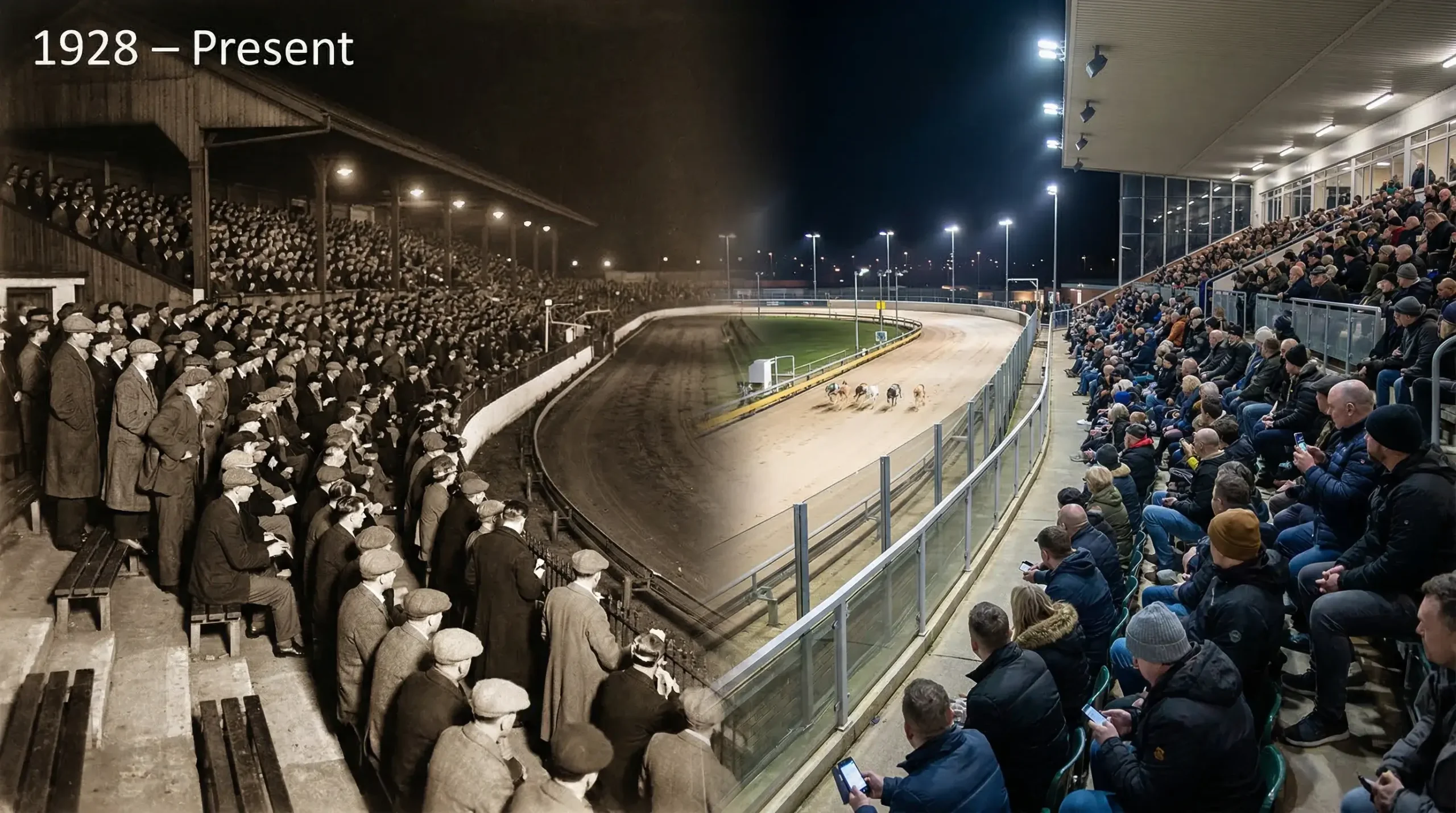
Monmore Green has been part of Wolverhampton since before most of the city’s current residents were born. The stadium opened its gates on 11 January 1928, and on that first evening of racing, 10,000 people packed the terraces to watch seven races under floodlights. The winner of the inaugural event was a greyhound called Arrow Tranby, covering 500 yards in 32.08 seconds at odds of 6/1. Nearly a century later, the stadium is still standing, still staging races, and still drawing crowds — albeit ones measured in the hundreds rather than the thousands. The wider context is set out in our Monmore Green results guide.
The history of Monmore Green mirrors the trajectory of British greyhound racing itself: explosive growth, wartime disruption, post-war decline, corporate consolidation, and a modern era defined by smaller audiences, tighter regulations, and an uncertain but stubborn refusal to disappear. Understanding Monmore’s history is not essential for placing a bet on tonight’s card, but it gives you a sense of the place — its resilience, its scars, and the continuity that connects tonight’s A4 race to that opening night in 1928.
Opening Night and the Pre-War Boom: 1928–1945
Greyhound racing arrived in Britain in 1926, when the first purpose-built track opened at Belle Vue in Manchester. Within two years the sport had exploded. Promoters raced to build stadiums across the country, and Monmore Green was one of dozens that opened in the late 1920s to capitalise on working-class demand for accessible, affordable evening entertainment. By the early 1940s, the sport had grown so rapidly that there were 77 licensed GBGB tracks and more than 200 independent venues operating across the UK.
That opening night at Monmore — 11 January 1928 — set the template for what the stadium would become. The 10,000-strong crowd was enormous for a venue in a suburb of Wolverhampton, and it reflected the genuine popular appetite for greyhound racing in the Black Country. The sport offered something that horse racing at the time did not: evening events under lights, accessible pricing, and a location within walking distance of terraced houses. You did not need a car, a day off work, or a suit. You needed a couple of shillings and a willingness to stand in the cold.
Arrow Tranby’s winning time of 32.08 seconds over 500 yards is a historical footnote now, but it anchors the timeline. That first race was run before electronic timing, before photo finishes, before starting traps replaced manual slipping. The sport at Monmore in 1928 was raw and basic by modern standards, with greyhounds chasing a mechanical lure around a sand track under floodlights that would seem dim by today’s specifications. But the essential product — dogs racing, punters betting, crowds cheering — was recognisably the same sport that runs at the track today.
The pre-war years were the golden age. Attendances across UK tracks peaked in the late 1930s and held strong through the early war years, when greyhound racing was one of the few entertainments allowed to continue during the conflict. Monmore shared in this boom, operating regular fixtures that drew large crowds from across the Black Country and South Staffordshire. The stadium also became a dual-purpose venue during this era, hosting speedway alongside greyhound racing — a partnership that would endure for nearly a century.
The wartime period tested every greyhound track. Some venues were requisitioned for military use; others closed temporarily due to bombing damage or travel restrictions. Monmore survived, and when peace returned in 1945, the stadium was positioned to benefit from the post-war surge in entertainment spending. The late 1940s and early 1950s saw crowds return to pre-war levels, and for a brief window the sport looked as though it would maintain its position as one of Britain’s most popular spectator pastimes.
Fire, Rebuild and Corporate Ownership: 1963–2022
The post-war decline of greyhound racing was slow but relentless. Television arrived, car ownership expanded, and the working-class communities that had filled the terraces began to find other ways to spend their evenings. Tracks started closing in the 1960s and 1970s, and the independent sector — those unlicensed flapping tracks that had operated outside the NGRC framework — shrank fastest of all.
Monmore’s most dramatic moment in this era came in 1963, when a fire damaged significant parts of the stadium infrastructure. The blaze destroyed sections of the grandstand and forced a period of rebuilding that tested the commitment of the stadium’s owners. That they rebuilt rather than sold the land speaks to the commercial viability of the track at that point — greyhound racing was declining nationally, but individual venues with strong local followings could still turn a profit.
The rebuilt Monmore entered a period of corporate ownership that would define the stadium’s modern identity. In 1974, Ladbrokes acquired the track as part of its broader strategy to own and operate greyhound venues alongside its bookmaking business. This vertical integration — owning both the product and the betting operation — became the standard model for survival in an era when independent tracks were closing at an accelerating rate.
Under Ladbrokes and its corporate successors, Monmore benefited from investment that many independent tracks could not match. The facilities were modernised, the racing product was professionalised, and the stadium gained access to national media distribution through partnerships with SIS, the satellite information service that pipes greyhound racing into betting shops across the country. That media exposure was crucial. It meant Monmore’s races were watched — and wagered on — by punters who had never set foot in Wolverhampton, transforming the stadium from a local venue into a national content provider.
Throughout this period, Monmore continued to operate as a dual-purpose venue. The Wolverhampton Wolves speedway team had raced at Monmore since 1928, and the shared use of the stadium created a calendar that divided the year between two-wheeled and four-legged action. The speedway brought its own fanbase and its own revenue, and for decades the arrangement served both sports well. The Wolves built a loyal following in the elite Premiership division, and Monmore became one of the few UK venues where you could watch both greyhounds and speedway in the same week.
The corporate lineage continued when Ladbrokes merged with Coral in 2016 to form GVC Holdings, later rebranded as Entain. Monmore passed into the Entain portfolio, and in 2023 a new joint venture — Premier Greyhound Racing, a partnership between Entain and the Arena Racing Company — assumed responsibility for managing the racing product at nine tracks, including Monmore. PGR’s arrival brought increased investment in prize money and media rights, but it also brought a strategic review that would reshape the stadium’s identity permanently.
The Greyhound-Only Era: 2023 and Beyond
In 2023, Entain announced that speedway at Monmore Green would cease after the current season, ending 95 years of motorcycle racing at the venue. The decision was framed as a strategic reallocation of resources. As Leo Walker, Entain’s Transformation Director for Retail, stated at the time: following the launch of Premier Greyhound Racing, the company had taken a decision to centre its resource and investment on greyhound racing at the track.
The speedway community reacted with dismay. The Wolverhampton Wolves had been a fixture at Monmore since the stadium’s opening year, and their departure severed one of the longest-running venue partnerships in British sport. For speedway fans, the closure represented another loss in a sport that had already seen multiple venues shut their doors. For Monmore as a business, it was a calculated bet: one sport, one focus, one product that Entain and PGR believed could sustain the stadium’s commercial future.
The greyhound-only era at Monmore has brought some practical changes. Without speedway occupying portions of the calendar and requiring specific track configurations, the greyhound schedule has expanded. The racing surface receives more consistent maintenance, and the stadium facilities are dedicated entirely to the greyhound product. Whether these operational improvements translate into a stronger long-term future for the venue remains an open question, but the first signs are cautiously positive. Its owner today is explained in Premier Greyhound Racing.
Monmore’s history is, at its core, a story of adaptation. From a 10,000-capacity spectacle in 1928 to a compact 1,150-seat stadium in 2026, the venue has shrunk in scale but survived. It has changed owners, rebuilt after a fire, absorbed corporate takeovers, lost its speedway tenants, and emerged into a new decade as a focused greyhound-racing operation under one of the largest gambling companies in the world. The dogs still run, the traps still open, and the punters still crowd the rail on a Saturday night — just as they did when Arrow Tranby crossed the line first on that January evening nearly a hundred years ago.
