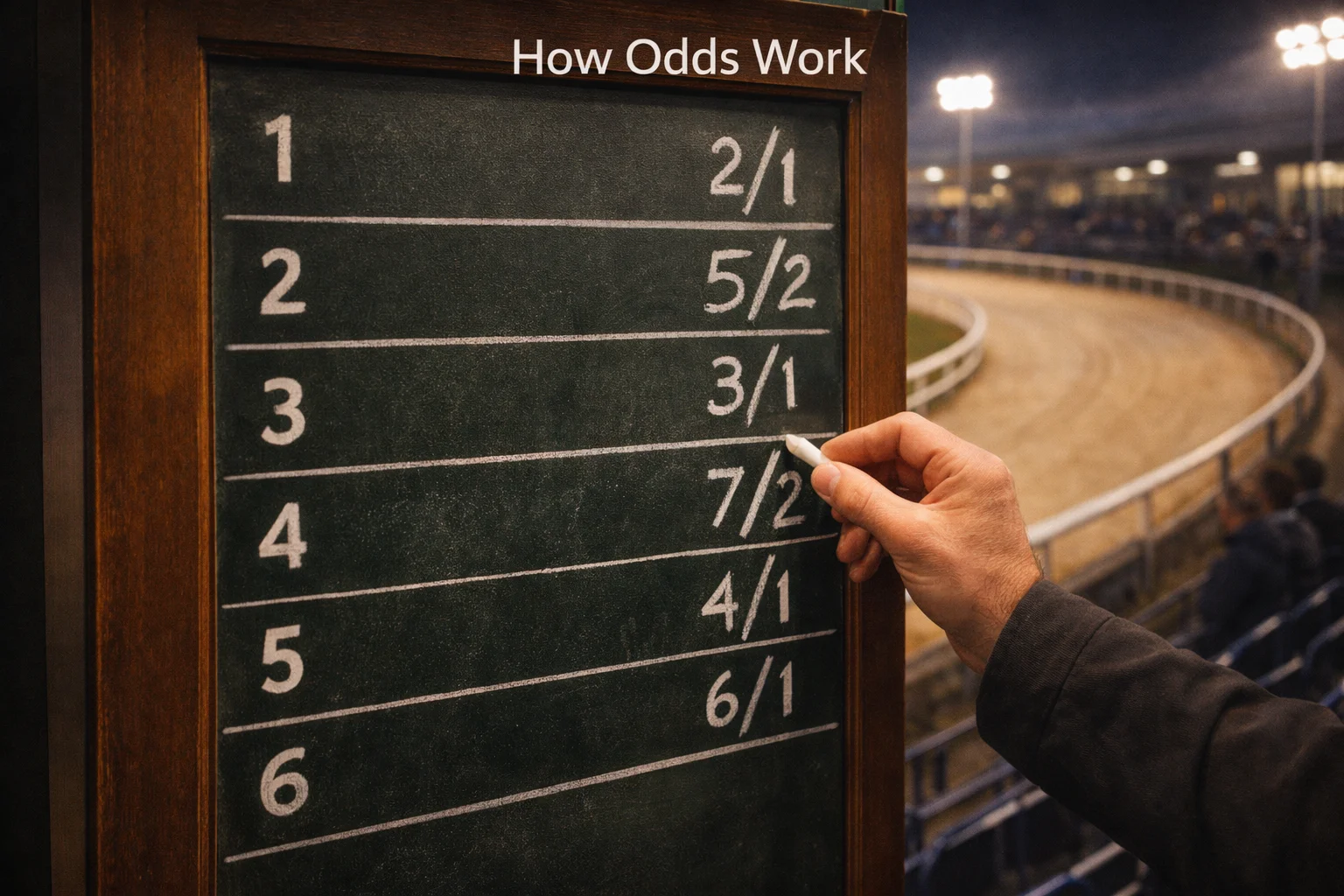
Greyhound odds are not complicated, but they are often poorly explained. Most guides either assume you already understand betting mechanics or drown you in jargon that obscures a simple concept. The reality is that greyhound odds work on the same principles as odds in any other sport — they express the likelihood of an outcome and determine how much you get paid if that outcome occurs. The wider context is set out in our Monmore Green results guide.
At Monmore Green, you can bet through on-course bookmakers, the tote, or via an online bookmaker on your phone. Each channel offers slightly different odds and slightly different bet types. This guide covers the core greyhound odds types — starting price, board price, forecast, tricast, each-way, and the tote pool — and explains what each one means in practical terms for anyone placing bets at the track or from home.
Starting Price vs Board Price: What You Actually Get Paid
The starting price — SP — is the official odds assigned to a greyhound at the moment the traps open. It is determined by the on-course bookmakers and represents the final market assessment of each dog’s chances. If you place a bet at SP, you are accepting whatever the odds are at the off, which means you do not know your exact potential return until the race begins.
Board price is different. When you approach a bookmaker at the track or look at the odds displayed on screens, you see prices that can change between races and even between bets. These are the current market prices, and if you bet at the board price you lock in those odds — your return is fixed at the moment you place the bet, regardless of whether the price shortens or drifts before the off. Online bookmakers also offer early prices that function the same way.
The practical difference matters more than you might think. If you spot a dog at 5/1 twenty minutes before a race and back it at that price, you get 5/1 even if the SP comes in at 3/1. Conversely, if you take 5/1 early and the dog drifts to 8/1 by the off, you have locked yourself into the shorter price. At greyhound meetings, where markets are thinner than in horse racing, prices can shift significantly in the final minutes before a race.
One common misconception is that short-priced favourites are safe bets. They are not. Across UK greyhound racing, favourites win only 30 to 40 percent of races. That means the majority of favourites lose, and backing them at short prices — evens, 4/5, 1/2 — produces a negative return over time unless your selection process is significantly better than the market’s. Understanding greyhound odds means accepting that no price is ever a certainty and that every bet is a probability trade-off.
Fractional odds remain the standard in UK greyhound racing. A price of 4/1 means you receive four pounds for every one pound staked, plus your stake back — so a £5 bet at 4/1 returns £25 in total. Decimal odds, used more commonly online, express the same thing differently: 4/1 becomes 5.00, meaning your total return is five times your stake. Most online bookmakers let you toggle between the two formats.
Forecast and Tricast: Predicting the Finish Order
Forecast betting is one of the most popular bet types in greyhound racing, and it is uniquely suited to the sport because the small field size — six runners — makes predicting the first two finishers a realistic proposition. A straight forecast requires you to name the first and second dog in the correct order. A reverse forecast covers both possible orders of your two selections, effectively giving you two bets for twice the stake.
The returns on forecast bets are calculated by a formula based on the starting prices of the first and second-place finishers, and they can be substantial. A forecast involving two outsiders can return ten, twenty, or even fifty times your stake. A forecast with two short-priced dogs returns less but hits more frequently. The skill lies in finding combinations where the likely finishing order is not fully reflected in the individual prices — situations where the market underrates the chance of a particular dog finishing second behind a likely winner.
Combination forecasts allow you to cover multiple dogs across first and second place. If you select three dogs in a combination forecast, you are effectively placing six straight forecasts. This broader coverage increases your hit rate but multiplies your stake accordingly. At Monmore, where six-dog fields are standard, a three-dog combination forecast gives you coverage across half the field — a reasonable starting point for any race where the form points to a small group of likely contenders.
Tricast betting extends the principle to three places: you must name the first, second, and third in the correct order. The returns are significantly larger than forecasts, but the difficulty increases sharply. With six runners, there are 120 possible exact-order combinations for the first three places. Hitting the right one requires good form analysis combined with luck, which is why tricast bets are best approached as small-stake, high-reward plays rather than core selections. Combination tricasts, covering multiple permutations across three or more selected dogs, offer broader coverage at a proportionally higher total stake.
Each-Way Bets and the Tote Pool: Alternative Markets
Each-way betting in greyhound racing works differently from horse racing, and the rules catch out newcomers regularly. An each-way bet is two bets in one: a win bet and a place bet. In greyhound racing, with fields of six, each-way terms typically pay out on first and second at a fraction of the win odds — usually one quarter. So if you back a dog each-way at 8/1 with quarter-the-odds place terms, the place part pays 2/1 if the dog finishes first or second.
The each-way option is most useful when you rate a dog highly but are not confident it will win. If your selection finishes second, you lose the win part but collect on the place part, softening the blow. The maths works best at longer prices: an each-way bet on a 10/1 shot that finishes second returns 2.5/1 on the place portion, which covers the total stake and produces a small profit. At shorter prices, each-way bets become less attractive because the place return does not compensate adequately for the doubled stake.
The tote pool is an alternative to fixed-odds betting. Instead of accepting a set price, your stake goes into a pool with all other bets on the same race. After the result, the pool is divided among the winning bets, minus an operator deduction. Tote returns are unpredictable — they depend on how much money is in the pool and how it is distributed across the runners. On popular races with large pools, the tote often pays close to SP. On quieter meetings, pools are smaller and returns can diverge significantly, sometimes favouring the bettor. The staking side is covered in the betting guide.
The broader context for pool betting is worth noting. Greyhound betting turnover has declined by 23 percent in real terms over three years, which directly affects pool sizes. Smaller pools mean more volatile tote returns and a greater likelihood of dividends that differ from SP. For experienced bettors, this volatility can be exploited — but for anyone learning how greyhound odds work, starting with fixed-odds bets from bookmakers is the simpler and more predictable route.
