
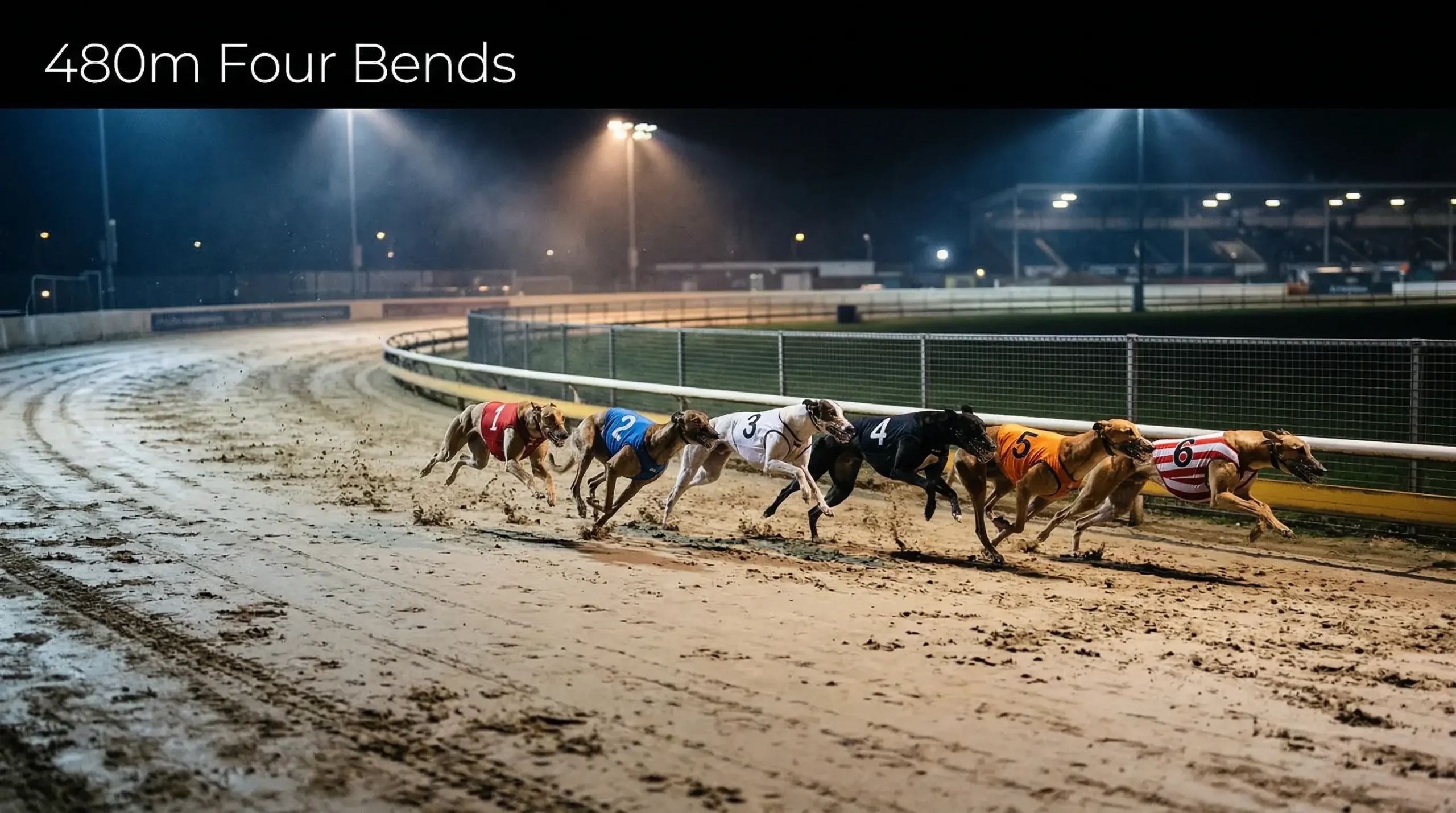
The 480-metre distance is the backbone of racing at Monmore Green. It is the standard trip — the one that fills most cards, produces the largest sample of data, and shapes the way punters and trainers think about the track. Every evening meeting and the majority of afternoon BAGS fixtures feature multiple 480m races, making it the distance where trap statistics carry the most weight and the most reliability. The wider context is set out in our Monmore Green results guide.
At Monmore’s 419-metre oval, the 480m trip involves four bends and a finish straight, with the first turn arriving at the 103-metre mark. That geometry is not just a piece of trivia — it is the single most important factor in understanding why certain traps outperform others at this distance. The run to the first bend is relatively short, which means dogs drawn inside have less ground to cover before they can claim the rail, and dogs drawn wide face a genuine structural disadvantage that no amount of early speed can always overcome.
This article examines the 480m trap performance data at Monmore, explains the running lines that create those numbers, and shows how to apply this information when making your selections.
Trap Win Rates at 480 Metres: What the Data Shows
Across UK greyhound tracks, Trap 1 — the red jacket, closest to the inside rail — averages a win rate of approximately 18 to 19 percent. In a perfectly balanced six-trap race, each position would win 16.66 percent of the time. That two-to-three percentage point advantage for the inside draw is not random noise. It is a structural feature of oval racing, and at Monmore’s 480m distance it is particularly pronounced because of the track’s geometry.
The data consistently shows that lower-numbered traps — Trap 1 and Trap 2 — outperform theoretical expectations over 480 metres at Monmore. Trap 1 benefits from immediate rail access. The dog does not need to cross any ground to find the inside running line; it is already there from the moment the lids open. Over four bends, that positional advantage compounds. Each bend rewards the dog on the rail with a shorter distance to travel, and over four bends the cumulative saving adds up to a meaningful margin.
Trap 2 also performs well because it has only one dog between it and the rail. A Trap 2 runner with decent early pace can tuck in behind or alongside the Trap 1 dog within the first fifty metres and secure a rail-hugging position before the first bend. Trap 3 sits in an intermediate zone — it can benefit if the inside dogs are slow to break, but it carries more risk because it needs to negotiate past two rivals to reach the rail.
The middle traps, particularly Trap 4, tend to perform close to the theoretical average at 480 metres. These dogs are neither close enough to the rail to claim it easily nor far enough outside to find clear running room. At Monmore, Trap 4 runners frequently end up in traffic at the first bend, squeezed between inside dogs cutting across and outside dogs drifting wide. The result is a win rate that hovers around or just below the expected 16.66 percent.
Traps 5 and 6 — the wide draws — face the biggest challenge over four bends. A Trap 6 runner at Monmore has to cover extra ground on every bend unless it possesses enough raw speed to lead into the first turn and dictate the race from the front. Some outside dogs manage this, particularly in lower-grade races where early pace is less uniform. But in A1 and A2 fields, where every dog breaks sharply, the wide traps are at a measurable disadvantage that shows up clearly in the long-term win percentages.
One important caveat: trap statistics are not destiny. They describe tendencies across hundreds of races, not the outcome of any individual one. A top-class greyhound in Trap 6 will still beat a moderate one in Trap 1 more often than not. The value of 480m trap performance data lies in identifying marginal edges — the situations where two evenly matched dogs are drawn in different traps, and the positional advantage tilts the probability just enough to influence a sensible bet.
Running Lines and Bend Positioning Over Four Bends
Numbers alone do not explain why certain traps dominate at 480 metres. To understand the data properly, you need to picture what actually happens when six dogs leave the traps and funnel into Monmore’s first bend at the 103-metre mark.
The run to that first bend is short — just over a hundred metres of straight track. In a sport where greyhounds can reach speeds above 40 miles per hour within a few strides, 103 metres disappears quickly. Dogs in Traps 1 and 2 have the shortest path to the bend and the smallest angle of approach. They can maintain a straight running line into the turn, which means less deceleration and less energy spent changing direction. Dogs in Traps 5 and 6 face a wider angle and must either cut across towards the rail — risking interference with dogs to their inside — or take the bend wide, covering extra ground.
On a reported occasion at Monmore, Trap 1 won seven out of twelve races in a single meeting — a 58 percent strike rate against an expected 16.66 percent. That kind of extreme clustering does not happen at every meeting, but it illustrates how powerfully track geometry can influence outcomes on a given night, especially when track conditions and running surface characteristics amplify the inside advantage.
Over the second and third bends, the running lines become more established. Dogs that secured the rail at the first bend tend to hold it because greyhounds are creatures of habit — once they find a rail, they follow it. This means the early positional advantage gained by inside traps carries through the entire race. The fourth and final bend often decides the outcome in tight 480m races, and here the rail dog has one last structural edge: it rounds the bend on the shortest possible arc and enters the home straight with momentum preserved.
Wide runners do have one tactical weapon at 480 metres: the ability to challenge on the outside off the final bend. If an outside-drawn dog has maintained its speed through the middle of the race while inside dogs have been bumping and checking each other, it can sweep around the final turn with a clean run and use the home straight to overhaul tired rivals. This happens most often in middle and lower grades, where early pace is inconsistent and the first bend produces more crowding and interference. In high-grade races, the front runners tend to be cleaner in their running, which narrows the window for outside closers.
The surface condition at Monmore also plays a role in how running lines develop over 480 metres. On a damp evening after rain, the inside rail can become chewed up by the first few races, reducing the grip advantage that Trap 1 normally enjoys. Experienced Monmore bettors pay attention to early race results to detect whether the track is running true to its usual pattern or whether conditions are shifting the advantage across the traps.
Using 480m Trap Data in Your Selections
Knowing the 480m trap performance data at Monmore is useful. Knowing how to apply it without falling into lazy habits is what separates profitable bettors from the rest.
The most common mistake is backing Trap 1 automatically in every 480m race. Yes, Trap 1 has an above-average win rate. But the market knows that too. Bookmakers adjust their prices to reflect trap bias, which means the inside draw is already factored into the odds in most races. Blindly backing red jackets at Monmore will not produce a long-term profit because the odds you receive are shorter than they should be relative to the actual advantage.
The smarter approach is to use trap data as a filter rather than a selection method. Start with form — which dogs in the race have the best recent times, the strongest finishing positions, and the most relevant experience at 480 metres? Then overlay the trap draw. If your top-rated dog on form happens to be drawn in Trap 1 or Trap 2, the trap data confirms your selection and gives you additional confidence. If your best-rated dog is in Trap 6 and a slightly weaker dog is in Trap 1, you have a genuine decision to make, and the trap data helps you weigh the probabilities.
Trap statistics also help with forecast and tricast betting, which many Monmore regulars favour. When constructing a forecast, placing inside-drawn dogs in your first and second positions reflects what the long-term data shows about positional advantage. A Trap 1 to Trap 3 forecast at 480 metres hits more frequently than a Trap 5 to Trap 6 forecast, all else being equal. This does not mean you should never include wide draws in your perms — it means you should weight your selections toward the traps that the data supports. The sprint is covered in 264m trap stats.
One final consideration: meeting-level trends. Trap statistics are most useful when viewed across a large sample, but within a single meeting the track surface can develop biases that differ from the overall pattern. If Trap 5 and Trap 6 win the first three races of an evening, it may signal that the outside is running fast that night, and adjusting your approach for the remaining races is sensible. The 480m trap performance data gives you the baseline; what happens on the night gives you the context.
