
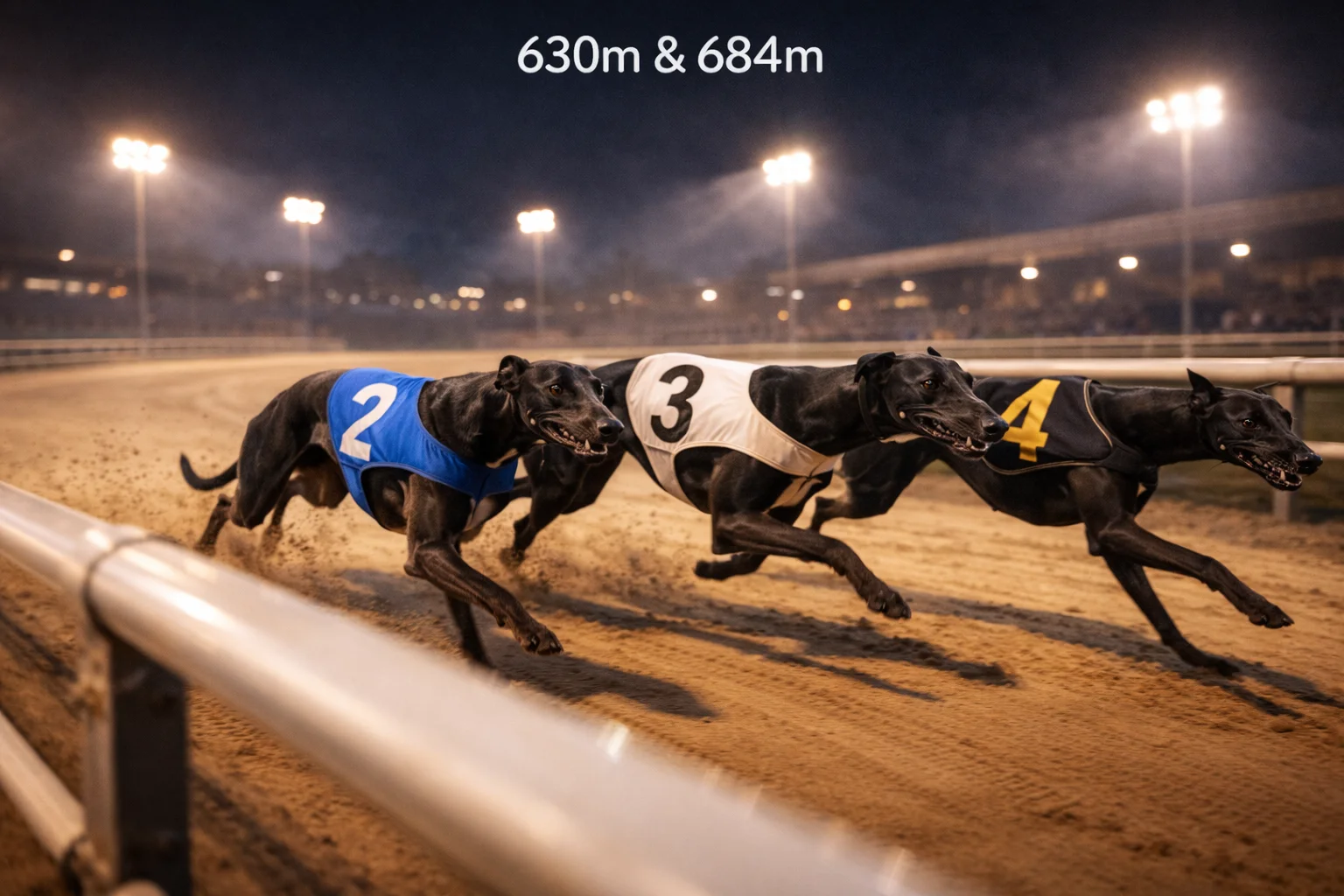
Monmore Green offers five racing distances, and two of them sit in territory that most punters find harder to assess than the sprint or the standard trip. The 630-metre and 684-metre races are the middle distances at this track — long enough to demand genuine stamina, short enough that early pace still matters, and tactical enough to reward the kind of analysis that separates serious bettors from those who rely on gut feeling. The wider context is set out in our Monmore Green results guide.
These races do not appear on every card. They feature less frequently than the 480m, which means the sample of data is smaller and the market is often less efficient. For anyone willing to do the homework, the middle distances at Monmore represent a real edge — a part of the card where public attention dips but where good form reading and an understanding of how extra bends change the race dynamics can produce consistent value.
This guide breaks down the differences between the 630m and 684m trips, explains what to look for in middle-distance form, and covers how the stamina component reshapes the trap draw equation.
630m vs 684m: Same Category, Different Demands
The 630m and 684m distances share the “middle-distance” label, but grouping them together hides a meaningful difference. The 630m race covers roughly one and a half laps of Monmore’s oval, involving six bends. The 684m adds an extra half-bend worth of running, taking the total to approximately six and a half bends before the finish. That additional fifty-four metres changes the race in ways that are not obvious from the numbers alone.
At 630m, the race begins on a different part of the track compared to the 480m start. The first turn still arrives at the 103-metre mark of the circuit, but the starting position means dogs approach it from a different angle. The opening phase of a 630m race is about establishing position for a longer journey — trainers and experienced dogs instinctively know that burning energy to lead into the first bend is less rewarding when there are five more bends to negotiate. This produces a slightly different pace profile compared to 480m races, where the first-bend battle is often decisive.
The 684m pushes the stamina requirement further. The extra distance means dogs are running for several seconds longer, and in greyhound racing, where even a couple of seconds can expose a stamina deficit, those additional metres act as a filter. Dogs that lead early and tire late — a common pattern at 480m among fast but one-paced runners — tend to be found out at 684m. The final bend and home straight become a test of reserves rather than a victory lap, and it is here that the genuine middle-distance specialists separate themselves.
Bend negotiation is the other distinguishing factor. Six bends at 630m and roughly six and a half at 684m mean that the total distance covered on bends, as opposed to straights, is proportionally higher than at 480m. Dogs that lose momentum on bends — those that run wide, check when crowded, or decelerate noticeably through turns — are at a compounding disadvantage at these distances. Each sloppy bend costs time, and when there are six of them, the cost adds up to lengths rather than fractions.
The distinction between 630m and 684m also shows up in the type of dog that thrives at each trip. The 630m is accessible to many 480m runners that have a touch of stamina in their pedigree. It does not require a fundamentally different type of greyhound; it requires a slightly better engine and cleaner bend work. The 684m is more selective. Dogs entered here are typically those that have shown they can sustain effort over a distance, and trainers enter them at this trip deliberately. When you see a dog with five recent 480m runs suddenly appearing in a 684m race, the trainer has made a judgement about that dog’s staying ability — and that judgement is information worth noting.
The surface at Monmore plays a bigger role over these distances too. A track that is running heavy after rain penalises all runners, but the effect is amplified over 630 and 684 metres because dogs are in contact with the surface for longer. A greyhound that handles softer going can gain a real advantage in middle-distance races when conditions deteriorate, and checking the weather and early race conditions before betting on the later 630m or 684m events is a habit worth developing.
Reading Form for Middle-Distance Races at Monmore
Reading form for middle-distance races at Monmore requires a shift in priorities compared to the standard trip. At 480m, early pace and trap speed dominate the assessment. At 630m and 684m, those factors still matter, but they share the stage with stamina indicators and bend-running quality.
The first thing to check is a dog’s distance history. A form line that includes multiple runs at 630m or 684m tells you the trainer considers this dog a middle-distance type. A dog stepping up from 480m for the first time is an unknown quantity at the trip, and while it might handle the extra distance comfortably, the risk is higher. Look at the finishing positions in recent races: a dog that consistently finishes strongly at 480m — closing on the leaders in the home straight — is a better candidate for stepping up than one that leads early and fades.
Sectional times, where available, are more revealing at middle distances than at any other trip. A dog that posts a fast early split but a notably slower second half is showing a stamina limitation that may not cost it at 480m but will be exposed over 630m or 684m. Conversely, a dog with a moderate first split but a strong second half is displaying the kind of sustained effort that translates well to longer trips.
Weight changes deserve attention in middle-distance form analysis. A greyhound that has gained a kilogram since its last run is carrying extra mass over six bends instead of four, and the energy cost of that extra weight compounds with every stride. Small weight increases that might be irrelevant at 264m become meaningful at 630m and above. Trainers are aware of this, which is why middle-distance specialists tend to be kept at a consistent racing weight more carefully than sprinters.
Race comments in the form line also carry different weight at these distances. A comment like “crowded bend three” at 480m means the dog lost position at the halfway point. The same comment at 630m means the dog lost position at roughly the one-third mark and had four more bends to recover. The recovery potential is greater, but the energy cost of the crowding is higher because the dog has further to run. Comments about late fading — “weakened from the fifth bend” or “no extra final bend” — are direct stamina flags that should influence your assessment significantly.
Stamina Bias and Trap Draw: Betting the Middle Distances
The trap draw at middle distances behaves differently from what most punters expect based on their 480m experience, and understanding that difference is where the betting edge lies.
At 480m, the inside traps enjoy a clear structural advantage because the rail saves distance over four bends and the short run to the first turn rewards early inside positioning. At 630m and 684m, the rail advantage still exists — the physics of oval racing do not change — but its impact is diluted by two factors. First, the pace of the early exchanges is often less frenetic at middle distances, which means outside-drawn dogs have more time to find position before the first bend becomes critical. Second, over six or more bends, the race has more phases where positional changes can occur, which reduces the dominance of the first-bend outcome.
The UK average for Trap 1 sits at around 18 to 19 percent across all distances. At Monmore’s middle distances, the inside trap still outperforms the theoretical level, but the margin above expected is typically narrower than at 480m. This creates an interesting dynamic for bettors: the market often prices the inside draw at middle distances as if the advantage were as strong as at the standard trip, which means outside-drawn dogs can occasionally be undervalued.
Stamina is the variable that most alters the betting calculus at these distances. A greyhound with proven stamina and a wide trap draw is a better proposition at 684m than the same dog would be at 480m from the same box. The reasoning is straightforward — if the dog can sustain its effort while rivals tire, the extra ground covered from a wide draw becomes less penalising because the inside dogs are decelerating too. Late-closing types drawn wide at 630m or 684m are some of the most consistently underpriced runners on the Monmore card. The marathon trip is analysed in 835m stayers.
Forecast betting at middle distances rewards patience and form study. Because these races feature more tactical variation than sprints or standard trips, the finishing order is harder for the casual bettor to predict, which inflates the pool returns. If you have done your homework on stamina profiles, bend-running ability, and distance history, the middle-distance races at Monmore offer some of the most rewarding forecast and tricast opportunities on the card.
