
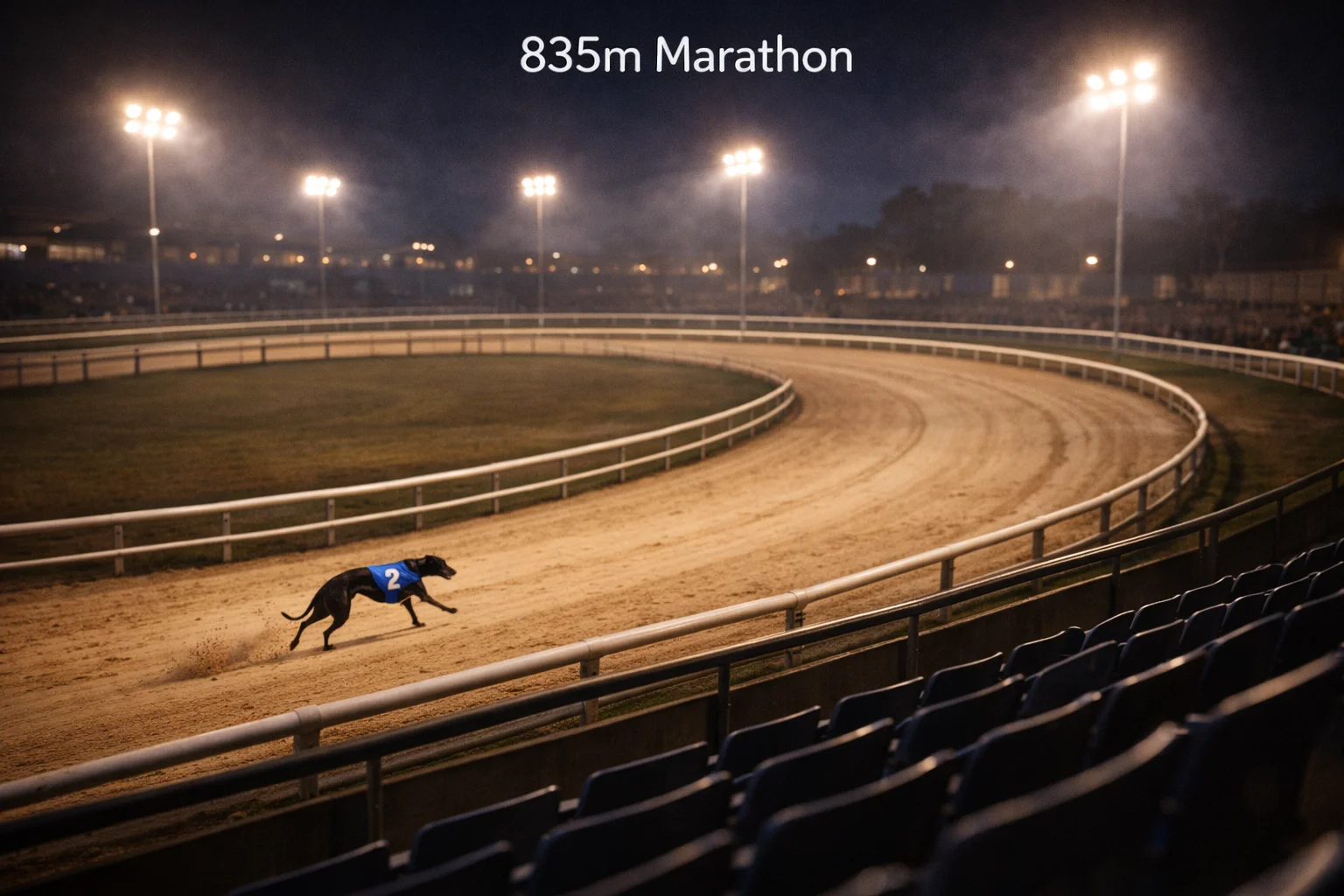
The 835m at Monmore Green is a different sport. That might sound like an exaggeration, but anyone who has watched a marathon greyhound race and compared it to a 264m sprint will tell you the same thing. The pace is different, the tactics are different, the type of dog that wins is different, and — crucially for anyone with money at stake — the way you read form and assess the draw has to change completely. The wider context is set out in our Monmore Green results guide.
At 835 metres, Monmore’s longest distance, the race covers two full laps of the track plus a section of a third. That means eight bends, two home straights, and a total running time that stretches well beyond the thirty-second barrier. For context, a 480m race lasts roughly twenty-nine to thirty seconds in the middle grades. An 835m race adds another twenty seconds or more, and those extra seconds are where the entire character of the race changes.
Marathon races at Monmore appear less frequently on the card than any other distance, which creates both a challenge and an opportunity for bettors. The challenge is a smaller data sample. The opportunity is a less efficient market, where prices are set with less certainty and where informed punters can find real value.
What Happens Over 835 Metres: Pace Patterns and Splits
The most important concept in 835m racing is pace collapse — the point in a race where a dog that set the early fractions begins to decelerate, sometimes dramatically. Every greyhound has a finite supply of anaerobic energy. In a 264m sprint, that supply is more than enough to sustain top speed for the entire race. At 480m, most dogs can maintain close to their peak through four bends before the home straight demands a final effort. At 835m, no greyhound on earth can sustain its early speed for the full distance. Every dog slows down. The question is which ones slow down the least.
The pace pattern in a typical Monmore 835m race follows a predictable arc. The first lap looks a lot like a normal 480m race — dogs break from the traps, jostle for position through the first two bends, and settle into running order along the back straight. At this point, the race is only half done. The second lap is where the separation begins. Dogs with genuine stamina maintain a rhythm through bends five and six while their rivals start to shorten stride. By the seventh bend, the race often looks completely different from how it started. The dog that led by three lengths at the halfway mark may now be fading, while a dog that sat fourth or fifth early is cruising into contention.
Pace collapse is not uniform — it depends on how fast the early fractions were. When two or three dogs contest the lead aggressively through the first lap, they burn each other out and create an opportunity for closers to sweep past in the final quarter of the race. When the early pace is moderate, the leader has a better chance of hanging on because it has conserved more energy. This is why 835m races at Monmore are so tactically rich. The shape of the race is not determined by the trap draw alone; it is shaped by the interaction between the dogs’ natural running styles and the pace they set in the opening exchanges.
Sectional splits reveal the collapse in hard numbers. A dog that runs the first 420 metres in twenty-six seconds might run the second 415 metres in twenty-eight or twenty-nine seconds — a drop of two to three seconds that translates to several lengths. The dogs that win 835m races at Monmore are typically those whose sectional drop-off is smallest: they might slow from twenty-six seconds to twenty-seven rather than twenty-nine. That one-second difference in fade rate, compounded over the second lap, is the margin between winning and finishing in the pack.
The two home straights in an 835m race also create a unique visual dynamic. Dogs pass the finish line once without stopping, and for punters watching in the stadium or on a stream, the positions at that first crossing are a useful mid-race checkpoint. If your selection is lying third as they pass the line for the first time, running within its stride and not under pressure, that is a strong sign. If it is already visibly labouring — remember, there is no jockey to push a greyhound along; the dog’s own reserves are all it has — the second lap is unlikely to improve things.
Identifying a Stayer: Form Clues Beyond Finishing Position
Identifying a true stayer from form alone is a skill that takes time to develop, but there are reliable indicators that show up repeatedly at Monmore’s 835m distance.
The most obvious clue is distance history. A dog with multiple 835m runs in its recent form has been identified by its trainer as a marathon type. Trainers do not enter dogs at this distance casually — it requires specific preparation and conditioning. Of the 5,133 new greyhounds registered with GBGB in 2024, only a fraction will have the temperament and physiology to compete at marathon distances. Stayers are specialists, and their form lines reflect that specialisation.
Finishing positions tell part of the story, but at 835m they need to be read with more nuance than at shorter distances. A dog that finishes second by two lengths at 835m has performed better than the same margin would suggest at 480m, because the race is longer and the cumulative effort is greater. What matters more than the finishing position is the pattern of the run. Look for comments that describe a dog finishing strongly — phrases like “stayed on well,” “ran on from the sixth bend,” or “closing at the line.” These indicate a dog that has stamina in reserve, which is the currency of marathon racing.
Weight and condition are more important at 835m than at any other distance. A greyhound carrying extra weight over two laps of the track is burning significantly more energy than the same dog at its ideal weight over one lap. Consistent weight — or a slight reduction from recent runs — is a positive signal for marathon performance. A dog that has gained half a kilogram between runs might not notice it at 264m. At 835m, that extra mass has to be carried for fifty seconds or more, and the energy cost is not trivial.
Pedigree is worth a glance, though it is not decisive. Some sire lines are known for producing stayers — dogs with natural aerobic capacity and an even temperament that suits long-distance racing. If a dog’s sire or dam has a record of producing marathon runners, it adds a piece of circumstantial evidence to your assessment. But pedigree is a background factor, not a primary one. Form, fitness, and running style should always take priority in your analysis.
One underrated indicator is a dog’s behaviour in the traps and in the opening strides. Stayers tend to be calmer at the start. They do not burn nervous energy before the lids open, and they break from the boxes with measured acceleration rather than the explosive burst of a sprinter. This calm departure is not a weakness at 835m — it is an asset, because it preserves the energy that will matter most in the second half of the race.
Trap Draw at 835m: Does Position Still Matter?
The question every punter asks about the trap draw at 835m is whether it matters as much as it does at 480m. The short answer is: less, but it still matters.
The UK-wide average for Trap 1 across all distances sits at around 18 to 19 percent. At 835m, the inside trap advantage narrows compared to shorter distances, and the logic is straightforward. Over eight bends, there are more opportunities for positional changes. A dog that loses the rail at the first bend has seven more bends where it can regain a favourable position, and the longer race gives it time to recover from early crowding. At 264m or 480m, losing the first bend can end your chance. At 835m, it is a setback rather than a death sentence.
That said, the inside traps at 835m still carry an advantage at Monmore, because the rail saves distance on every single bend. Eight bends at a slight distance saving per turn adds up to a meaningful total over the full trip. A Trap 1 runner that stays on the rail for the entire 835m covers measurably less ground than a Trap 6 runner that races wide throughout. The difference is that at marathon distances, the dog’s stamina and race intelligence matter more than its starting position, so the trap advantage is less dominant in the overall outcome.
The traps that become more interesting at 835m are the middle ones — Traps 3 and 4. At shorter distances, these traps are often caught in traffic. At 835m, the slower initial pace and the longer race give middle-drawn dogs more room to find position without being squeezed. A Trap 3 runner in a marathon race can settle in behind the early leaders, conserve energy through the first lap, and then move to the rail as the pace setters begin to tire. This tactical running style suits the middle traps because they have access to both the inside and outside running lines.
Wide traps remain at a disadvantage, but the extent of that disadvantage depends heavily on the dog’s running style. A wide-drawn closer — a dog that naturally sits behind the pace and finishes strongly — can be a serious threat in 835m races because it has the entire second lap to work its way into the race. The market often discounts wide-drawn marathon dogs more aggressively than the data warrants, creating pockets of value for bettors who understand the reduced importance of trap draw at this distance. The middle distances are covered in 630m and 684m.
The small sample size at 835m is the main challenge when analysing trap data. Monmore runs fewer marathons than 480m races, which means the trap statistics are noisier and less reliable as standalone indicators. Use them as context rather than gospel: the inside still has an edge, the outside is still at a disadvantage, but the margins are tighter and the dog’s individual qualities matter more than at any other distance on the card. At 835m at Monmore, the best dog usually wins, regardless of the trap. Usually.
