
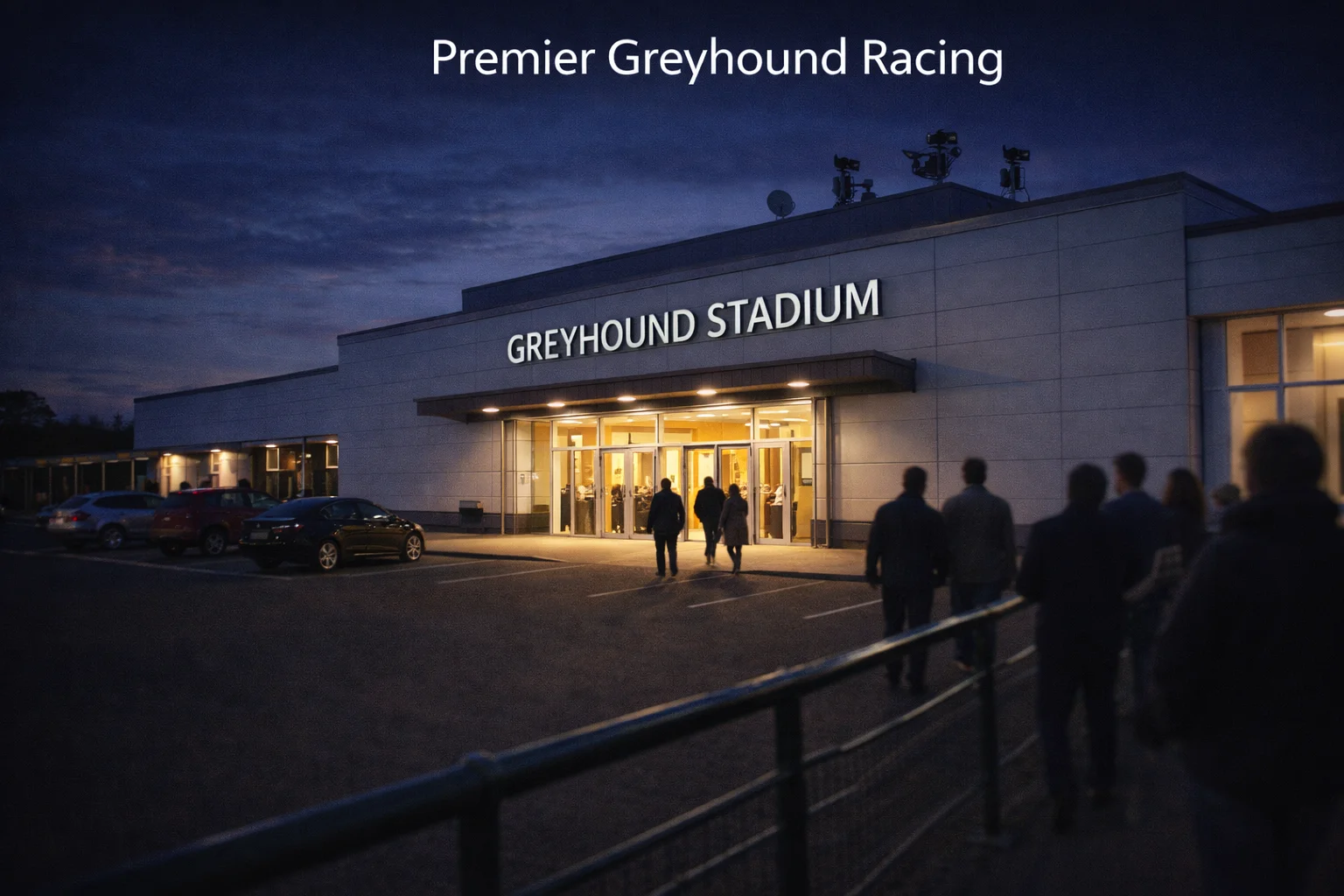
If you follow greyhound racing at Monmore Green or any of the other major UK tracks, you have been affected by Premier Greyhound Racing whether you know it or not. PGR is the joint venture between Entain and the Arena Racing Company that, since its launch, has reshaped media rights, prize money distribution, and track operations across nine licensed greyhound tracks in the UK, with initial investments in open racing prize money exceeding 2.5 million pounds. That is not a minor adjustment to the landscape. It is the most significant structural change in UK greyhound racing in decades. The wider context is set out in our Monmore Green results guide.
Understanding the PGR model matters for punters because it directly affects what you see on the racecard, the quality of the dogs you are betting on, and the fixture schedule that determines when and where racing takes place. This guide explains how PGR came into existence, what it changed, and how its influence plays out at Monmore.
Entain, ARC and the Birth of Premier Greyhound Racing
Premier Greyhound Racing launched as a 50-50 joint venture between Entain and the Arena Racing Company. Entain, the gambling group behind Ladbrokes and Coral, brought the tracks and the customer base. ARC, which operates horse racing venues and holds media rights across multiple sports, brought expertise in content distribution and rights negotiation. Together, they created a coordinated product across multiple venues rather than leaving each track to operate independently in a fragmented market.
The PGR network initially encompassed nine tracks, including Monmore Green, and the venture secured media rights deals with major UK retail betting operators. Racing from PGR tracks is broadcast into betting shops nationwide through SIS, the satellite information service that has been the backbone of off-course greyhound betting for decades. By controlling media rights centrally, PGR negotiates better terms with bookmakers than individual tracks could achieve alone, a consolidation play that mirrors what happened in horse racing years earlier.
The initial investment of more than 2.5 million pounds into open racing prize money was designed to elevate the quality of the product. Higher prizes attract better dogs and more ambitious training operations, which produces more competitive racing and higher betting volumes. The theory is sound, though the execution has involved difficult decisions, including the closure of some venues and the concentration of resources at the most commercially viable tracks.
The corporate structure shapes PGR’s incentives. As a joint venture between a gambling operator and a media company, its primary concern is generating content that drives betting turnover. The racing product exists, in commercial terms, to create wagering opportunities. That alignment means PGR is motivated to invest in quality, because better racing generates more betting, which generates more revenue for the venture and its partners. Whether that commercial logic produces outcomes that are good for the sport, the dogs, and the fans is a question that different stakeholders answer differently.
What PGR Changed: Prize Money, Media Rights and Track Operations
The most visible change under PGR has been the redistribution of prize money. Open racing events at PGR tracks receive larger purses than they did under previous arrangements, which has improved the quality of feature-night fields. The Gold Cup at Monmore, for instance, carries a prize that reflects the investment in the premium end of the sport. For graded racing, the everyday A1-to-A10 programme, the effects are more subtle, with prize money levels maintained rather than dramatically increased.
Media rights centralisation is the less glamorous but more consequential change. Before PGR, individual tracks negotiated their own broadcasting deals, which produced inconsistent coverage and variable quality. Under PGR, the media product is coordinated: camera angles, graphics, commentary, and broadcast schedules are standardised across the network. For bettors watching in shops or online, this means a more professional and consistent viewing experience regardless of which PGR track is hosting the current race.
Track operations have also been reshaped. PGR’s strategic review led to the closure of Crayford in January 2025 and the transition from Perry Barr to Dunstall Park later that year. These were commercially driven decisions, consolidating racing at fewer, better-resourced venues rather than spreading investment across a larger number of ageing stadiums. The approach is controversial among racing fans who lost their local tracks, but it reflects the reality that the sport’s shrinking audience and declining betting turnover cannot sustain the number of venues that existed a decade ago.
The financial pressures on the industry provide important context. BGRF revenue fell from 7.6 million pounds in 2022-23 to 7.3 million in 2023-24, continuing a long-term decline from historical peaks above 20 million. PGR’s response has been to prioritise quality over quantity: fewer tracks running better racing with higher production values, aimed at sustaining the sport’s commercial relevance in a contracting market. Whether that strategy succeeds depends on whether improved quality can offset the loss of venues and the broader decline in greyhound betting volumes.
How PGR Affects What You See at Monmore
For a regular Monmore racegoer, the PGR era has brought changes that range from the obvious to the barely perceptible. The most noticeable is the fixture schedule: Monmore’s weekly card is coordinated with other PGR tracks to avoid clashes, which means the days and times of meetings are determined by the network rather than by the stadium alone. This coordination benefits bettors by ensuring a spread of racing across the week, but it also means Monmore has less autonomy over its own calendar than it did when it operated independently.
The quality of the broadcast product has improved. If you watch Monmore racing through a betting shop screen or an online stream, the camera work, graphics, and commentary are noticeably more polished than before PGR standardised the production. This matters significantly for the much larger audience watching remotely and placing bets without attending in person. For an industry where the overwhelming majority of betting revenue comes from off-course customers, the broadcast quality is arguably the most important product improvement PGR has delivered.
Prize money at Monmore has been maintained at levels that attract competitive fields, and feature events have benefited from PGR’s investment in open racing. The closure of speedway at the stadium in 2023, a decision made by Entain as part of its broader strategy, freed resources for greyhound-focused investment, and the PGR model has channelled some of those resources into the racing product. For bettors, the practical effect is a racing programme that is more consistent in quality: fewer weak meetings, fewer fields where one dog is miles ahead of its opponents, and a more predictable card that rewards serious form study. Where the sport is heading is in the future of UK racing.
Whether the sum of these changes makes Monmore a better or worse venue than it was before PGR depends on what you value. If you prize the independence and local character of a standalone greyhound track, the corporatisation under PGR represents a loss. If you care most about the quality of the racing and the reliability of the product, the PGR model has delivered measurable improvements. The dogs still run. The traps still open. The punters still line up at the tote. The model behind them has changed, and that change is reshaping what greyhound racing looks and feels like at Monmore and across the country.
