
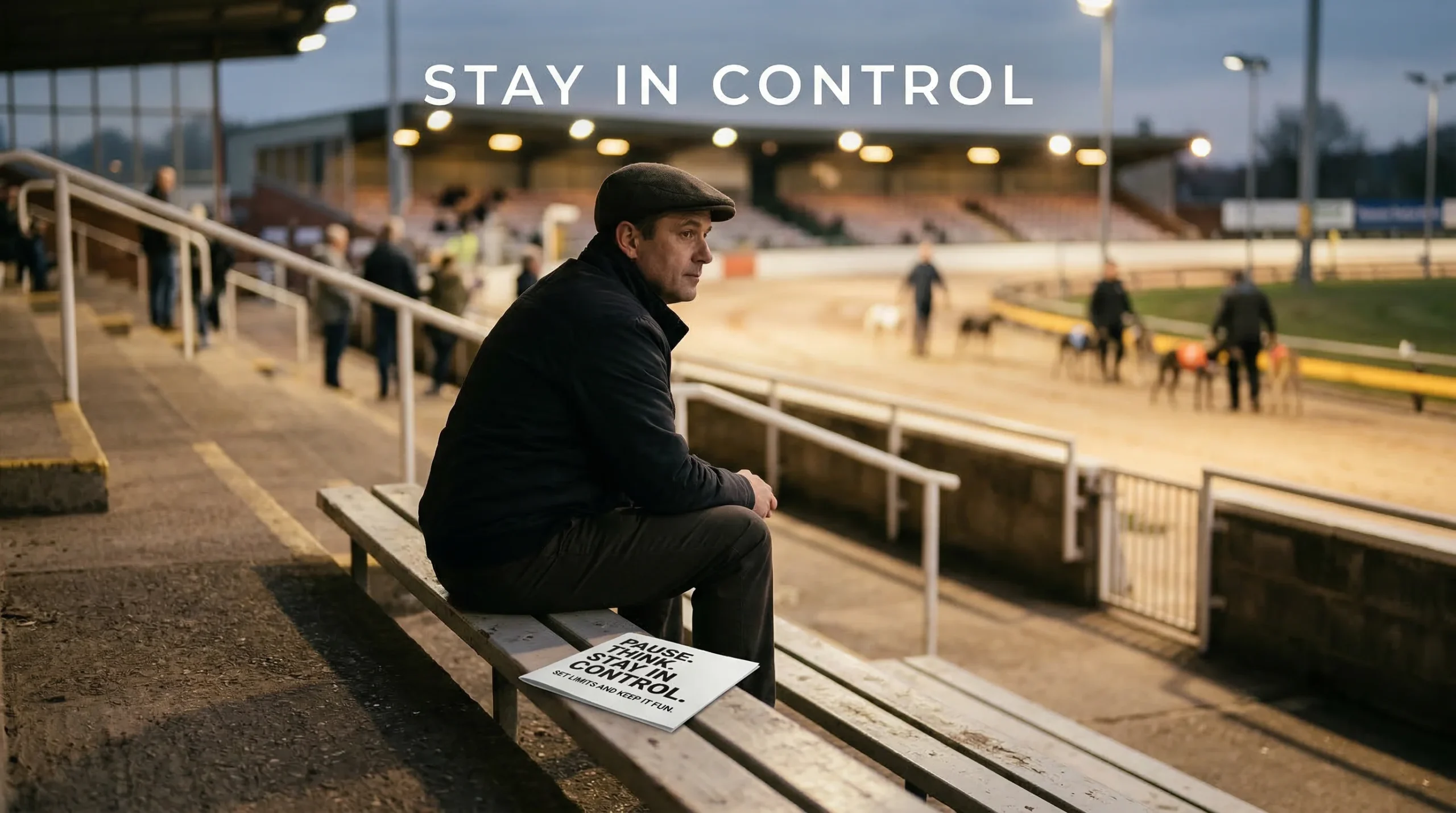
A night at Monmore Green is supposed to be fun. The racing is fast, the atmosphere is social, and the betting adds an edge that makes every race feel personal. For most people, it stays exactly that — an evening’s entertainment that costs roughly the same as a decent meal out, with the occasional win to sweeten the deal. But gambling has a way of shifting from leisure to compulsion without announcing the transition, and greyhound racing’s rapid pace — a new race every twelve to fifteen minutes, each one a fresh opportunity to chase a loss or press a winning streak — can accelerate that shift in ways that slower sports do not. The wider context is set out in our Monmore Green results guide.
This guide is not a lecture. It is a practical look at how to set limits before you arrive at Monmore, how to recognise the signals that betting has moved from enjoyment to problem, and where to find help if you or someone you know needs it. Staying in control is not about betting less — it is about betting with awareness.
Setting Limits Before You Arrive: Time, Money, Mindset
The most effective responsible gambling strategies are the ones you put in place before the first race, not the ones you try to implement after race eight when your bankroll is half gone and the temptation to double up is whispering in your ear.
A money limit is the foundation. Decide before you leave the house how much you are prepared to lose — not how much you plan to bet, but how much you can afford to lose entirely and walk away without financial stress. That number is your ceiling. Once you reach it, the evening’s betting is over. You can still watch the racing, enjoy the atmosphere, and have a drink, but the tote window and the bookmaker app are closed. Writing this number down or setting a deposit limit on your betting account makes it concrete rather than aspirational.
A time limit works alongside the money limit. Greyhound meetings run for three to four hours, and the constant stream of races can create a sense that there is always one more opportunity to recover a loss or build on a profit. Setting a time at which you will stop betting — regardless of how the evening is going — breaks that cycle. If you decide in advance that you will stop after race eight, you give yourself a clear exit point that is not contingent on results.
Mindset is the less tangible but equally important third element. The 23 percent decline in greyhound betting turnover over three years tells you something about the broader market, but at the individual level the relevant question is simpler: are you betting for entertainment or for income? If the answer is entertainment, your limits should reflect what you would spend on any other night out. If the answer is income, you need a much more rigorous approach — documented staking plans, bankroll management, and an honest assessment of whether your results justify the time and money you are investing.
One practical technique that experienced Monmore regulars use is the separate wallet. Take your betting budget in cash, put it in a different pocket or wallet from your everyday money, and bet only from that pot. When it is empty, you are done. This physical separation prevents the creep that happens when betting money and personal money share the same space — reaching for your card to top up a depleted betting balance feels different from pulling cash out of an envelope that is visibly getting thinner.
Deposit limits on online accounts work on the same principle. Every major UK bookmaker is required by the Gambling Commission to offer deposit-limit tools, and setting one takes less than a minute. Choose a weekly or monthly limit that matches your entertainment budget, and the platform will enforce it automatically. This is not an admission of weakness — it is a practical safeguard that removes the decision from the moment of temptation and places it in a calmer context.
Recognising When Betting Stops Being Fun
The transition from recreational betting to problem gambling is rarely dramatic. There is no single moment when a switch flips. Instead, it tends to be a gradual shift in behaviour and thinking that is easier to see from the outside than from within.
Chasing losses is the most commonly cited warning sign, and it is the most relevant to greyhound racing because of the sport’s pace. When you lose a bet and immediately increase your next stake to try to win it back, you are chasing. Doing this once in an evening is human nature. Doing it habitually — at every meeting, after every losing race — is a pattern that erodes your bankroll and your judgement simultaneously.
Betting more than you planned is a related signal. If you set a limit of thirty pounds and find yourself at the ATM withdrawing more halfway through the meeting, the limit is not working — not because the number was wrong, but because the impulse to continue has overridden the decision you made in a calmer moment. The gap between intention and action is the space where gambling problems develop.
Emotional betting is another indicator. If you are placing bets to manage your mood — betting when you are stressed, upset, or bored rather than when you have identified value — the function of gambling has shifted from entertainment to self-medication. This is not unique to greyhound racing, but the availability and frequency of races at Monmore can make it easier to fall into the pattern than in sports with less frequent fixtures.
Secrecy about the extent of your betting, lying to family or friends about how much you have spent, or feeling anxious or irritable when you cannot bet are all signs that the activity has moved beyond the recreational category. None of these indicators means you have an irreversible problem — they are signals that your relationship with gambling needs attention, and they are most useful when you recognise them early rather than late.
Where to Get Help: UK Resources and On-Track Support
If you recognise any of the warning signs in your own behaviour, or if someone close to you has raised concerns, support is available — and it is free, confidential, and designed specifically for people in your situation.
GamCare is the UK’s leading provider of support for problem gambling. Its helpline is staffed by trained advisors who can offer immediate guidance, and its website provides tools for self-assessment, live chat, and referrals to local treatment services. The National Gambling Helpline operates extended hours and is available by phone and online.
GamStop is the national self-exclusion scheme for online gambling. Registering with GamStop blocks you from all UK-licensed online gambling sites for a period of your choosing — six months, one year, or five years. This is a blunt instrument, but for anyone who finds that online betting is the primary source of their problem, it removes the temptation entirely while you work on the underlying issue.
At Monmore itself, responsible gambling information is displayed within the stadium. Betting operators at the track are required to provide information about support services, and staff are trained to respond to requests for help without judgement. Self-exclusion from the stadium is available if you feel that removing yourself from the physical environment is the right step.
The industry as a whole has committed funding to responsible gambling initiatives. The BGRF collected 6.75 million pounds in the 2024-25 financial year, and a portion of that funding supports welfare programmes that include responsible gambling components. Whether that commitment is sufficient to offset the harm that gambling can cause is a legitimate debate, but the practical resources available to individuals are real, accessible, and worth using if you need them. The staking side is covered in the betting guide.
Staying in control at Monmore is not about never losing or never having a bad night. It is about making sure that a bad night remains exactly that — a single bad evening, not the start of a pattern. Set your limits, respect them, and if you find that you cannot, reach out for support before the problem deepens. The dogs will still be running next week. The important thing is that you are in a position to enjoy them.
