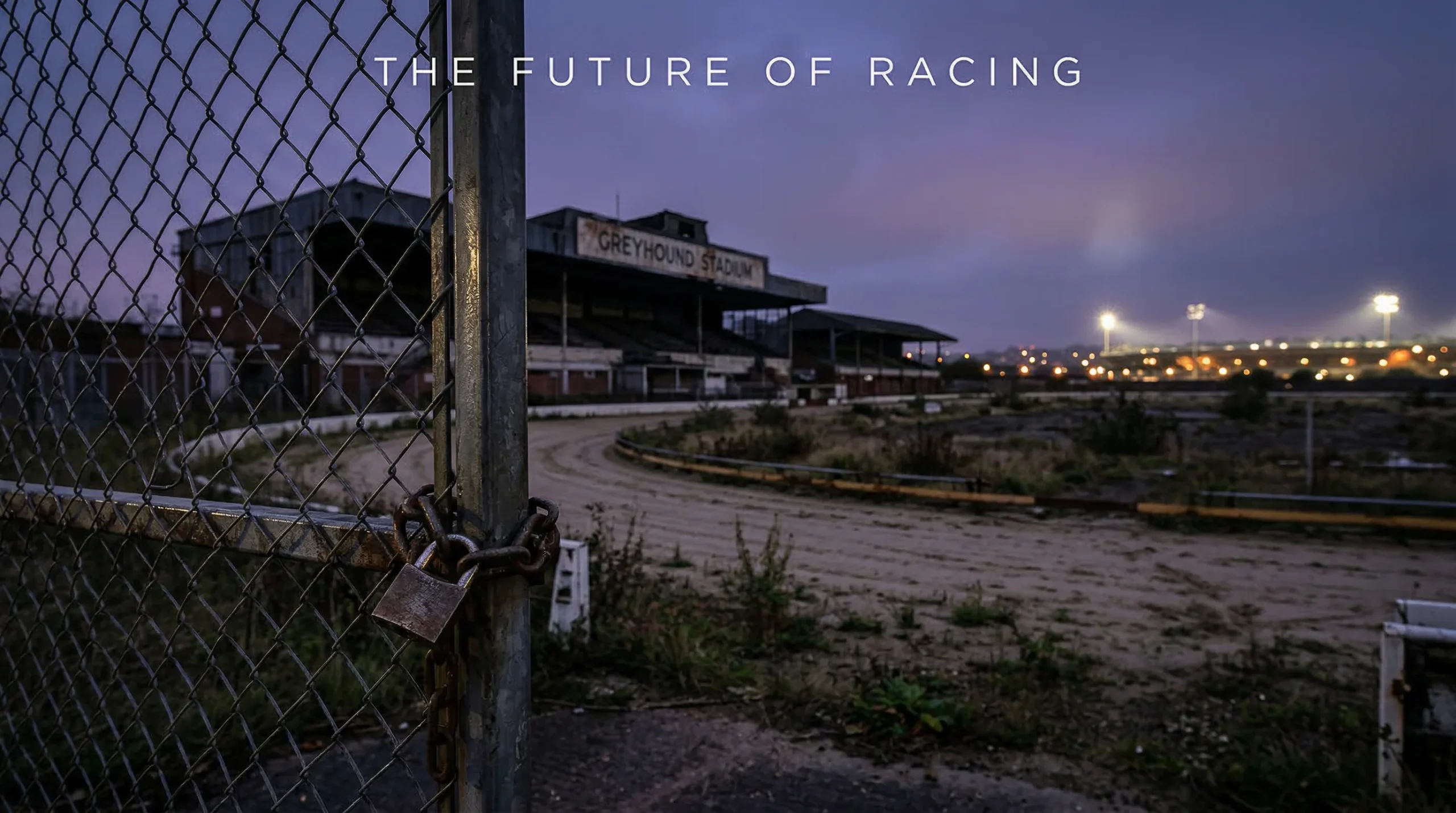
UK greyhound racing is fighting on multiple fronts. In 2025 alone, three licensed tracks closed permanently — Crayford in January, Perry Barr in August, and Swindon, the last independent venue in the country. Wales announced plans to ban the sport. Scotland introduced a parliamentary bill to outlaw racing on oval tracks. The number of licensed stadiums, which once exceeded 77, has fallen to around 18 and continues to contract. Against that backdrop, the future of the sport is not an abstract question. It is an urgent one. The wider context is set out in our Monmore Green results guide.
The counterargument is that the sport has been declared dying for decades and is still here. Greyhound racing survived the television revolution, the decline of working-class leisure culture, the rise of competing gambling products, and relentless welfare criticism. Its defenders point to improving injury data, growing adoption rates, and the investment of Premier Greyhound Racing as evidence that the industry is adapting rather than collapsing. This guide examines the threats, the responses, and the commercial realities that will determine whether UK greyhound racing reaches its centenary in recognisable form.
The 2025 Closure Wave: Which Tracks Closed and Why
The three closures of 2025 were not random misfortunes. Each one reflected a structural problem within the industry, and together they illustrate the forces that are reshaping the UK greyhound track map.
Crayford, an Entain-owned track in Kent, was closed as part of PGR’s strategic consolidation. The venue was operationally viable but commercially marginal — the cost of maintaining and upgrading the stadium exceeded the revenue it generated through racing and betting. Entain’s calculation was that concentrating resources at fewer, stronger venues would produce a better overall return. For the trainers and racegoers who had depended on Crayford, the logic was cold comfort.
Perry Barr in Birmingham was a more complicated closure. The stadium had been a fixture of Midlands greyhound racing for generations, but its facilities had aged, its location was subject to redevelopment pressure, and the opening of Dunstall Park in Wolverhampton provided a modern alternative within the same region. The Perry Barr closure was partially softened by the Dunstall transfer — some fixtures, dogs, and trainers moved across to the new venue — but the loss of a historic track still left a gap in Birmingham’s sporting landscape.
Swindon was the closure that carried the most symbolic weight. As the last independent track in the UK — the final venue not owned by a corporate operator — its demise confirmed that the era of the owner-promoter in licensed greyhound racing is over. Every surviving GBGB track is now part of a corporate or partnership structure, which provides financial stability but also concentrates decision-making power in the hands of entities whose primary interest is commercial return rather than local tradition.
Scotland lost its last track in 2025, completing the sport’s withdrawal from a nation that had never been a stronghold of greyhound racing but had nonetheless supported venues for decades. The closure predated the Scottish Parliament’s proposed ban, but the political environment made it clear that investment in a new Scottish venue would be commercially irrational. For context, in the 1940s there were 77 licensed tracks and more than 200 independent venues operating across the UK. The contrast with 2026 is stark.
Wales Ban, Scotland Bill and Westminster’s Response
The legislative landscape shifted decisively in 2025. In February, the Welsh government announced its intention to ban greyhound racing. While Wales has no currently licensed tracks, the ban would prevent any future venue from opening and sends a clear political signal about the devolved government’s view of the sport. In April 2025, Mark Ruskell MSP introduced a bill in the Scottish Parliament to prohibit greyhound racing on oval tracks — the format used by all licensed venues. If passed, the bill would make Scotland the second UK nation to outlaw the sport.
The UK government at Westminster took a different position. In 2025, the government confirmed that it has no plans to ban greyhound racing in England, recognising the sport’s contribution to cultural life and the rural economy, including approximately 5,400 jobs. That statement was welcomed by the industry but does not constitute a guarantee — future governments may take a different view, particularly if welfare data deteriorates or public opinion shifts further against the sport.
The legislative patchwork creates an unusual situation. Greyhound racing is legal and regulated in England, banned in Wales, heading for a ban in Scotland, and operating in Northern Ireland under separate arrangements. For the industry, this means that its entire future depends on English tracks and the English political environment. Any change in Westminster’s position would be existential. For now, the English government is supportive, but the sport cannot afford to take that support for granted.
The welfare argument drives the legislative pressure. Campaigners cite injury data, fatality figures, and the historical practice of economic euthanasia as grounds for prohibition. The industry responds with its improving statistics and increased investment. Both sides use the same data but reach different conclusions, which makes the debate more about values than about facts — and values-based debates are harder for the industry to win because they do not lend themselves to data-driven rebuttals.
Revenue, Bookmaker Funding and the Commercial Squeeze
The commercial pressures on UK greyhound racing are as threatening as the legislative ones, and they are harder to address because they are driven by market forces rather than political decisions.
The primary revenue stream for the sport — bookmaker contributions through the BGRF — has been declining steadily. BGRF income fell to 7.3 million pounds in 2023-24, down from historical peaks that exceeded 20 million. That decline mirrors the broader contraction in greyhound betting turnover, which has been squeezed by competition from online casino products, football betting, and other gambling formats that offer higher margins for bookmakers.
As Mark Moisley, GBGB’s Commercial Director, has acknowledged, revenue from bookmakers is declining year on year and has been for some time. If it continues at the current rate, the industry will face serious problems sooner rather than later. That candid assessment from within the industry reflects a recognition that the financial model underpinning greyhound racing is under strain.
The PGR model is the industry’s main commercial response. By consolidating tracks, centralising media rights, and investing in product quality, PGR aims to slow the revenue decline by offering bookmakers a better product that justifies their continued contribution. The strategy has logic, but it requires the remaining tracks to generate enough turnover to sustain the entire infrastructure — welfare, regulation, prize money, track maintenance — that the sport needs to operate. Whether that is achievable with a shrinking number of venues and a betting market that continues to contract is the defining commercial question for the future of the sport. How many tracks remain is in the UK tracks map.
The alternative revenue sources that might relieve the pressure — sponsorship, stadium hospitality, tourism — are limited by the scale of the audience. Greyhound racing does not attract the television deals or corporate partners that sustain horse racing, football, or cricket. It remains a niche sport with a loyal but ageing audience, and that demographic reality constrains the commercial options available. The future of UK greyhound racing depends on whether the sport can do more with less, and whether the less continues to be enough.
