
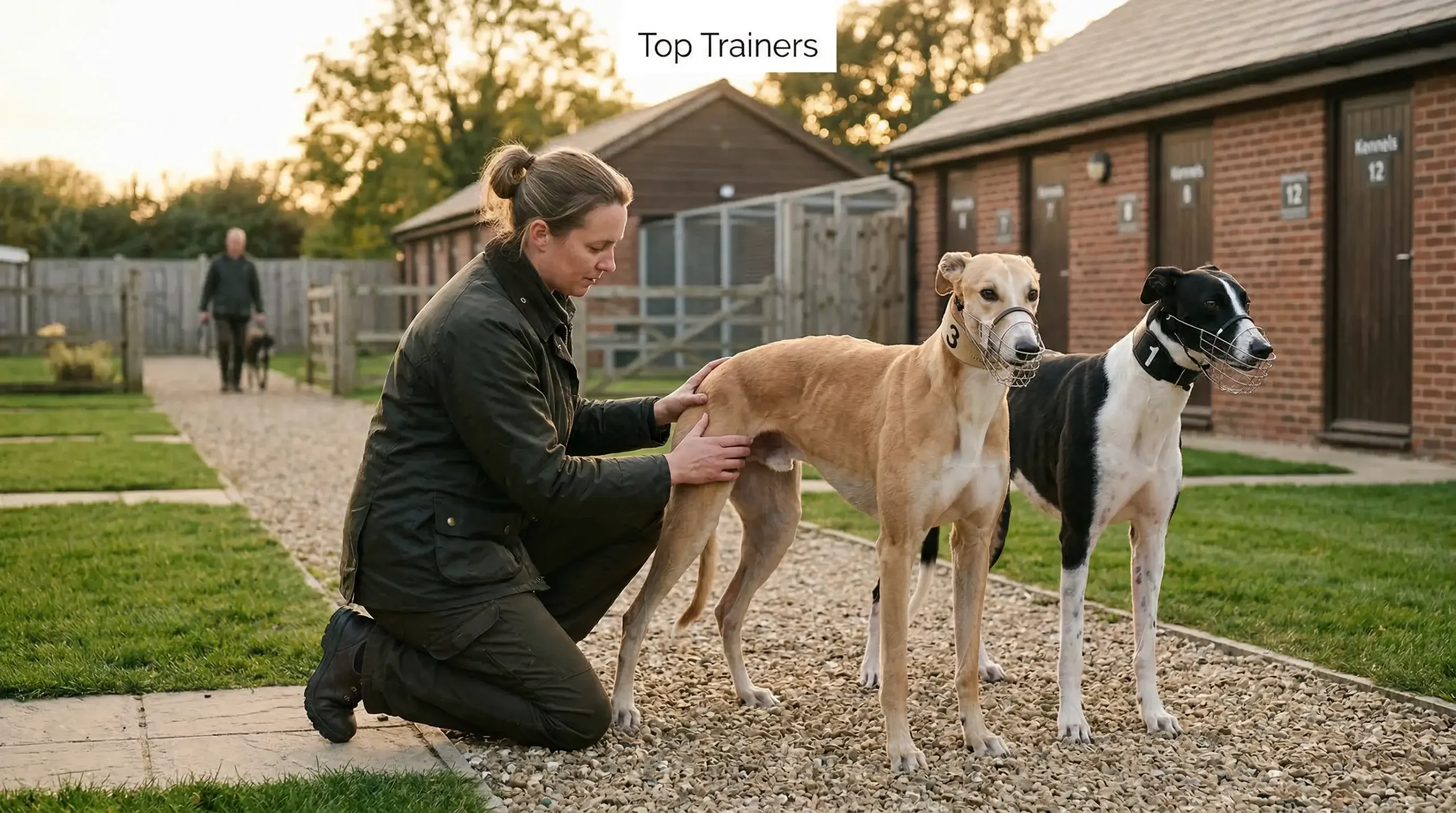
Behind every greyhound that breaks from the traps at Monmore Green stands a trainer who has shaped its fitness, managed its diet, planned its race entries, and decided which distance and grade give it the best chance. The trainer is the one variable in greyhound racing that connects every other data point — form, weight, trap draw, distance choice — into a coherent picture. Ignore the trainer and you are betting on numbers without context. The wider context is set out in our Monmore Green results guide.
The UK greyhound industry employs approximately 500 licensed trainers, each responsible for a kennel of racing dogs distributed across the country’s licensed tracks. At Monmore, a smaller subset of those trainers regularly enters runners, and their individual records create patterns that reward close attention. Some Monmore trainers specialise in sprint dogs. Others focus on middle-distance or marathon types. Some run high-volume operations that dominate the card on a given night; others send fewer entries but at a consistently higher strike rate.
This guide explains how to measure a greyhound trainer’s performance, what to look for among Monmore’s leading kennels, and how to weave trainer data into your betting process without overcomplicating things.
How to Measure a Greyhound Trainer: Strike Rate, P/L and ROI
Strike rate is the first number most people check, and it is the easiest to understand. If a trainer sends out 100 runners in a month and 20 of them win, the strike rate is 20 percent. Simple enough. But strike rate alone tells you very little about whether following that trainer would have made you money, because it says nothing about the prices those winners returned.
A trainer with a 25 percent strike rate might sound impressive until you discover that most of those winners started as odds-on favourites. If you backed every single runner from that kennel, the short prices on the winners would not compensate for the longer odds on the 75 percent that lost. That is where profit-and-loss and return-on-investment enter the picture.
Profit-and-loss to a level stake — often abbreviated as P/L — measures what would have happened if you placed a one-unit bet on every runner from a given trainer over a defined period. A positive P/L means the trainer’s runners have collectively returned more than the total amount staked. A negative P/L means the opposite. This metric cuts through the noise because it accounts for both the win frequency and the odds at which those wins occurred. A trainer with a modest 15 percent strike rate but a positive P/L is producing winners at prices the market undervalues — and that is exactly what a bettor is looking for.
Return on investment expresses P/L as a percentage of total stakes. A trainer with a +10% ROI over 200 runners is generating ten pence of profit for every pound staked. In greyhound racing, where margins are tight and the market is generally efficient, a sustained ROI above five percent is noteworthy. Anything above ten percent over a meaningful sample size is exceptional and usually points to a specific edge — perhaps the trainer excels at placing dogs in the right grade, or regularly finds value at a particular distance.
With around 500 trainers competing across UK tracks, the range of performance is wide. Some operate full-time commercial kennels with dozens of dogs in training; others run smaller outfits with a handful of runners. At Monmore, the regulars tend to fall into recognisable patterns. A high-volume trainer might send four or five dogs to a single meeting, accepting that not all will win but banking on the aggregate return. A low-volume trainer might only enter a dog when conditions are ideal — the right grade, the right trap, the right distance — which often produces a higher strike rate but fewer opportunities.
Sample size matters enormously when evaluating trainer metrics. A trainer who has sent 15 runners to Monmore and produced 5 winners has a 33 percent strike rate, which sounds elite. But 15 runners is a tiny sample. Random variance alone could account for the results. Before drawing conclusions from trainer data, look for at least 50 to 100 runners as a minimum. Below that threshold, the numbers are suggestive rather than reliable.
Monmore’s Leading Kennels: Who Sends the Most Winners
Monmore’s card is populated by a core group of trainers who supply the majority of runners week after week. These are the kennels whose names appear most frequently on the racecard, and getting to know their tendencies is one of the most practical things you can do as a regular Monmore bettor.
The leading kennels at any track tend to share a few characteristics. They have enough dogs in training to enter multiple runners per meeting, which gives them scheduling flexibility. They know the track intimately — how it rides in different weather, which traps suit which running styles, and when the grading structure offers an opening for a well-placed entry. They also have working relationships with the racing office, which means their dogs are generally graded appropriately, reducing the frequency of mismatches that can waste a dog’s race.
What varies among Monmore’s top kennels is their approach to distance. Some trainers run the bulk of their dogs over the standard 480m trip, where the largest pool of races and the most consistent data make it easier to manage entries. Others have built reputations as sprint or middle-distance specialists, and their entries at 264m or 630m signal a deliberate placement that carries additional weight. When a known sprint trainer enters a dog at 264m, it is worth paying attention — that entry reflects a professional assessment that the dog is suited to the trip.
Volume alone does not make a trainer worth following. A kennel that sends out 10 dogs a week but wins with 1 has a 10 percent strike rate, which is below the break-even threshold for most staking plans. The trainers to watch are those whose strike rate combines with favourable odds to produce a flat or positive P/L. These are usually the mid-volume operators — kennels that send three to six runners per meeting and win with one or two at prices that reflect underestimated ability rather than acknowledged superiority.
Seasonal form is also a factor. Some Monmore trainers have their kennels at peak fitness during specific months, which might correlate with the end of the breeding season, the arrival of new dogs from Ireland, or simply the trainer’s own conditioning cycle. Tracking a trainer’s results month by month over a year can reveal patterns that the overall annual figures smooth out. A trainer with a 17 percent annual strike rate might hit 25 percent in March and April before dropping to 12 percent in summer — and that March spike is where the real betting value lies.
Incorporating Trainer Form Into Your Betting Process
The practical question is not whether trainer data matters — it clearly does — but how much weight to give it relative to form, trap draw, and distance data. The answer depends on the type of race.
In high-grade races at Monmore, where every dog is competitive and the market is more efficient, trainer data serves as a tiebreaker rather than a primary selection tool. If two dogs are closely matched on form and drawn in similar traps, the one trained by a kennel with a positive ROI at the track holds a marginal edge. That edge will not show up in every race, but over a long enough sample it contributes to a profitable approach.
In lower-grade and maiden races, trainer data becomes more important. These races feature dogs with less established form, which means the racecard gives you less to work with. In these situations, the trainer’s record fills the gap. A maiden runner from a kennel that consistently places its new dogs in winnable races is a more attractive proposition than a maiden from a trainer with no track record of successful introductions. UK-wide data shows that favourites win only 30 to 40 percent of greyhound races, which means there is plenty of room for informed punters to find value — and trainer patterns are one of the richest seams of information available. How to use the numbers is in the betting tips.
The key is to treat trainer data as one input among several rather than a system in itself. A profitable Monmore approach combines form analysis, trap draw assessment, distance suitability, and trainer intelligence into a single evaluation. No one factor is sufficient on its own. But when the form, the draw, and the trainer all point in the same direction, you have a selection that deserves confidence — and a stake that reflects that confidence.
