
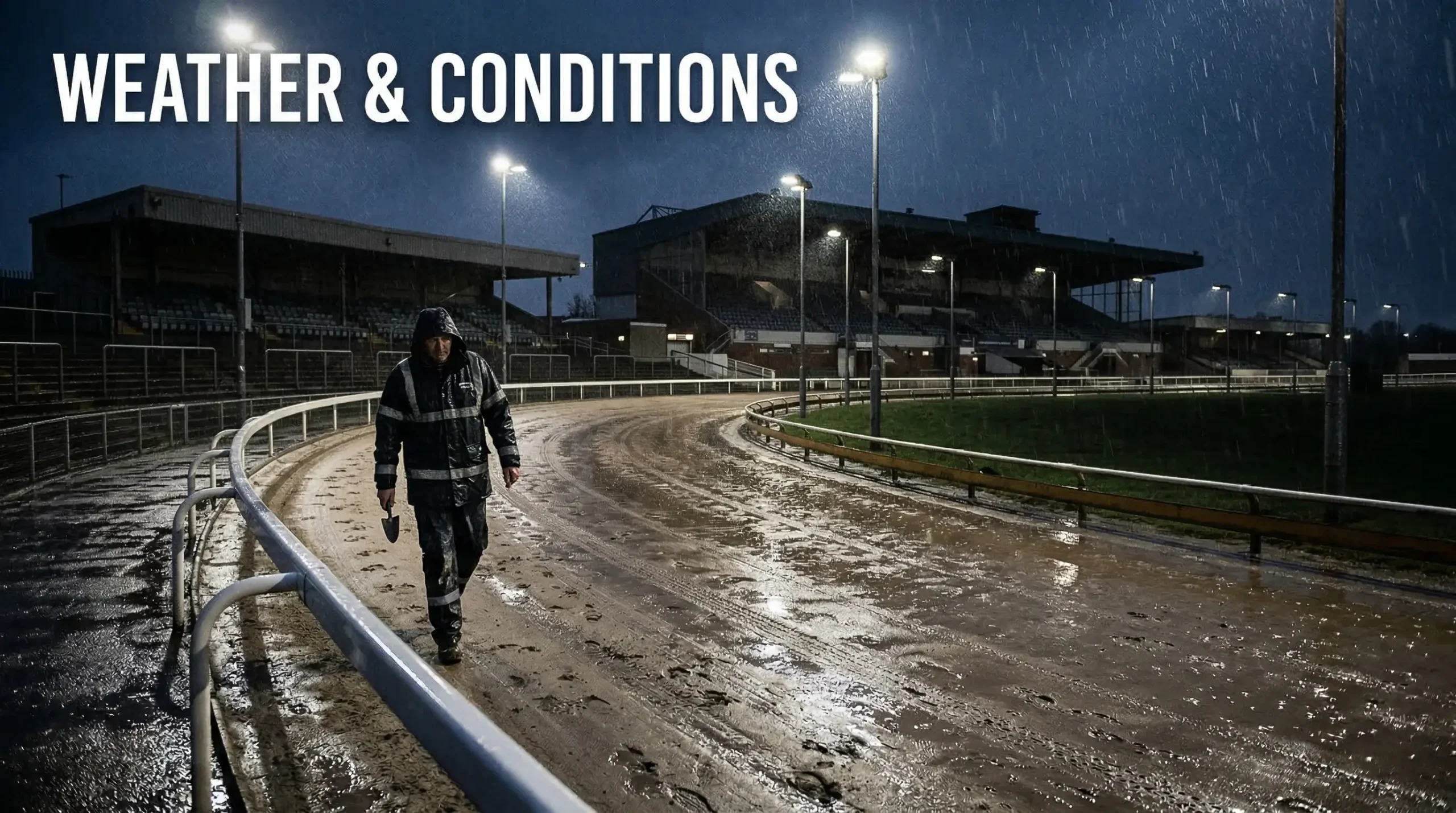
Greyhound racing is an outdoor sport, and the weather does not take the night off just because there is a meeting at Monmore Green. Rain, wind, temperature, and humidity all influence how the track rides, how fast the dogs run, and — most importantly for bettors — whether the usual patterns of trap advantage and form reliability hold true or shift in ways that create opportunity. The wider context is set out in our Monmore Green results guide.
Most punters check the form, glance at the draw, and place their bet. The ones who consistently find value add one more step: they check Monmore conditions. A track that is firm and fast on a dry Thursday evening behaves differently from the same track on a wet Saturday when rain has been falling since lunchtime. Understanding how weather interacts with the sand surface at Monmore gives you an additional layer of information that the majority of the market ignores.
Rain, Wind and Temperature: What Each Does to Race Times
Rain is the most significant weather variable at Monmore. The track surface is sand-based, and water changes its properties in measurable ways. Light rain tends to compact the surface, making it firmer and faster. Dogs running on a lightly damp track often post quicker times than on a bone-dry surface where the sand is loose and energy-absorbing. This is counterintuitive for newcomers who assume that wet equals slow, but anyone who has spent time watching Monmore races in different conditions recognises the effect.
Heavy rain is a different story. Prolonged or intense rainfall saturates the surface, creating standing water in low spots and turning the sand into a heavy, grip-reducing surface. Dogs work harder to maintain their speed, and times slow measurably. The inside rail, which is usually the fastest running line, can become the worst part of the track if water pools along the inner edge. On heavily rain-affected evenings, the normal trap bias at Monmore can reverse: the inside advantage that sees Trap 1 outperform expectations can diminish or even disappear as the rail becomes waterlogged and dogs running slightly wider find better footing.
Wind affects greyhound racing differently depending on direction. A headwind on the home straight slows finishing times and can disadvantage front-runners who face the full force of the breeze while closers tuck in behind them. A tailwind has the opposite effect, inflating speeds on the straight and potentially making early leaders harder to catch. Crosswinds are the most disruptive because they affect dogs differently depending on their position on the track — a dog running on the outside of a bend into a crosswind faces more resistance than one sheltered on the inside rail.
Temperature has a subtler but real effect. Cold evenings — particularly in winter — tend to produce slightly slower times because the sand surface loses moisture and becomes looser. Very warm conditions can harden the surface if the track has been baking in sun all day, which typically benefits faster dogs and amplifies the inside draw advantage. The ideal racing conditions at most UK tracks, including Monmore, are mild and dry with light cloud cover: warm enough to keep the surface compact, cool enough to prevent it from hardening excessively.
Humidity interacts with temperature to influence surface moisture levels even when no rain has fallen. High humidity on a warm evening can keep the surface slightly damp, maintaining its compactness and speed. Low humidity in cold conditions allows the sand to dry out and become slower. These are marginal effects, but marginal effects are exactly what form study is designed to capture — the small advantages that, compounded over dozens of bets, produce a meaningful edge.
How Monmore Manages Its Sand Surface Between Races
The track surface at Monmore is not a passive element that simply accepts whatever the weather delivers. Between every race, the surface is groomed by a tractor-drawn harrow that breaks up compacted areas, redistributes sand, and smooths the running line. This maintenance is essential: without it, the inside rail would become deeply rutted within a few races, the bends would develop uneven camber, and the track would become progressively slower and more dangerous throughout the meeting.
The quality of between-race maintenance is one of the factors that separates well-run tracks from poorly maintained ones. At Monmore, the ground staff follow established procedures that have been refined over years of operation. The industry has invested in professional development too: GBGB reported that participants accumulated more than 580 hours of continuing professional development in 2024, and track surface management is one of the areas covered by that training programme. Better-trained staff produce a more consistent surface, which produces more reliable racing, which makes form study more effective for bettors.
Despite careful maintenance, the surface does change over the course of a meeting. The first race is typically run on the freshest, most evenly prepared track. By race eight or nine, wear patterns have developed — the inside rail has been run on by dozens of dogs, the bends have absorbed repeated impacts, and the sand has shifted in response to the accumulated traffic. These changes are subtle but measurable: experienced Monmore bettors note that inside-trap bias tends to be strongest in the early races of a meeting and can moderate as the evening progresses and the surface evolves.
Seasonal maintenance goes beyond between-race grooming. The track surface is periodically replaced or topped up with fresh sand, drainage systems are inspected and cleared, and the bend camber is checked and adjusted. These interventions typically happen during breaks in the fixture schedule and are not visible to racegoers, but they affect the baseline condition of the track and can produce noticeable changes in how the surface rides when racing resumes after a maintenance period.
Adjusting Your Selections When the Going Changes
The practical question for bettors is not whether weather affects racing at Monmore — it clearly does — but how to incorporate that knowledge into your selection process without overcomplicating things.
The simplest approach is to check the weather forecast before each meeting and note the conditions at the track. If rain is forecast, expect slower times and a potential reduction in inside-trap bias. If the evening is dry and mild, expect the track to ride true to its normal patterns. This binary assessment — wet or dry — captures most of the useful information and takes thirty seconds.
The next level is to watch the first two or three races of a meeting before committing serious stakes. The early results tell you how the track is actually riding, which is more reliable than any forecast. If Trap 1 wins the first two races comfortably, the inside is running fast and the normal bias is in play. If wide-drawn dogs are performing well in the early races, something about the conditions is favouring the outside — and adjusting your selections for the remaining card accordingly is a rational, data-informed response. Why conditions move the draw is in track bias explained.
Dogs with proven ability on different types of surface are worth noting in your form analysis. Some greyhounds handle wet conditions better than others, and race comments that mention strong performances on heavy or soft going are useful flags. A dog described as running well on a rain-affected track has demonstrated an ability that becomes relevant every time the weather turns — and that ability is not always reflected in its odds, because most punters do not factor Monmore conditions into their assessment.
